

The Quick Answer
Is 8.5 to 9 hours “too much sleep”? No. Allowing your body to naturally sleep that long is not dangerous. While older epidemiological studies linked longer sleep duration to higher mortality, modern clinical research suggests this was largely a case of reverse causality: underlying illnesses were causing people to sleep longer, rather than longer sleep causing illness. When a healthy individual naturally sleeps for 8.5 to 9 hours, it can improve cognitive performance, support healthy metabolic function, and strengthen immune function.

Discover (Why Getting Less Than 8.5 to 9 Hours of Sleep Isn’t Necessarily Dangerous)
Introduction: The Rigid “8-Hour” Sleep Myth
For decades, we have been told that eight hours is the golden rule of sleep. We are warned that getting less than seven hours of rest damages our health, while sleeping more than eight hours is framed as lazy, overindulgent, or even medically hazardous. Popular media regularly publishes headlines claiming that sleeping nine hours or more increases your risk of cardiovascular disease and premature death.
This rigid narrative has created a widespread cultural misunderstanding. At Juna Sleep, we evaluate sleep health through the lens of peer-reviewed clinical science rather than outdated showroom slogans. As the Juna Sleep Nerd, I talk to many clients who feel guilty when their bodies naturally demand 8.5 or 9 hours of sleep. They worry they are sleeping “too much.”
Your body is not an alarm clock that can be programmed to a single, arbitrary setting. Just as height, bone density, and caloric needs vary across populations, individual sleep needs exist on a natural biological spectrum.
Whether you are visiting our showrooms from local Midwest hubs like Brookings, Mitchell, or Yankton, our goal is to help you understand your unique sleep profile. Forcing yourself to wake up before your body has completed its natural recovery cycles does not protect your health—it compromises it.

Discover ( the Truth Behind the Rigid “8-Hour” Sleep Myth)
The Origin of the “Too Much Sleep” Myth: Unpacking the Data
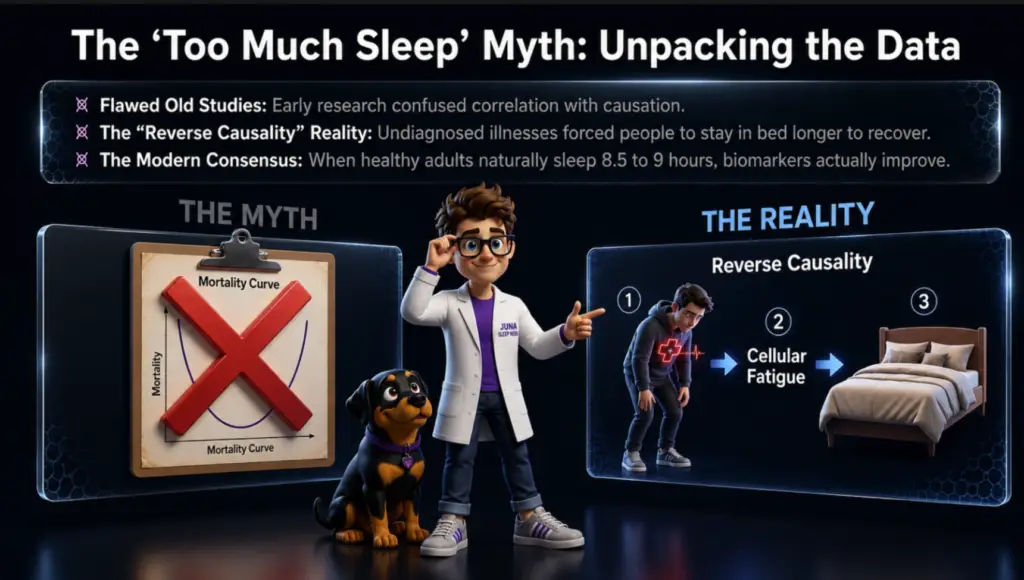
To understand why the “too much sleep is dangerous” myth persists, we have to look closely at the design of older scientific studies. The panic stemmed from large-scale, self-reported epidemiological surveys conducted during the late 20th- and early 21st-century separation windows. These studies tracked thousands of participants and consistently found a “U-shaped curve” between sleep duration and mortality: those sleeping fewer than 6 hours and those sleeping more than 9 hours both showed higher mortality rates.
However, these early studies suffered from a major scientific flaw: they established correlation, not causation. They failed to account for a critical clinical concept known as reverse causality.
Confounding Variables Exposed
When modern researchers re-analyzed this historical data while controlling for underlying health issues, the apparent dangers of sleeping 9 hours completely vanished. The individuals in those early studies were not dying because they slept 9 or 10 hours; they were sleeping 9 or 10 hours because their bodies were trying to fight off pre-existing, undiagnosed systemic illnesses.
The Reverse Causality Broken Loop
Old Theory: Long Sleep Duration ————–> Systemic Illness & Mortality
True Science: Chronic Underlying Illness ——> Increased Cellular Fatigue ——> Natural Demand for Longer Sleep
Chronic conditions like clinical depression, severe sleep apnea, underlying cardiovascular inflammation, and early-stage autoimmune disorders all place an immense metabolic load on the human body. This cellular strain drastically increases physical fatigue, forcing the individual to stay in bed longer in an attempt to recover.
Additionally, many of those self-reported surveys failed to account for poor sleep quality. If a participant spent 10 hours in an uncomfortable bed but was tossing, turning, and waking up constantly due to painful pressure points, their actual sleep time was remarkably low. They weren’t experiencing “too much sleep”—they were suffering from severe sleep deprivation wrapped in a long window of time spent in bed.
The Modern Scientific Consensus: The 8.5 to 9-Hour Reality
When modern sleep labs isolate healthy individuals without underlying medical conditions and allow them to sleep without alarms, a vastly different physiological picture emerges. Recent clinical trials demonstrate that when healthy adults are allowed to sleep naturally for 8.5 to 9 hours, their bodies do not experience adverse effects. Instead, they show significant improvements across almost every biomarker of physical and mental health.
This extended window is highly beneficial given the structure of human sleep architecture. A single sleep cycle lasts roughly 90 to 110 minutes, moving through light sleep, deep slow-wave N3 sleep, and rapid eye movement (REM) sleep.
[90-110 Minute Sleep Cycle Sequence]
Stage N1 (Light) -> Stage N2 (Transition) -> Stage N3 (Deep Slow-Wave) -> REM (Dreaming)
The composition of these cycles changes significantly as the night progresses. The first half of the night is dominated by deep slow-wave N3 sleep, which focuses primarily on physical tissue repair, muscle recovery, and immune system calibration.
The second half of the night—specifically hours 7, 8, and 9—is heavily weighted toward REM sleep. If you artificially cut your sleep window short to 7 hours to fit a social schedule, you are not just losing sleep time; you are cutting off your brain’s final, longest REM sleep.
Discover ( What Modern Science Says About 8.5 to 9 Hours of Sleep )
Cognitive Transformation: BrainWashing in the Extended Window
Allowing your nervous system to naturally complete its 8.5 to 9-hour sleep cycle provides profound cognitive benefits. During the extended morning hours when REM sleep is at its peak, the brain executes critical cognitive maintenance.

Advanced Memory Consolidation
During REM sleep, the hippocampus—the brain’s temporary storage drive—transfers the day’s experiences, data, and newly learned skills into the neocortex for long-term storage. This process organizes your memories and clears your mental cache, preparing your brain to learn new information the following day. Clinical studies show that individuals allowed a natural 9-hour sleep window perform significantly better on complex problem-solving, cognitive retention, and motor-skill tests than those limited to a rigid 7 or 8-hour schedule.
Glymphatic Filtration Optimization
While memory consolidation peaks during REM, your brain’s waste-clearance system—the glymphatic system—requires a long, uninterrupted period of deep slow-wave sleep to fully execute its clearing cycle.
During these deep sleep stages, your brain cells physically shrink by roughly 60%, allowing cerebrospinal fluid to rush through the tissue like a biological dishwasher. This process flushes out toxic metabolic waste products, including beta-amyloid and tau proteins, which are directly linked to cognitive decline and neurological disorders later in life.
Giving your body the time it needs to naturally complete this cleansing process ensures you wake up with sharp focus, mental clarity, and long-term neurological protection.
Metabolic Optimization: How 9 Hours of Sleep Prevents Weight Gain
The benefits of an unhurried, natural sleep window extend far beyond cognitive performance. Recent metabolic research has shown that allowing your body to rest for 8.5 to 9 hours is an effective natural way to regulate your metabolism, hormonal balance, and weight.
Your endocrine system relies heavily on the internal timing mechanism of your circadian rhythm. When you cut your sleep short, you trigger a cascade of hormonal disruptions that alter how your body processes energy:
- Leptin and Ghrelin Calibration: Leptin signals satiety to your brain, while ghrelin stimulates appetite. Getting a natural 8.5 to 9 hours of sleep ensures these hormones stay properly balanced. Forcing yourself to wake up early suppresses leptin and spikes ghrelin, leaving you with intense cravings for fast-acting, high-calorie carbohydrates throughout the day.
- Insulin Sensitivity Enhancement: Clinical trials have demonstrated that individuals who naturally extend their sleep to 8.5 or 9 hours display significantly higher insulin sensitivity. This means your cells can efficiently clear glucose from your bloodstream, reducing your risk of developing insulin resistance and type 2 diabetes.
- Cortisol Suppression: Waking up abruptly to a loud alarm before your natural sleep drive has cleared causes a sharp spike in your resting cortisol levels. Elevated cortisol shifts your body into a protective, catabolic state, which encourages fat storage around your vital organs and breaks down lean muscle tissue.
Time in Bed vs. Total Sleep Time: The Mattress Connection
To properly evaluate your personal sleep health, you must understand the difference between two critical metrics: Time in Bed (TIB) and Total Sleep Time (TST).
Time in Bed (TIB): Total hours spent lying on the mattress surface.
Total Sleep Time (TST): Actual hours spent in verified neurological sleep states.
Sleep Efficiency Metric: (Total Sleep Time / Time in Bed) x 100 = Target > 85%
If you go to bed at 10:00 PM and get up at 7:00 AM, your Time in Bed is exactly 9 hours. If you are sleeping on a low-quality, generic mattress that sags or traps body heat, your sleep efficiency will plummet.
You may spend an hour tossing and turning to relieve painful hip or shoulder pressure points, and wake up twenty times throughout the night because the mattress core is trapping heat against your skin. In this scenario, your Total Sleep Time might only be 6.5 hours, despite your 9 hours in bed.
This is exactly where the “too much sleep” misperception harms sleepers. You wake up feeling exhausted, look at the clock, and assume you are tired because you spent “too much time” sleeping. In reality, you are suffering from chronic sleep deprivation because your mattress environment prevents your brain from entering deep, restful sleep states.
To fix this, you don’t need less time in bed—you need a high-performance sleep surface designed to maximize your sleep efficiency.
The Juna Advantage: Engineering Support for Extended Rest
When you allow your body to enjoy a natural 8.5 to 9-hour sleep window, your mattress handles physical compression and movement for a significantly longer period each day. Standard commercial mattresses built with cheap, low-density commodity foams cannot handle this extended use; they rapidly soften, sag, and form permanent body impressions that ruin your alignment.
At Juna Sleep, we eliminate the traditional retail middlemen and corporate markups. This factory-direct model allows us to invest entirely in high-spec, commercial-grade materials engineered to support long, healthy sleep windows.
Commercial-Grade Material Density
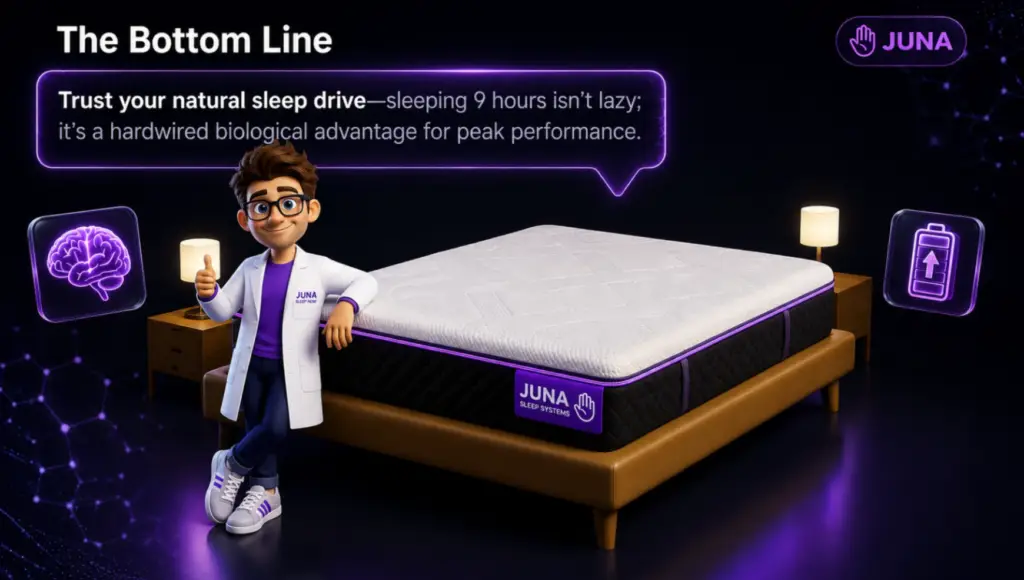
While big-box brands use cheap 1.2 to 1.8 lb foams that break down within a few years, Juna mattresses are built with premium, high-resilience foams ranging from 2.5 lb to 5 lb in density. These dense materials provide uniform, resilient support across your entire body, preventing the “hammocking” effect that strains muscles and misaligns the spine.
In internal stress testing, our high-density foam layers demonstrated less than a 4% loss in firmness over a simulated 20-year lifespan. We back this durability with our comprehensive 12-year and 18-year non-prorated warranties, providing long-term protection that helps preserve its value as your mattress ages.
The Lifetime Comfort Commitment
Your physical body is dynamic—it adapts and changes over time due to aging, injury, changes in fitness, or pregnancy. A mattress firmness level that feels ideal today might cause uncomfortable pressure points a few years down the road, waking you up and fracturing your sleep architecture.
With Juna’s exclusive Lifetime Comfort Commitment, you are never locked into a single choice. Our mattresses are engineered with a zipper-accessible cover, allowing our Juna Mattress Nerds to come directly to your home at any point in the future to rearrange, flip, or replace the internal foam layers. Whether you need to shift the feel from plush to ultra-firm or add targeted support to your lower back, we can continually tune your sleep system to maintain maximum sleep efficiency for life.
Showroom Insights for Regional Sleepers
You should never have to guess whether your sleep environment is supporting your health. The true test of a sleep system happens in real life, not during a high-pressure, five-minute showroom demonstration.
If you are ready to stop fighting the “8-hour rule” myth and want to experience how a mattress engineered with premium components can maximize your natural rest, stop by one of our local showrooms. Our Mattress Nerds focus on sleep education, helping you analyze your habits in a relaxed environment:
- Juna Sleep Systems – Sioux Falls, SD: Perfectly situated for regional residents driving in from surrounding communities like Brandon, Harrisburg, and Tea.
- Juna Sleep Systems – Rapid City, SD: Conveniently accessible for western sleepers living in Box Elder, Summerset, and Sturgis.
Frequently Asked Questions (FAQ)
- Is it bad to sleep 9 hours a night? No. Recent clinical studies show that for a healthy adult, naturally sleeping 8.5 to 9 hours is completely safe and highly beneficial. It allows your brain to complete its final, longest REM sleep cycles, which are critical for memory consolidation, emotional processing, and cognitive focus.
- Why did older studies claim that too much sleep causes early death? Older epidemiological surveys suffered from a data flaw known as reverse causality. They noticed that people who slept more than 9 hours had higher mortality rates, but failed to realize these individuals were sleeping longer because they were already suffering from serious, undiagnosed health issues like sleep apnea, heart disease, or depression.
- What is the difference between Time in Bed and Total Sleep Time? Time in Bed (TIB) is the total number of hours you spend lying on your mattress surface, while Total Sleep Time (TST) is the actual duration your brain spends in verified sleep states. If your mattress is uncomfortable and causes you to toss and turn, your TST will be dangerously low even if your TIB is high.
- How does a bad mattress make it feel like you are sleeping “too much”? A mattress that sags or traps heat triggers frequent, brief awakenings throughout the night. Because your sleep architecture is fragmented, you spend 9 or 10 hours in bed but wake up feeling exhausted. You aren’t tired from sleeping “too much”—you are tired because your mattress ruined your sleep efficiency.
- How does natural, extended sleep improve metabolic health? Sleeping a natural 8.5 to 9 hours keeps your hunger hormones, leptin and ghrelin, perfectly balanced, reducing intense cravings for high-calorie carbohydrates. It also enhances your body’s overall insulin sensitivity and keeps resting cortisol levels low, which discourages the storage of visceral fat.
- What makes Juna’s high-density foams better for long sleep windows? Standard commercial mattresses use cheap 1.2 to 1.8 lb commodity foams that collapse under continuous pressure. Juna builds sleep systems using heavy-duty 2.5-5 lb high-resilience foam. These commercial-grade materials withstand extended use with less than a 4% loss in firmness over 20 years.
- Can I change my natural sleep duration need through willpower? No. Your baseline sleep need is a hardwired biological trait, much like your height or eye color. Trying to force your body to operate on less sleep than your genetics demand creates a chronic adenosine debt, leading to mental fatigue, weight gain, and immune weakness.
Respect Your Natural Sleep Window Today
Your body’s natural demand for rest isn’t a behavioral flaw or a sign of laziness—it is an intelligent biological process designed to optimize your brain and body. Stop cutting your morning sleep cycles short to fit an arbitrary rule. Whether you need the absolute motion isolation of our heavy-duty pocketed coils or the long-term flexibility of our modular foam matrices, Juna builds custom sleep systems that honor your unique physiology.
Visit our closest local Juna showroom today to consult with an expert Mattress Nerd.
Browse our factory-direct collections online to secure the deep recovery your health demands!
