
The Quick Answer
True thermoregulation of the mattress is required to facilitate the 2- to 3-degree drop in core body temperature necessary to initiate and sustain deep slow-wave sleep. While the bedding industry heavily markets chemical “cooling gels” and phase-change materials, these solutions are temporary gimmicks that inevitably heat up within 90 minutes. True, long-term temperature regulation requires physical, open-cell foam breathability and structural airflow channels that continuously move heat away from the body throughout the night.

Learn about ( mattress thermoregulation)
Introduction: The Midnight Heat Wave
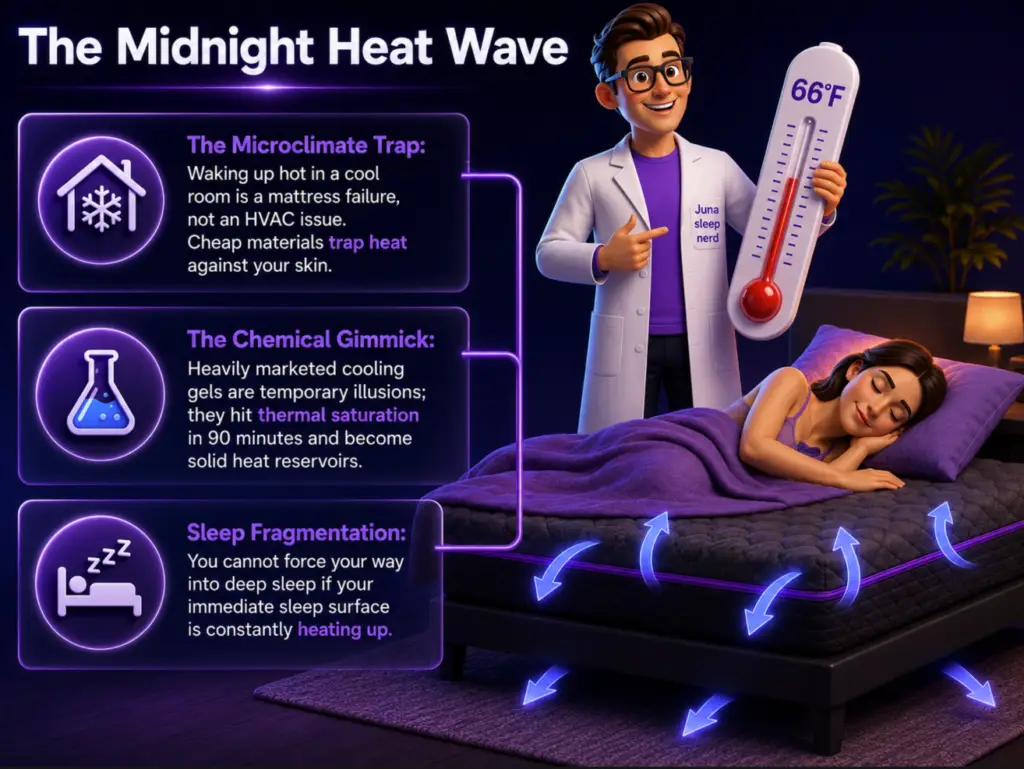
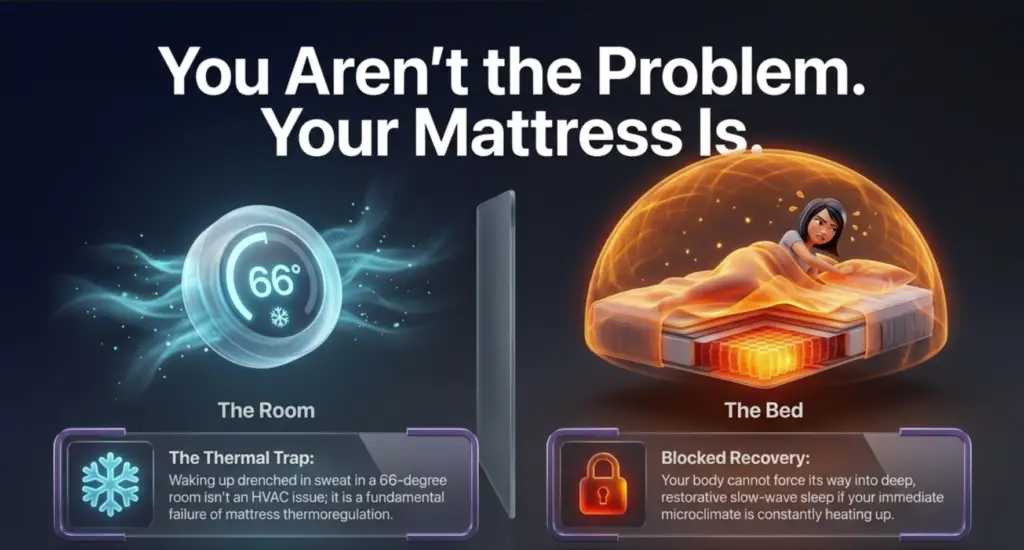
You fall asleep perfectly comfortable, but at 3:00 AM, you wake up drenched in sweat, kicking off the blankets to cool down. You check the thermostat—it is set to a crisp 66 degrees. The room is cold, but your bed feels like an oven. This frustrating phenomenon is not a problem with your home’s HVAC system; it is a fundamental failure of mattress thermoregulation.
At Juna Sleep, we approach sleep as a strict biochemical process rather than a retail luxury. As the Juna Sleep Nerd, I see thousands of sleepers suffering from sleep fragmentation because their mattresses act as thermal traps. They try to fix the problem by purchasing highly marketed “cooling sheets” or mattresses infused with colorful blue “cooling gels,” only to find the nighttime hot flashes return a few weeks later.
Your body cannot force its way into deep, restorative slow-wave sleep if its immediate microclimate is constantly heating up. Whether you are visiting our showrooms from local regional hubs like Brookings, Mitchell, or Yankton, our goal is to show you the real physics of thermal management. To achieve continuous, uninterrupted rest, your physical sleep surface must be built to breathe, not just feel cold to the touch for the first ten minutes of a showroom test.
The Circadian Temperature Curve: Shifting into Deep Rest
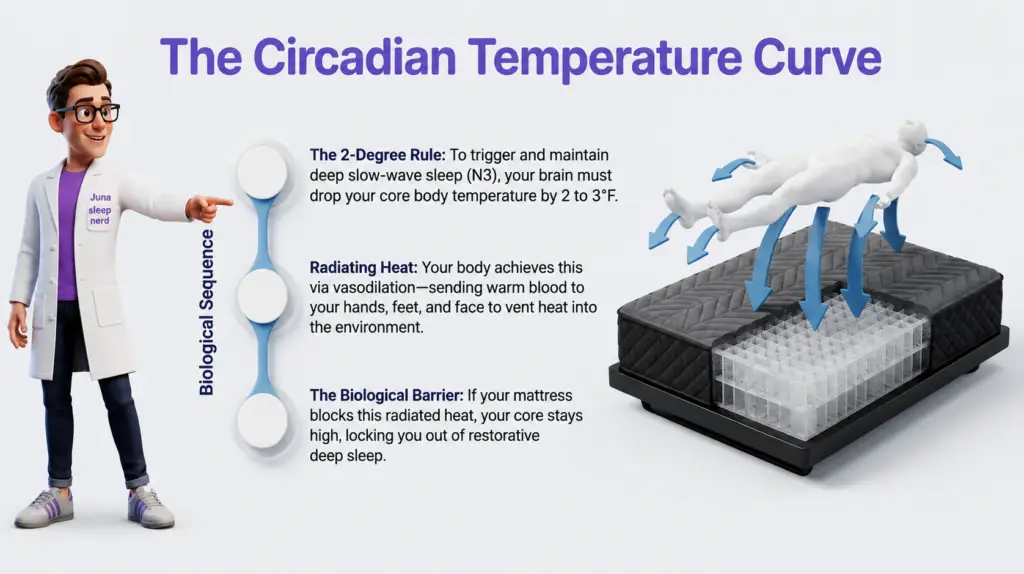
Your sleep-wake cycle is intrinsically tied to your core body temperature. Governed by the suprachiasmatic nucleus (SCN) in the brain, your temperature follows a strict 24-hour circadian rhythm. To prepare your nervous system for sleep, your body must actively drop its internal core temperature by roughly 2 to 3 degrees Fahrenheit.
This biological temperature drop is achieved through a process called vasodilation. Your brain signals the blood vessels in your extremities—specifically your hands, feet, and face—to widen. This shifts warm blood away from your internal organs and toward the surface of your skin, allowing the heat to radiate out into the environment.
[The Biological Cooling Chain]
SCN Signals Sleep -> Blood Vessels Dilate -> Heat Radiates via Extremities -> Core Temperature Drops 2-3°F -> Deep N3 Sleep Initiates
If your mattress is made of cheap, synthetic materials that trap radiated heat, your microclimate creates a thermal barrier. The heat you are trying to shed gets pushed right back into your skin, stopping your core temperature from dropping. As a result, your brain struggles to enter or maintain deep slow-wave N3 sleep, leaving you trapped in lighter, easily disrupted stages of rest.
Learn ( About the Circadian Temperature Curve: Shifting Into Deep Rest)
The Cooling Mattress Gimmick: Unmasking Phase-Change Gels
The modern mattress market is flooded with chemical solutions designed to combat trapped heat. Brands use terms like “liquid gel infusions,” “copper-infused memory foam,” and “phase-change materials (PCM)” to convince consumers their beds offer advanced cooling capabilities. From a scientific standpoint, these features are temporary fixes.
Phase-change materials operate on a fundamental thermodynamic principle: they absorb heat as they transition from solid to liquid. When you first lie down on a gel-infused mattress in a store, it feels ice-cold because the chemical molecules are actively drawing heat away from your hand. This creates a compelling showroom demonstration, but it fails to address how the body rests over an eight-hour night.
The Thermal Saturation Point
Every chemical gel or phase-change material has a fixed thermal capacity. Within 60 to 90 minutes of continuous physical contact, these materials hit their absolute saturation point. Once the gel matches your body temperature, it can no longer absorb any additional heat.
[The Phase-Change Gel Timeline]
0-30 Mins: Gel absorbs heat actively ————-> Feels Cold
30-90 Mins: Gel reaches maximum capacity ———> Temperature Equalizes
90+ Mins: Gel acts as a solid heat reservoir —-> Traps Heat and Creates Hot Flashes
Worse yet, dense chemical gels lack structural breathability. Once saturated, they become a solid heat reservoir beneath your body, trapping your thermal energy and keeping it pressed against your skin for the rest of the night.
Learn ( About the Thermal Saturation Point)
The Physics of Real Ventilation: Conductive vs. Convective Cooling
To engineer true all-night mattress thermoregulation, a bed must move away from chemical absorption and utilize convective ventilation.
- Conductive Cooling (The Gimmick): Relies on direct physical contact to transfer heat to a static material, such as gel or copper flecks. It quickly saturates and stops working.
- Convective Cooling (The Science): Relies on the continuous movement of air or fluid to carry heat away from the body. It provides an unlimited capacity for temperature regulation because old, warm air is constantly replaced by fresh, cool air.
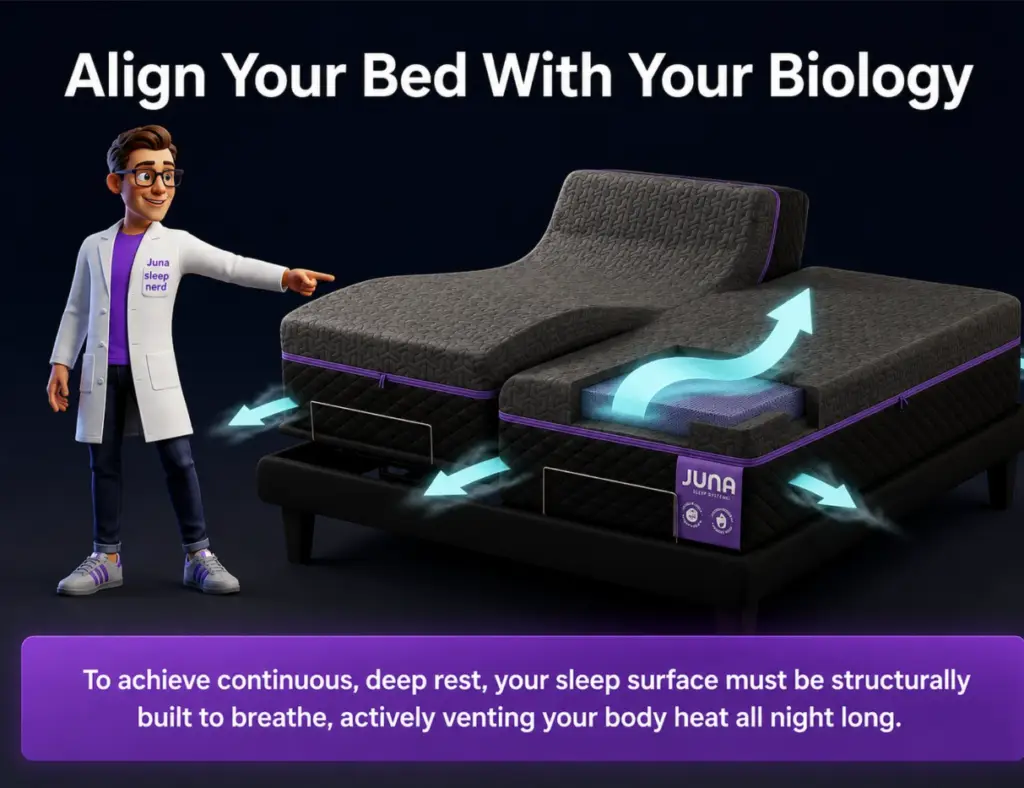
True convective cooling requires a mattress core with an open-cell molecular structure and physical airflow paths. When you move throughout the night, the mattress should act like a mechanical bellows, actively pumping warm air out through the sides of the bed and pulling cooler room air up through the base. This process keeps your sleep surface in perfect harmony with your room’s ambient temperature.
The Architecture of Thermal Exchange: Real vs. Chemical Cooling
The following table contrasts the performance metrics of traditional gel-infused mattresses with those of a physically ventilated, open-cell sleep system.
| Thermal Performance Metric | Gel-Infused Commodity Foam | Copper/Graphite Flecks | Juna Open-Cell High-Density Foam |
| Primary Cooling Mechanism | Conductive Phase-Change | Conductive Dissipation | Convective Airflow Exchange |
| Time to Thermal Saturation | 60 to 90 Minutes | 45 to 60 Minutes | Never (Continuous Exchange) |
| Air Leakage/Permeability Score | Extremely Low (<10 cfm) | Low (<15 cfm) | Exceptionally High (>80 cfm) |
| Long-Term Performance Retention | Degrades as Chemicals Set | Diminishes Over Time | Permanent Structural Airflow |
| Perimeter Boundary Ventilation | Blocked by Dense Foam Rails | Standard Closed Edge Encasement | Infinity Edge Butterfly Quad Coils |
| Impact on Core Body Temperature | Delays Circadian Temperature Drop | Temporary Initial Relief | Sustains the 2-3°F Core Drop |
How Trapped Heat Fractures Your Sleep Architecture
When a mattress fails to regulate temperature, the consequences extend far beyond simple physical discomfort. Thermal stress actively damages your internal sleep architecture.
During a normal night, your brain moves through sequential cycles of light, deep N3, and REM sleep. Deep slow-wave sleep is highly sensitive to temperature variations. If your core temperature rises even a fraction of a degree because heat is trapped in your mattress, your brain immediately registers a stress response.
This thermal stress triggers micro-arousals—brief, seconds-long awakenings that push you out of deep slow-wave sleep and back into light N1 or N2 sleep. You may not remember these morning awakenings, but they disrupt your sleep continuity. This prevents your glymphatic system from flushing out metabolic waste, leaving you waking up with chronic brain fog, morning grogginess, and physical fatigue.
The Juna Advantage: Physically Engineered Airflow
At Juna Sleep, we build mattresses to solve the root cause of trapped body heat. Because we operate as a factory-direct manufacturer, we eliminate the multi-tiered middleman markups that force standard commercial brands to use cheap, closed-cell commodity foams. Instead, we invest directly in premium, highly breathable material architectures.
High-Density Open-Cell Cellular Matrices
Juna mattresses are constructed using commercial-grade, high-resilience foam with densities ranging from 2.5 lb to 5 lb. Unlike traditional memory foam, which features closed cellular walls that trap air like a plastic bag, our premium foam is manufactured with an open-cell matrix.
At a microscopic level, the cell walls are open, creating a vast network of interconnected air pathways. When your body weight compresses the foam, air flows freely through the entire mattress core rather than getting trapped beneath your body.
Closed-Cell (Standard Foam): [1.2-1.8 lb]—> Air Blocked / Heat Trapped
Open-Cell (Juna Foam): [2.5-5 lb] —> Continuous Air Passage / Convective Venting
The Infinity Edge Boundary Ventilation
To maximize this convective airflow, Juna pairs its open-cell foam layers with our specialized Infinity Edge perimeter system. Instead of enclosing the mattress core with thick, solid-foam border walls that block side ventilation, our perimeter features a responsive butterfly quad-coil unit.
These independent, pocketed steel coils provide structural support right to the very edge of the bed while leaving the perimeter completely open to airflow. As heat moves through the open-cell foam core, it vents cleanly through the sides of the mattress, keeping your bedding climate cool, dry, and balanced all night long.
Showroom Insights for Regional Sleepers
The best way to evaluate a mattress’s breathability is to look at the actual engineering of the materials. Our local showrooms are staffed by knowledgeable Mattress Nerds who focus on sleep science education rather than high-pressure sales tactics.
If you are tired of waking up hot and want to see how an open-cell, factory-direct sleep system can improve your rest, visit a Juna showroom near you:
Juna Sleep Systems – Sioux Falls, SD: Located conveniently to the regional communities of Brandon, Harrisburg, and Tea.
Juna Sleep Systems – Rapid City, SD: Providing factory-direct sleep systems to Box Elder, Summerset, and Sturgis.
Frequently Asked Questions (FAQ)
- Why do I wake up hot at 3:00 AM even if my bedroom is cold? This occurs due to a failure of mattress thermoregulation. Your body must release heat to drop its core temperature for deep sleep. If your mattress is made with cheap, closed-cell synthetic foam, it traps heat and pushes it right back against your skin, creating a hot flash even in a cool room.
- Are cooling gel mattresses a marketing gimmick? Yes. Chemical cooling gels and phase-change materials feel cold to the touch in a store showroom, but they have a limited thermal capacity. Within 60 to 90 minutes of continuous contact, the gel saturates with your body heat, loses its cooling ability, and turns into a solid heat trap.
- What is the difference between open-cell and closed-cell foam? Closed-cell foam features isolated cellular walls that trap air and prevent ventilation, turning the mattress into a heat trap. Open-cell foam features interconnected microscopic pathways that allow air to flow freely through the material, continuously carrying heat away from your body.
- How does trapped heat affect my sleep quality? Trapped heat creates thermal stress that triggers micro-arousals throughout the night. These brief awakenings push you out of deep, slow-wave N3 sleep and back into light sleep stages. This disrupts your sleep continuity, preventing proper muscle recovery and brain clearing.
- How does the Juna Infinity Edge system help keep the mattress cool? Standard mattresses use thick, solid foam border rails that block side ventilation. Juna’s Infinity Edge uses a butterfly quad-coil system that keeps the perimeter completely open. This allows hot air to vent cleanly out the sides of the mattress while maintaining firm edge support.
- Does Juna’s Lifetime Comfort Commitment cover changes in temperature preferences? Yes. If your body’s temperature needs shift over time due to hormonal changes, aging, or lifestyle adjustments, our Lifetime Comfort Commitment allows us to modify your mattress. Our Mattress Nerds can come to your home to swap or adjust internal layers to optimize airflow for your changing needs.
- What is the ideal bedroom temperature for deep sleep? Clinical research suggests the optimal ambient bedroom temperature for deep sleep is between 60 and 67 degrees Fahrenheit, paired with a highly breathable, open-cell mattress surface that allows your core body temperature to drop naturally.
Align Your Bed with Your Biology Today
Your body’s nightly temperature drop is a non-negotiable requirement for deep slow-wave sleep. Stop letting a poorly ventilated, gel-infused mattress disrupt your recovery. Whether you need the advanced airflow of our open-cell, high-density foams or the open-perimeter ventilation of our Infinity Edge coil systems, Juna builds sleep environments that respect your physiology.
