

The Quick Answer
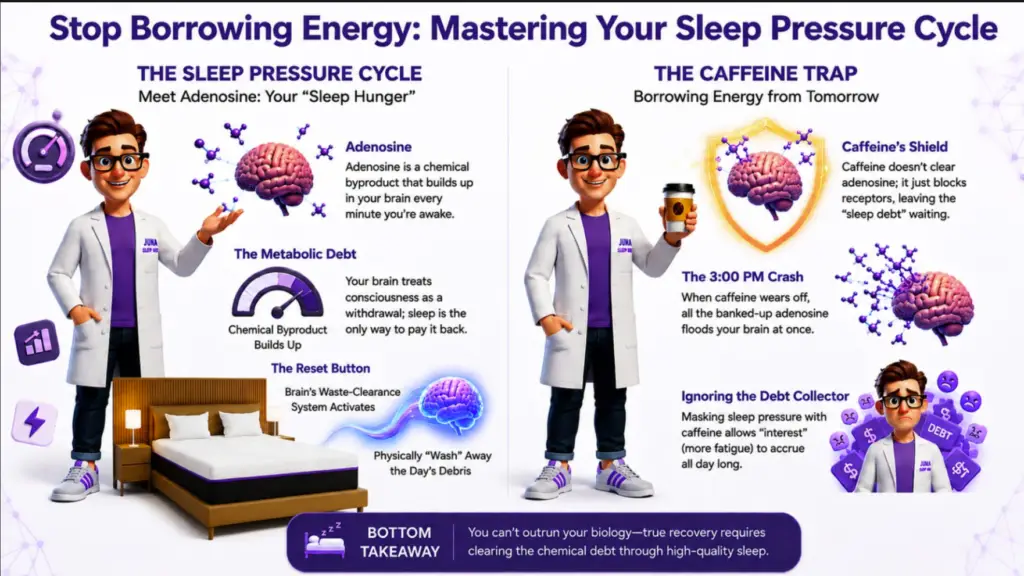
Sleep pressure adenosine is the biological “sleep hunger” that builds up the longer you stay awake. Adenosine, a byproduct of cellular energy consumption, accumulates in the brain throughout the day, binding to receptors that signal fatigue. Only high-quality, restorative sleep effectively clears this chemical, resetting your cognitive clock.
Discover ( Sleep pressure adenosine)
Introduction to the Sleep Pressure Cycle
If you’ve ever felt an overwhelming “weight” behind your eyes after a long day at work or a marathon session at the gym, you aren’t just tired—you are experiencing the biological force of sleep pressure adenosine. From the moment you wake up, your brain begins a countdown. Every minute of consciousness acts as a withdrawal from your metabolic bank, leaving behind a chemical “debt” that must be paid in hours of rest.
At Juna Sleep, we view ourselves as more than mattress builders; we are stewards of your recovery. Understanding sleep pressure adenosine is the first step in realizing that your mattress isn’t just furniture—it is a specialized medical tool designed to facilitate the complex chemical clearance your brain requires every single night. Whether you are driving in from Brandon, Harrisburg, or Tea to visit our Sioux Falls showroom, our goal is to help you understand the “why” behind your weariness.
The Biology of Adenosine: Why We Get Tired
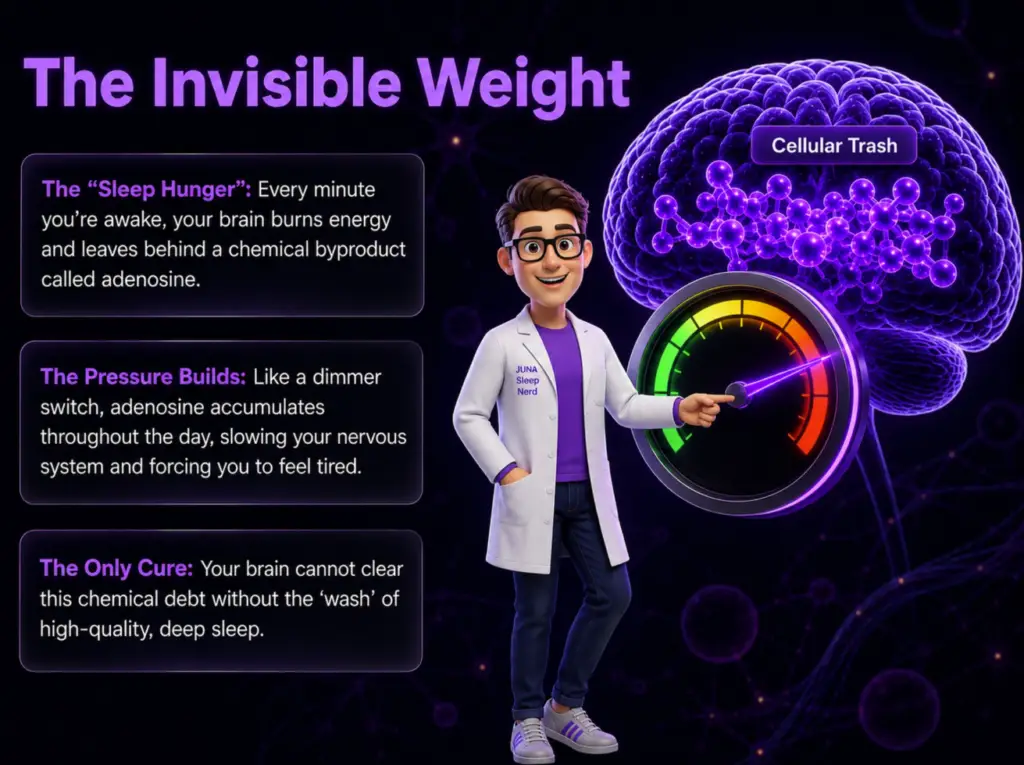
To understand sleep pressure adenosine, we have to look at how your cells use energy. Your body runs on a molecule called ATP (Adenosine Triphosphate). As your brain processes information, moves your muscles, and maintains your heart rate, it breaks down ATP for fuel. The “trash” left behind from this process is adenosine.
Throughout the day, this adenosine drifts through your system and binds to specific receptors (A1 receptors) in the brain. This binding acts like a dimmer switch for your central nervous system. It slows down the firing of neurons and promotes the activity of sleep-promoting regions in the ventrolateral preoptic nucleus (VLPO).
The Accumulation Phase
The longer you remain awake, the more sleep pressure adenosine accumulates. This is known as the homeostatic sleep drive. While your circadian rhythm (your internal clock) tells you when to sleep based on light, adenosine tells you how much you need to sleep based on how long you’ve been awake.
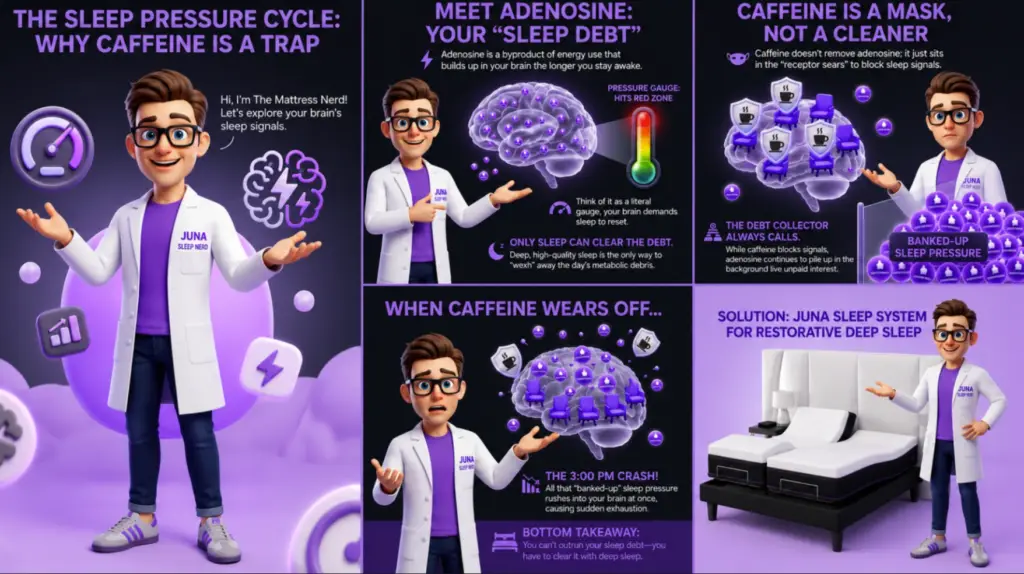
Expert Insight: “Think of adenosine as a literal pressure gauge. When the gauge hits the red zone, your brain’s demand for sleep becomes an irresistible biological imperative.” — The Juna Sleep Nerd
Discover ( The Biology of Adenosine: Why We Get Tired)
The Caffeine Trap: Borrowing Energy from Tomorrow
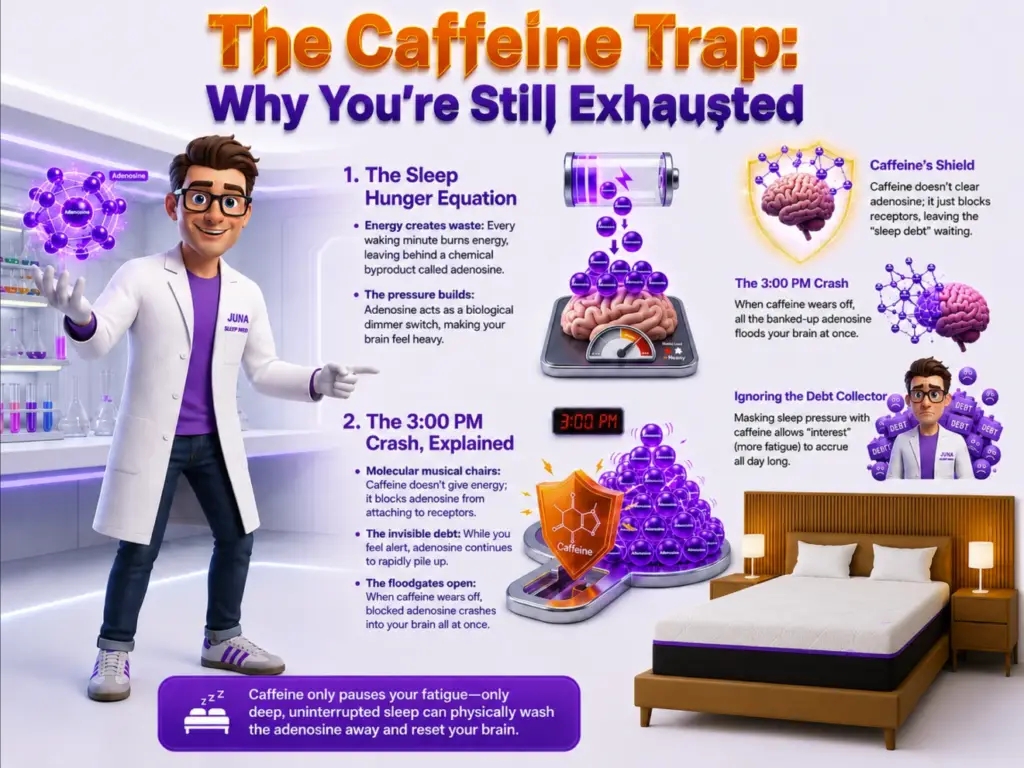
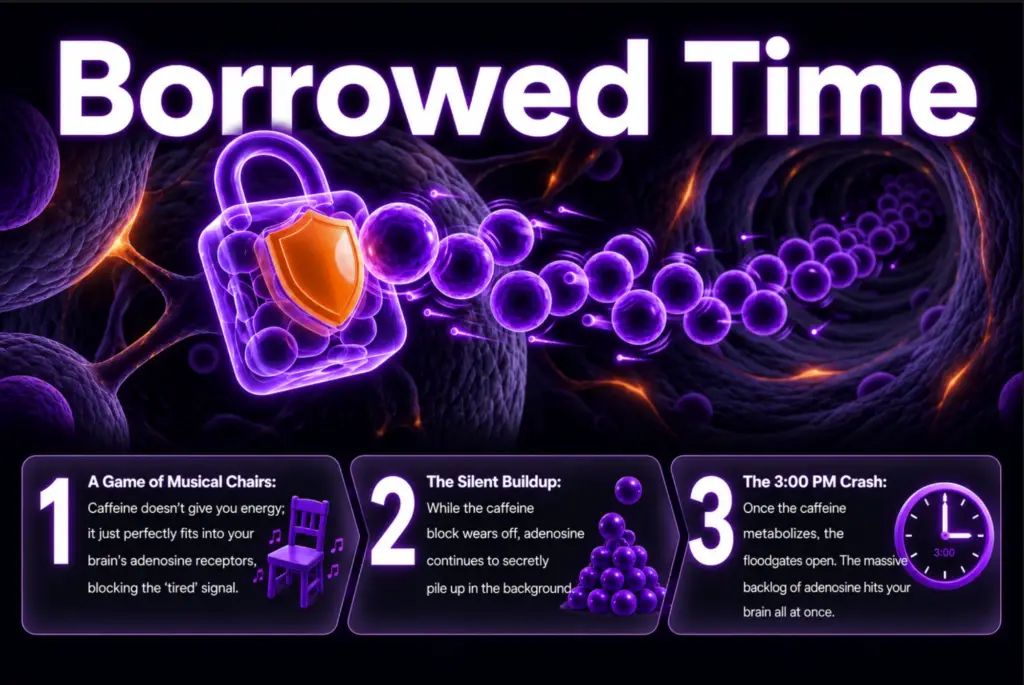
Most people attempt to manage their sleep pressure adenosine with caffeine. However, caffeine doesn’t actually “clear” adenosine; it simply plays a game of musical chairs.
Caffeine is a “competitive antagonist.” It has a molecular structure strikingly similar to adenosine, allowing it to fit into the same receptors. When caffeine occupies those seats, the adenosine molecules are left floating in the hallway, unable to tell your brain that you’re tired.
The Adenosine Crash
Once the caffeine is metabolized (which takes about 5 to 6 hours for half of it to leave your system), all that banked-up sleep pressure adenosine rushes into the receptors at once. This is the “afternoon crash” people feel at 3:00 PM. You haven’t avoided the sleep debt; you’ve just ignored the debt collector while interest (more adenosine) continued to accrue.
Clearing the Fog: How Sleep Resets the Brain
The only way to effectively clear sleep pressure adenosine is through deep, high-quality sleep. During sleep, particularly during slow-wave N3 sleep, the brain’s glymphatic system—a waste-clearance pathway—becomes ten times more active.
This process “washes” the brain, removing the day’s metabolic debris. If your sleep is fragmented by an uncomfortable mattress, a partner’s movement, or poor spinal alignment, you never spend enough time in the deep stages required for total clearance. You wake up with “residual adenosine,” leading to that groggy, “unrefreshed” feeling that persists even after eight hours in bed.
Discover ( How Sleep Resets the Brain)
The Comparison: High vs. Low Sleep Pressure
The following table compares the physiological and cognitive states associated with varying levels of adenosine accumulation.
| Feature | Low Sleep Pressure (Morning) | High Sleep Pressure (Evening) | Residual Pressure (Sleep Deprived) |
| Adenosine Concentration | Minimal | Peak Levels | Elevated at Wake-up |
| Cognitive Function | High Alertness / Sharp Focus | Slowed Reaction Time | “Brain Fog” & Irritability |
| Metabolic Health | Normal Glucose Regulation | Increased Hunger Hormones | Insulin Resistance Risk |
| Physical Feeling | Energetic / Lightweight | Heavy Limbs / “Heavy Eyes” | Chronic Fatigue / Muscle Ache |
| Memory Retention | High Encoding Capacity | Diminished Focus | Poor Information Recall |
The Juna Advantage: Engineering the Perfect Clearance Environment
At Juna Sleep, we understand that clearing sleep pressure adenosine is a physical process that requires an uninterrupted environment. If you are tossing and turning, you are resetting the clock on your glymphatic clearance. This is where the Juna philosophy of “Real Life” engineering comes into play.
The Lifetime Comfort Commitment
The biggest enemy of deep sleep is a mattress that no longer fits your body. Most traditional retailers lock you into a firmness level that might feel great in a 5-minute showroom test but fails you six months later. With Juna’s Lifetime Comfort Commitment, you are not stuck.
If your body changes—perhaps through injury, pregnancy, or aging—and your mattress starts causing pressure points that wake you up, our Juna Mattress Nerds come to your home. We can adjust the internal layers to make the mattress firmer, softer, or even adjust the lumbar support. By refining your comfort over time, we ensure you stay in deep sleep longer, allowing for the total clearance of sleep pressure adenosine.
The H-Bed: Closeness Without Compromise
For couples, the #1 cause of interrupted sleep (and thus, failed adenosine clearance) is partner disturbance. Traditional split kings leave a “trench” or a gap in the middle, sacrificing the “cuddle zone.” The Juna H-Bed solves this. It is a unified King mattress with deep vertical slits at the head and foot but a solid 28-inch “bridge” in the center.
This allows one partner to elevate their head to reduce snoring (a major adenosine-clearance inhibitor) while the other remains flat or in a “Zero Gravity” position. You get independent adjustability without the gap, keeping both partners in deep sleep cycles.
Premium Materials for Longevity
While most big-box brands use 1.2 lb to 1.8 lb density foam, Juna uses high-resilience foams ranging from 2.5 lb to 5 lb density. These materials don’t just feel better; they provide the stable support needed to prevent “roll-off” or “hammocking.” Combined with our Infinity Edge—a reinforced perimeter featuring a 6-inch support core and butterfly quad coils—you get a larger, more stable sleep surface. Whether you’re in Des Moines, West Des Moines, or Ames, you deserve a mattress that doesn’t collapse under the weight of real life.
The Two-Process Model: Adenosine vs. The Internal Clock
To truly master sleep pressure adenosine, we have to understand that it doesn’t work alone. Sleep is governed by what scientists call the “Two-Process Model.”
- Process S (The Sleep Drive): This is the accumulation of sleep pressure adenosine. It is a linear buildup; the longer you are awake, the higher the pressure.
- Process C (The Circadian Rhythm): This is your internal biological clock, governed by the suprachiasmatic nucleus. It responds to light and dark, telling your body when it is time to be alert and when it is time to wind down.
In a perfect world, these two processes align. By the time the sun goes down (Process C), your sleep pressure adenosine levels (Process S) should be at their peak. However, if you are sleeping on a mattress that causes discomfort, you might wake up before your brain has fully cleared the adenosine. This results in a “sleep debt” that carries over into the next day.
Discover (The Two-Process Model: Adenosine vs. The Internal Clock)
Why Your Mattress is the “Process S” Reset Button
If you live in Rapid City, Box Elder, or Summerset, you know that a long day of work or hiking in the Black Hills builds up immense physical fatigue. But if your mattress is sagging—a common issue with cheap foam mattresses—your body stays in a state of “micro-stress.”
This stress prevents you from entering the deep N3 stages of sleep where adenosine clearance is most efficient. Juna mattresses are engineered with high-density materials to ensure that your “Process S” is fully reset every single night, preventing the compounding interest of sleep deprivation.
Zero Gravity: Maximizing Adenosine Clearance Through Posture
One of the most effective ways to facilitate the deep sleep required to clear sleep pressure adenosine is through proper body positioning. This is why we often recommend pairing a Juna mattress with an Adjustable Base.
The Benefits of Zero Gravity
The “Zero Gravity” position—originally developed by NASA—elevates the head and feet slightly above the heart. This creates a weightless, pressure-relieving feel that mimics the feeling of floating.
- Reduced Pressure Points: By distributing body weight evenly, you stop tossing and turning.
- Improved Circulation: Better blood flow helps the body’s natural recovery processes.
- Breathe Easier: Elevation can help open airways, reducing the snoring that often wakes people up and halts the adenosine-clearing process.
When you combine the Juna H-Bed with an adjustable base, you and your partner can find your own version of “Zero-G.” You can find relief from the day’s sleep pressure adenosine without drifting apart into a “split-king gap.”
The Infinity Edge: More Room to Recover
Have you ever felt like you were going to roll off the bed if you moved too close to the side? That “roll-off” feeling is a major sleep disruptor. When your brain senses instability, it won’t let you fall into the deep sleep needed to flush sleep pressure adenosine.
Most mattresses use a cheap foam encasement around the perimeter. Over time, this foam softens and collapses. Juna’s Infinity Edge is different. We use:
- A 6-inch high-resiliency support core.
- 2-inch firm side rails for sitting support.
- A butterfly quad coil unit with a reinforced perimeter.
This creates a stable, usable sleep surface all the way to the edge. If you’re in a smaller room in Johnston, or Altoona, the Infinity Edge effectively makes your bed feel “bigger” because you can actually sleep on the entire surface without fear of falling.
The Juna Factory-Direct Advantage: Better Materials, Better Sleep
Why does Juna use 5 lb density foam when the rest of the industry uses 1.5 lb? Because we are factory direct. In the traditional mattress world, a bed goes from a factory to a brand, then to a wholesaler, then to a retail store. Everyone takes a cut, which means the “quality” of the materials has to be lowered to keep the price competitive.
At Juna, we cut out the middleman. We put that extra money back into the mattress.
- Durability: Our internal testing showed less than 4% firmness loss over 20 years.
- Non-Prorated Warranties: We offer 12-year and 18-year non-prorated warranties because we know our materials won’t break down like commodity foams.
- Local Craftsmanship: Every Juna is handcrafted. When you visit us in Sioux Falls or Rapid City, you are buying a product built for real life, not just a showroom floor.
Conclusion: Don’t Let Adenosine Win
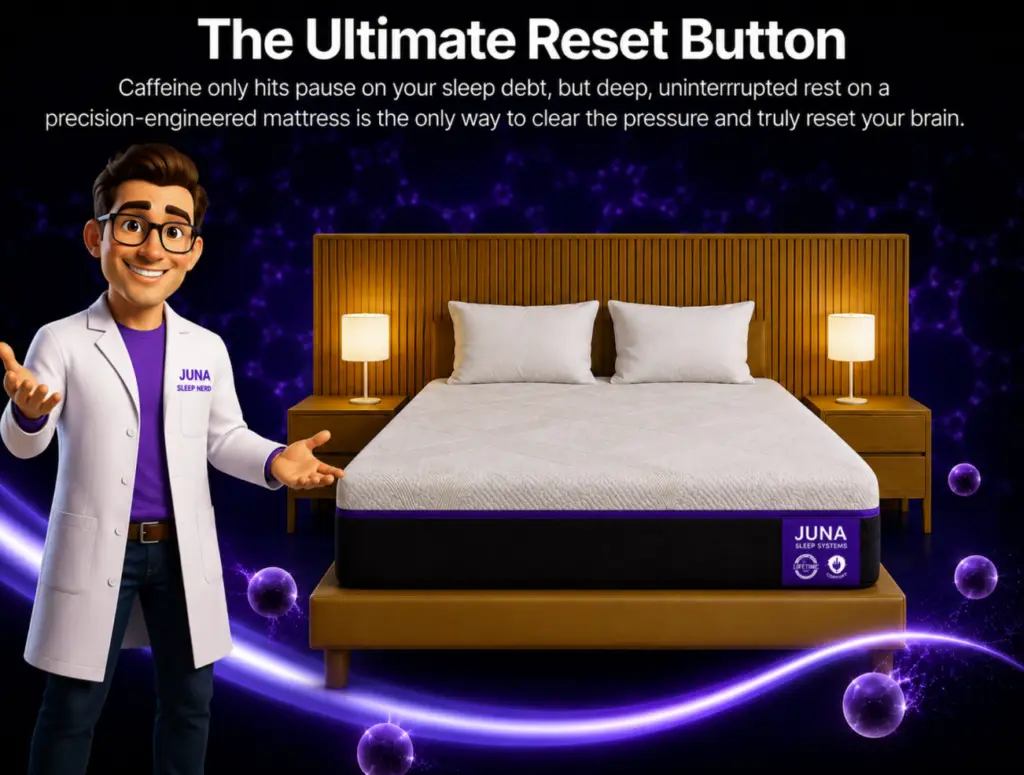
Sleep pressure adenosine is a fact of biology, but chronic sleep deprivation doesn’t have to be. By choosing a sleep system that prioritizes deep, uninterrupted recovery, you are giving your brain the “wash” it needs to perform at its best.
You don’t have to settle for a mattress that “just okay.” With our Lifetime Comfort Commitment, local factory-direct service, and innovative designs like the H-Bed, Juna ensures that your sleep pressure is handled with the scientific precision it deserves.
Frequently Asked Questions (FAQ)
- How long does it take to clear sleep pressure adenosine? For most healthy adults, it takes 7 to 9 hours of high-quality sleep to fully clear the sleep pressure adenosine accumulated during a 16-hour day. If your sleep is interrupted, some adenosine may remain, leading to morning grogginess.
- Does exercise increase sleep pressure? Yes. Physical exertion increases the breakdown of ATP, which leads to a faster buildup of sleep pressure adenosine. This is why you often feel “physically tired” and fall asleep faster after a day of heavy activity.
- Can I “catch up” on sleep pressure over the weekend? While you can clear some residual sleep pressure adenosine by sleeping in, you cannot fully undo the biological stress caused by chronic sleep deprivation. Consistency is key to maintaining a healthy sleep-wake cycle.
- How does the Juna H-Bed help with sleep pressure? The H-Bed allows couples to use independent adjustable positions (like elevating the head to stop snoring) without a gap in the middle. By reducing partner disturbances and snoring, both individuals stay in the deep sleep stages required to clear sleep pressure adenosine.
- What is the “caffeine crash” related to adenosine? Caffeine blocks adenosine receptors but doesn’t stop sleep pressure adenosine from building up. When the caffeine wears off, all the accumulated adenosine floods the receptors at once, causing a sudden, intense feeling of exhaustion.
- Does the Lifetime Comfort Commitment cover sagging? The Lifetime Comfort Commitment is for fine-tuning your comfort (making it firmer or softer). For actual defects like sagging, Juna provides 12-year and 18-year non-prorated warranties to ensure your investment is protected.
- Why is deep sleep so important for adenosine? During deep sleep (Slow Wave Sleep), the brain’s glymphatic system opens up, allowing cerebrospinal fluid to flush out metabolic waste, including sleep pressure adenosine. Without deep sleep, this “cleaning” process is incomplete.
Visit a Juna Showroom Near You
Ready to experience the Juna difference? Stop by one of our three locations to talk to a Mattress Nerd and find the system that will finally help you master your sleep pressure adenosine.
- Juna Sleep Systems – Sioux Falls, SD (Serving Brandon, Harrisburg, and Tea)
- Juna Sleep Systems – Rapid City, SD (Serving Box Elder, Summerset, and Sturgis)
Discover our collection online or visit us today to take the first step toward better sleep!
