
The Quick Answer
Clinical data consistently demonstrates that CBT-I for Insomnia is the undisputed gold standard for treating chronic sleep issues. Unlike pharmaceutical sedatives, which merely mask symptoms by chemically knocking out the central nervous system, Cognitive Behavioral Therapy for Insomnia addresses the underlying behavioral and psychological root causes of sleep disruption, delivering permanent, drug-free recovery and restoring natural sleep architecture.
Discover ( Cognitive Behavioral Therapy for Insomnia (CBTI)
Introduction: Moving Past the Quick Fix
For generations, the standard societal response to a fractured night of sleep has been found at the bottom of a prescription pill bottle. Millions of adults regularly turn to sedative-hypnotics, over-the-counter antihistamines, or heavy sleep aids to force their brains into a state of unconsciousness. However, being chemically sedated is fundamentally different from achieving natural, restorative sleep. Artificial sedation bypasses the body’s intricate neurobiological sleep architecture, leaving the individual chronically unrefreshed, dependent, and trapped in a cycle of daytime fatigue.
At Juna Sleep, we look directly at the molecular and behavioral architecture of human recovery. Your mattress should never be an arena where you fight your brain every night; it should be a carefully calibrated physical tool engineered to support evidence-based sleep wellness. This is why we advocate for CBT-I for Insomnia—the clinically proven, non-pharmacological behavioral therapy that sleep physicians and neuroscientists worldwide recognize as the absolute gold standard.
Whether you are making the short drive to our showrooms from regional communities like Brookings, SD, or Marshall, MN, understanding how your cognitive habits and physical sleep environment interact is the first step toward reclaiming your nights without chemical assistance.
What is CBT-I for Insomnia?
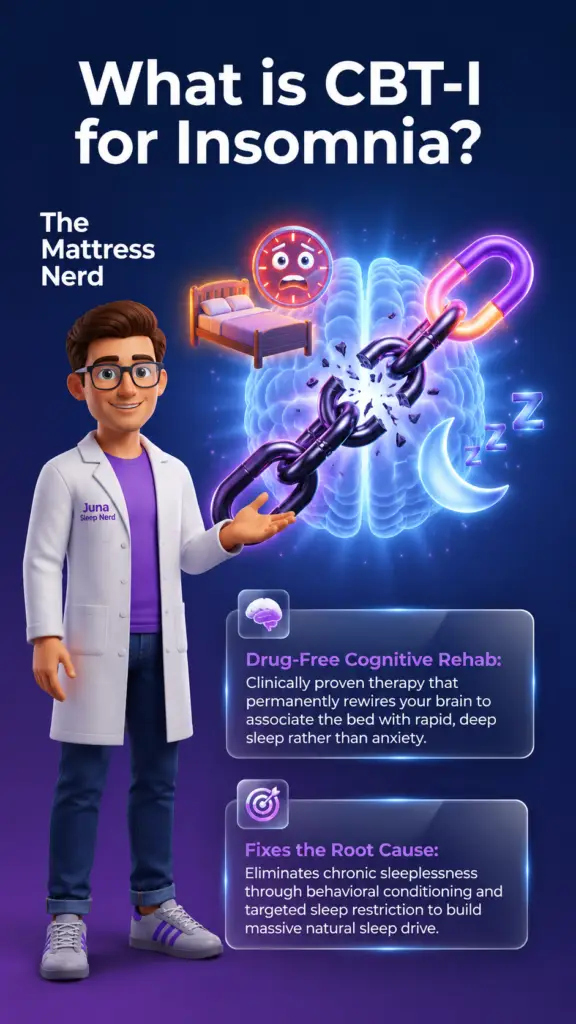
To understand why CBT-I for Insomnia is so uniquely effective, it helps to dismantle what it actually is. Cognitive Behavioral Therapy for Insomnia is a structured, collaborative, and short-term psychotherapeutic intervention. It is specifically engineered to target the cognitive distortions, counterproductive habits, and physiological hyperarousal that keep people awake. While sleeping pills act as a temporary chemical blanket over a raging fire, this behavioral framework isolates and permanently extinguishes the fuel source of chronic sleep issues.
From a neurological perspective, chronic sleeplessness is largely a learned condition. Over months or years of struggling to rest, your brain accidentally builds a strong neural pathway that connects your bed with stress, frustration, and intense alertness. By utilizing CBT-I for Insomnia, you work systematically to dissolve these negative connections, replacing them with a healthy homeostatic sleep drive and balanced circadian signaling. It is a form of cognitive rehabilitation that trains your central nervous system to view the bedroom as a safe haven for deep recovery.
The Core Pillars of Clinical Behavioral Interventions
Clinical protocols for Cognitive Behavioral Therapy for Insomnia do not rely on generic sleep hygiene tips like avoiding caffeine or lowering the room temperature. Instead, they use a highly targeted, multi-faceted approach tailored to your specific biological data. The program generally runs for six to eight weeks under the supervision of a certified clinician, focusing on rewriting your nighttime habits through several foundational pillars:
- Stimulus Control Therapy: Breaking the mental association between the bed and wakefulness.
- Sleep Restriction Therapy: Limiting time spent in bed to mirror actual sleep capacity, building up immense sleep pressure.
- Cognitive Restructuring: Disarming the catastrophic thoughts and anxiety surrounding sleep loss.
- Relaxation Training: Utilizing biofeedback, progressive muscle relaxation, and autonomic down-regulation to calm the nervous system.
By combining these targeted interventions, patients can systematically rebuild their sleep architecture from the ground up, providing long-term relief that pharmaceuticals simply cannot match.
Stimulus Control Therapy: Re-wiring the Bedroom Environment
The first and arguably most vital pillar of CBT-I for Insomnia is Stimulus Control Therapy. This technique is based on classic Pavlovian behavioral conditioning principles. If you consistently use your bed to scroll through your phone, worry about finances, watch television, or stare at the clock while feeling frustrated, your brain starts to categorize the mattress as a place of high alertness.
[IMAGE SUGGESTION: A conceptual graphic showing a clear behavioral pathway: a bed connecting directly to a calm brain icon, highlighting the core principles of Stimulus Control Therapy. Alt Text: Infographic detailing the principles of Stimulus Control Therapy within a CBT-I for Insomnia protocol.]
The strict guidelines of this therapy are designed to disrupt that unhelpful pattern:
- Reserve the Bed Only for Sleep and Intimacy: No working, eating, or screens are permitted in the sleep environment.
- The 20-Minute Rule: If you are unable to fall asleep within roughly twenty minutes, you must immediately get out of bed.
- Leave the Room: Move to a dimly lit separate room and engage in a quiet, non-stimulating activity (like reading a physical book) until you feel genuinely tired.
- Return Only When Sleepy: Do not return to the mattress until your natural sleep pressure has taken over.
The goal here is absolute: you want your brain to form an immediate, automatic connection between your mattress and rapid sleep onset. To optimize this behavioral conditioning, it is essential to ensure your physical sleep surface is completely free of pressure points or sagging zones that could trigger physical discomfort.
Cognitive Restructuring: Calming Nighttime Worry
The second major pillar of clinical CBT-I for Insomnia is cognitive restructuring. When you suffer from chronic sleep issues, your mind tends to amplify your worries as the night goes on. You might look at the clock at 2:15 AM and think, “If I don’t fall asleep right now, I will completely ruin my presentation tomorrow, jeopardize my job, and destroy my health.”
These catastrophic thoughts trigger an immediate survival response through the Hypothalamic-Pituitary-Adrenal (HPA) axis. Your brain treats these exaggerated worries as a literal physical threat, flooding your bloodstream with adrenaline and cortisol.
Cognitive restructuring teaches you to identify, challenge, and neutralize these unhelpful thoughts. You learn to replace panic with realistic, calming facts, such as: “Even if I sleep poorly tonight, I have successfully navigated challenging workdays before, and my body will naturally make up for it by increasing my deep sleep drive tomorrow night.” This cognitive shift helps quiet down a hyperactive nervous system, making it much easier to transition into deep rest.

Sleep Restriction: Consolidating the Sleep Window
Perhaps the most counterintuitive element of CBT-I for Insomnia is Sleep Restriction Therapy. When someone is struggling with insomnia, they often try to maximize their time in bed—staying under the covers for 9 or 10 hours in the hope of catching a few fragmented fragments of rest. This habit actually dilutes your sleep quality, leading to long stretches of frustrating wakefulness and a highly fragmented sleep cycle.
Under the guidance of a trained professional, sleep restriction temporarily limits your time in bed to match the exact number of hours you are currently averaging as actual sleep (with a strict minimum floor of 5 hours). For example, if you spend 8 hours in bed but your sleep diary shows you only sleep for 5.5 hours, your new allowed window in bed is restricted to exactly 5.5 hours.
This intentional restriction capitalizes on your homeostatic sleep drive. By staying awake longer, you rapidly build up adenosine levels in your brain, maximizing your internal sleep pressure. As a result, when you finally lay down, you fall asleep much faster and stay asleep much longer. Once your sleep efficiency reaches an optimal level (typically above 85% to 90%), your clinician will gradually extend your time in bed by 15-minute increments until you reach your ideal biological duration.

The Clinical Face-Off: CBT-I for Insomnia vs. Sedative Medications
The following detailed markdown table summarizes clinical insights regarding behavioral therapy compared to conventional pharmaceutical sleep aids.
| Evaluation Metric | Clinical CBT-I Protocol | Conventional Sleeping Pills |
| Primary Mechanism | Rewires behavioral habits & cognitive anxiety | Chemically sedates the central nervous system |
| Long-Term Success | Sustained improvement after therapy ends | High relapse rates once medication stops |
| Impact on Sleep Cycles | Preserves natural N3 deep and REM stages | Often suppresses vital deep and REM sleep |
| Risk of Dependency | None; builds natural self-reliance | High risk of physical & psychological tolerance |
| Common Side Effects | Temporary daytime sleepiness during restriction phase | Daytime hangovers, memory issues, sleepwalking |
| Primary Financial Focus | Lifelong tools for sustainable self-management | Recurring prescription refills and medical costs |
The True Cost of Sleeping Pills Side Effects
While pharmaceutical interventions can offer short-term relief during an acute situational crisis (such as unexpected grief or immediate trauma), using them as a long-term solution carries significant risks. Many patients overlook the long list of sleeping pills side effects that can seriously compromise daytime performance and overall health.
First, standard chemical sedatives often disrupt your natural sleep architecture. They frequently suppress the deep, slow-wave N3 cycles and REM phases that your brain relies on for physical repair, immune regulation, and memory consolidation. This explains why people who rely on sleeping pills often wake up feeling physically heavy and mentally foggy.
Furthermore, the human brain quickly adapts to these substances, leading to a rapid buildup of chemical tolerance. Within just a few weeks of continuous use, the initial dose often loses its effectiveness, prompting many individuals to increase their dosage. When they eventually try to stop taking the medication, they frequently encounter severe “rebound insomnia”—an intense return of their sleep issues caused by the central nervous system struggling to self-regulate without the drugs.
The Juna Advantage: Supporting the Gold Standard Protocol
While CBT-I for Insomnia provides the behavioral blueprint and cognitive tools needed to heal your sleep architecture, these clinical techniques cannot reach their full potential if they are undermined by a poor physical sleep environment. During the highly demanding phase of Sleep Restriction Therapy, for instance, your allowed time in bed is strictly compressed. Every single minute spent on the mattress must be hyper-efficient. If you are wasting your limited sleep window tossing and turning because a cheap, low-density mattress is creating painful pressure points, your behavioral therapy will feel like an uphill battle.
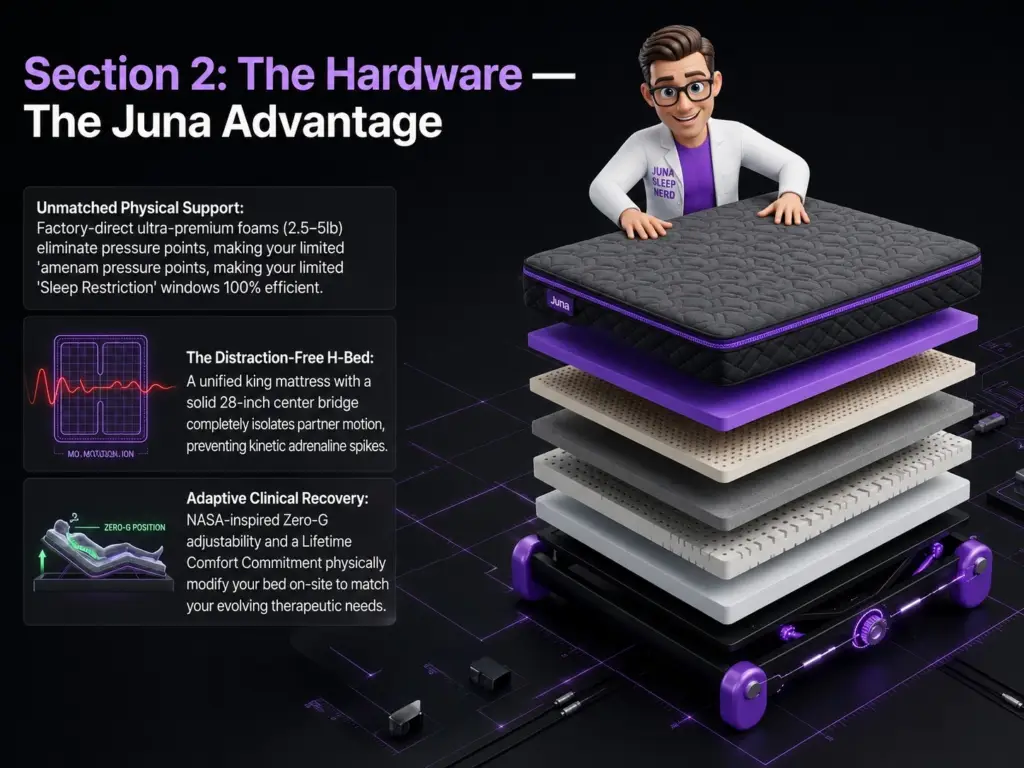
At Juna Sleep, we engineer our sleep systems to act as a physical foundation for evidence-based recovery protocols. We refuse to use the low-grade 1.2 lb to 1.8 lb commodity foams found in mass-market mattresses, which rapidly crater, sag, and throw your skeleton out of alignment. Instead, our beds are handcrafted with ultra-premium 2.5 lb to 5 lb density foams. These high-performance materials conform perfectly to your unique anatomy, distributing your body weight flawlessly and soothing your nervous system’s sensory receptors. By eliminating physical discomfort, Juna keeps your body deeply anchored in restorative sleep stages, allowing you to maximize the biological benefits of your behavioral training.
True Customization via the Lifetime Comfort Commitment
Navigating CBT-I for Insomnia requires a highly adaptive environment. As you progress through stimulus control and sleep restriction, your body’s physical preferences and support needs can actively shift. If your mattress surface is too rigid, it can trigger localized muscle tension, sending alarm signals back up your spinal cord that mimic a fight-or-flight response. Standard commercial mattress retailers lock you into a single firmness level based on a brief, artificial showroom test. If that surface turns out to be a mismatch for your therapeutic journey a few months later, you are usually stuck with a frustrating piece of furniture.
Juna eliminates this risk entirely through our exclusive Lifetime Comfort Commitment. Your mattress can grow, shift, and adapt alongside your clinical progress. If you or your health professional determine that your body requires a softer surface to successfully implement Stimulus Control Therapy, or a more supportive lumbar zone to stay asleep during restriction windows, you simply contact a friendly Juna Mattress Nerd. We will come directly to your home, unzip your mattress cover, and physically adjust the internal comfort layers on-site. This personalized adjustment removes the guesswork and stress from your environment, giving your nervous system the exact stability it needs to rebuild healthy sleep habits.
Isolating the Mind with the Juna H-Bed
A critical component of cognitive behavioral conditioning is maintaining a pristine, distraction-free environment. For individuals retraining their brains to view the bed as a sanctuary of absolute calm, partner disturbance can be a major setback. If your partner rolls over, shifts positions, or operates on an entirely different sleep schedule, those kinetic motion waves will travel directly across a conventional mattress. For a sensitive sleeper trying to overcome chronic insomnia, that sudden physical jolt triggers a burst of adrenaline, completely resetting the clock on your sleep onset.
The Juna H-Bed is engineered specifically to eliminate partner motion transfer without separating couples into isolated beds. Built as a single, unified King-sized mattress, the H-Bed features a revolutionary “H” geometry: deep vertical cuts at the center-head and center-foot, balanced by a completely solid, uncut 28-inch foam bridge right in the middle.
This breakthrough design allows for completely independent side-to-side mechanical movement and kinetic isolation. If one partner shifts or adjusts their base elevation, the motion is completely absorbed before it can cross the midline. The seamless center bridge preserves the unified “cuddle zone” of a true King bed, allowing you to undergo behavioral conditioning in an undisturbed, peaceful environment.
[IMAGE SUGGESTION: A top-down blueprint schematic of the Juna H-Bed, demonstrating the independent head/foot articulation and the solid 28-inch center motion-isolation bridge. Alt Text: Structural engineering layout of the Juna H-Bed highlighting the motion isolation central bridge.]
NASA-Inspired Posture Engineering for Autonomic Calm
To successfully implement relaxation training and transition smoothly into deep, slow-wave rest, your body must be entirely unburdened by mechanical strain. Pairing your Juna mattress with an Advanced Adjustable Base provides the ultimate tool for physiological down-regulation. By utilizing the pre-set “Zero Gravity” position, your head and legs are elevated to precise angles calculated by NASA researchers to create a completely weightless posture.
- Decompressing the Spine: Elevating the torso and thighs unloads gravity-induced pressure from your lower back, immediately reducing muscle tension.
- Lowering Your Pulse: This neutral positioning improves blood circulation, easing the workload on your heart and helping transition your autonomic nervous system from sympathetic alertness to parasympathetic calm.
- Opening Airway Passages: Slight head elevation prevents airway resistance and snoring, stabilizing your oxygen saturation throughout the night and preventing the micro-arousals that shatter your sleep cycles.
The Factory-Direct Difference: Premium Densities for Real Rest
How can Juna afford to source ultra-premium, heavy-duty materials while maintaining honest, accessible pricing? It all comes down to our factory-direct business model. The traditional mattress industry is built on a complex chain of middlemen, distributors, national brokers, and third-party retail storefronts—with each entity adding substantial financial markups to the final price. To stay profitable, those mainstream brands are forced to dramatically reduce the quality of the materials inside the bed.
At Juna, we cut out the commercial middlemen completely. We build our mattresses closer to our customers and sell them directly through our own regional factory showrooms. This direct model allows us to route our investments away from corporate retail markups and straight into high-performance components, including our specialized Infinity Edge support system.
By combining a 6-inch high-resiliency support core with 2-inch ultra-firm perimeter side rails and a 2.5-inch butterfly quad coil unit, we create a stable, usable sleep surface all the way to the very edge. You get consistent, predictable orthotic support across every square inch of your mattress, ensuring your behavioral recovery is backed by the finest engineering available.

Conclusion: Embrace Lasting Behavioral Recovery
Relying on temporary fixes like sleeping pills only masks the symptoms of chronic sleeplessness while introducing the risk of dangerous side effects, dependency, and distorted sleep architecture. Reclaiming your natural, healthy rest requires addressing the underlying behavioral and psychological triggers through the gold standard: CBT-I for Insomnia.
By training your brain to associate the bedroom with peaceful rest and supporting that mental shift with a custom-tailored, factory-direct Juna Sleep System, you give your body and mind the ultimate foundation for lifelong, drug-free recovery. Stop settling for chemical sedation and start investing in the real science of human rest.
Frequently Asked Questions (FAQ)
1. Why is CBT-I for Insomnia considered more effective than sleeping pills?
CBT-I for Insomnia is the clinical gold standard because it treats the actual behavioral habits and cognitive anxieties that trigger chronic sleep issues. While pharmaceutical sleep aids temporarily sedate the central nervous system—often disrupting vital REM and deep slow-wave stages—CBT-I provides permanent, drug-free tools that lead to long-term self-reliance without the risk of dependency or hangovers.
2. What exactly is Stimulus Control Therapy?
Stimulus Control Therapy is a core pillar of Cognitive Behavioral Therapy for Insomnia designed to rebuild a strong mental connection between your bed and rapid sleep onset. It requires reserving the bed strictly for sleep and intimacy, getting out of bed if you are awake for more than 20 minutes, and returning to the mattress only when you feel genuinely sleepy.
3. How does a high-density mattress support the sleep restriction phase?
During sleep restriction, your total time allowed in bed is highly compressed to maximize your natural homeostatic sleep drive. Because every minute on the mattress is vital, Juna uses ultra-premium 2.5 lb to 5 lb density foams to prevent pressure points and tossing and turning, ensuring your limited sleep window is incredibly efficient and completely undisturbed.
4. What makes Juna’s 12-year and 18-year warranties non-prorated?
A non-prorated warranty means your protective coverage value never degrades or depreciates based on the age of the mattress. Whether a covered structural defect in materials or workmanship occurs in the second year or the fifteenth year, Juna handles the full repair or replacement without charging you a fee based on how long you’ve owned the bed.
5. Can a Juna Mattress Nerd adjust my bed if my comfort needs change?
Yes! Thanks to our exclusive Lifetime Comfort Commitment, our dedicated Juna Mattress Nerds can come directly to your home to unzip the mattress cover and adjust the internal foam layout. We can make your bed firmer, softer, or provide targeted lumbar adjustments to continuously support your physical and therapeutic needs over time.
6. How does the Juna H-Bed prevent partner disturbance during behavioral retraining?
The Juna H-Bed utilizes a unique “H” geometry featuring independent head and foot articulation separated by a solid, uncut 28-inch central foam bridge. This specialized design provides total kinetic motion isolation, meaning one partner can shift or get up without transferring movement to the other side, preventing the sudden adrenaline spikes that disrupt a sensitive sleeper.
7. Where can I experience Juna’s factory-direct quality in person?
You can work face-to-face with an expert Mattress Nerd and try our premium sleep systems at any of our three regional factory showrooms: Juna Sleep Systems in Sioux Falls, South Dakota and Juna Sleep Systems in Rapid City, South Dakota.
Visit a Juna Showroom Near You
Are you ready to break free from the cycle of quick fixes and experience true, sustainable sleep recovery? Visit one of our three regional factory-direct showrooms today to talk directly with a friendly Juna Mattress Nerd and discover a custom-built system designed around your life.
- Juna Sleep Systems – Sioux Falls, SD: A convenient drive for families coming from Brookings, Mitchell, or Yankton.
- Juna Sleep Systems – Rapid City, SD: Easily accessible for West River communities, including Box Elder, Summerset, and Sturgis.
Stop by a showroom today or browse our full collection online to take your first real step toward permanent, natural sleep alignment!
