
The Quick Answer
Chronic insomnia is fundamentally a disorder of hyperarousal driven by insomnia biology. It occurs when an overactive sympathetic nervous system and abnormal nighttime cortisol spikes keep your body trapped in a perpetual “fight-or-flight” state, overriding the brain’s natural homeostatic sleep pressure and making deep rest biologically impossible.
Introduction to the Hyperarousal State
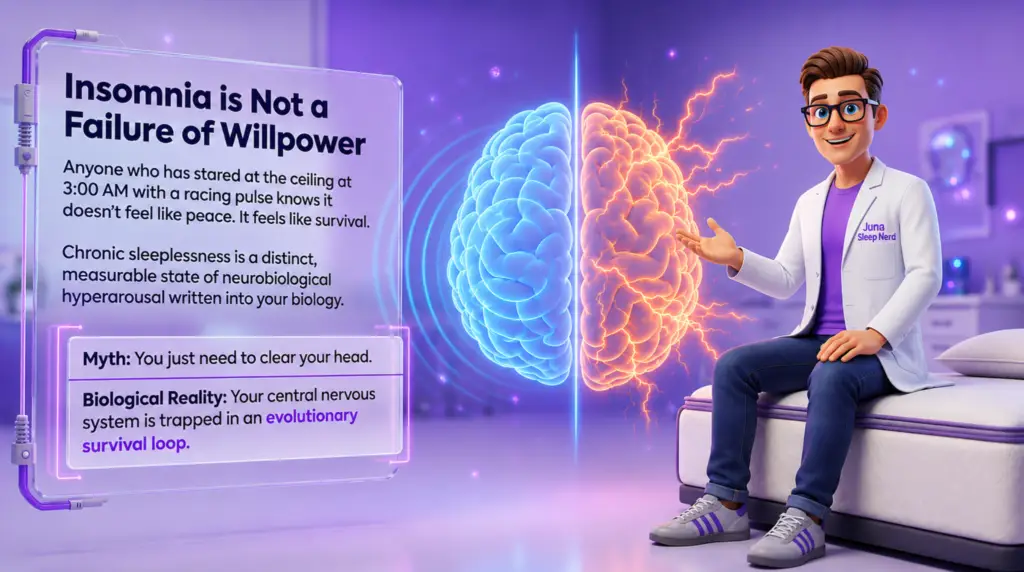
There is a common misconception that insomnia is simply a consequence of mind over matter—that if you could just “clear your head” or “relax,” sleep would naturally follow. But anyone who has stared at the ceiling at 3:00 AM with a racing pulse and an icy spike of dread in their chest knows that insomnia doesn’t feel like peace; it feels like survival. That is because, at its core, chronic sleeplessness is not a failure of will. It is a distinct, measurable state of neurobiological hyperarousal written into your insomnia biology.
At Juna Sleep, we don’t view mattresses as mere furniture or showroom luxury items; we engineer them as specialized physical tools designed to reduce your body’s physiological stress markers and support systemic recovery. When your central nervous system is stuck in an evolutionary survival loop, your sleep environment must actively work to downregulate your body’s defense mechanisms.
Whether you are driving in from local communities such as Brandon, Harrisburg, or Tea to visit our Sioux Falls factory showroom, our goal is to help you understand the chemical and anatomical forces that sabotage your rest. By deconstructing the survival mechanics of your brain, you can stop blaming yourself and start constructing a true sanctuary for recovery
Learn about the https://my.clevelandclinic.org/health/symptoms/hyperarousal
The Autonomic Mismatch: Sympathetic Dominance
To fully comprehend the biology of insomnia, we have to examine the autonomic nervous system (ANS), which controls our involuntary bodily functions. The ANS operates via two opposing branches that act as the gas pedal and the brake pedal of your physiology: the sympathetic nervous system (SNS) and the parasympathetic nervous system (PNS).
- The Sympathetic Nervous System (The Gas Pedal): This branch orchestrates the evolutionary “fight-or-flight” response. It dilates pupils, accelerates heart rate, constricts blood vessels, and floods the bloodstream with glucose to prepare muscles for immediate physical combat or flight from a predator.
- The Parasympathetic Nervous System (The Brake Pad): This branch governs the “rest-and-digest” or “feed-and-breed” state. It lowers blood pressure, slows heart rate, stimulates digestion, and allows the body to drift smoothly through deep cellular repair cycles.
In a healthy individual, as the sun sets and ambient light fades, the master circadian pacemaker in the suprachiasmatic nucleus signals the body to ease off the sympathetic gas pedal and depress the parasympathetic brake.
However, in individuals suffering from chronic insomnia, this autonomic handoff completely fails. The overactive sympathetic nervous system remains aggressively dominant long after you turn off the lights. Your body is biologically convinced that danger is imminent, keeping your core body temperature elevated, your heart rate variability low, and your brain waves locked in high-frequency beta patterns that prevent transition into slow-wave sleep.
The Chemical Saboteur: Nighttime Cortisol Spikes
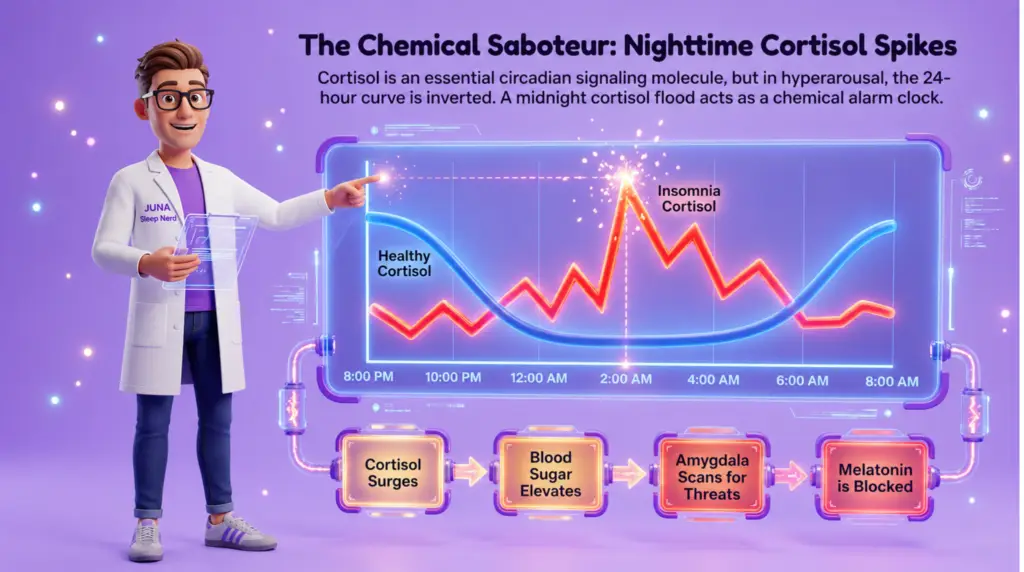
The physical sensations of fight-or-flight sleep are largely driven by the endocrine system, specifically through cortisol levels. Cortisol is commonly known as the body’s primary stress hormone, but it also functions as an essential circadian signaling molecule.
In a standard, healthy biological rhythm, cortisol follows a strict 24-hour curve. It should drop to its absolute lowest point around midnight, allowing sleep-inducing neurochemicals to take over, before spiking dramatically between 6:00 AM and 8:00 AM (known as the Cortisol Awakening Response) to provide the energy needed to wake up and face the day.
[IMAGE SUGGESTION 1: A clean, scientific line graph illustrating a normal, dipping 24-hour cortisol curve contrasted against a jagged, elevated curve showing erratic nighttime cortisol spikes typical in chronic insomnia patients. Alt Text: Scientific graph contrasting healthy circadian cortisol rhythms with nighttime cortisol spikes in insomnia biology.]
In patients trapped by insomnia biology, this curve is completely inverted or flattened. Instead of dropping smoothly to baseline at bedtime, these individuals experience severe nighttime cortisol spikes.
When cortisol floods your bloodstream at midnight or 2:00 AM, it acts like a chemical alarm clock. It triggers gluconeogenesis, elevating blood sugar, and signals the brain’s emotional center—the amygdala—to scan the environment for threats.
This hormonal surge directly blocks the synthesis and release of melatonin, ensuring that even if you manage to fall asleep, your sleep architecture remains fragmented, light, and unrefreshing.
The Adenosine Override: Why Sleep Pressure Fails
One of the most frustrating aspects of fight-or-flight hyperarousal is that you can feel completely exhausted, yet remain totally unable to sleep. To understand why this happens, we must look at how stress overrides the homeostatic sleep drive.
Every single minute your brain is awake and burning energy via Adenosine Triphosphate (ATP), a metabolic byproduct called adenosine builds up in your brain’s interstitial space. This steady accumulation creates what sleep scientists call sleep pressure—the literal physical hunger for sleep that grows heavier the longer you stay awake.
Under normal conditions, high sleep pressure binds to A1 neuro-receptors, quietening the arousal centers of your brain and stimulating the sleep-promoting regions within the ventrolateral preoptic nucleus (VLPO).
However, when the sympathetic nervous system is overactive, sending continuous threat signals, the brain’s survival networks completely override this homeostatic drive. The brain prioritizes immediate survival over cellular maintenance.
It doesn’t matter if your sleep pressure gauge is maxed out after 20 hours of wakefulness; if your bloodstream is flooded with adrenaline and cortisol from nighttime cortisol spikes, the neurochemical wake-active systems (like orexin, histamine, and norepinephrine) will forcibly keep the cortical gates open. You are left feeling “wired but tired”—biologically exhausted, yet chemically forbidden from sleeping.
The Neurobiology of Hyperarousal: HPA Axis Disruption
The systemic root of this ongoing chemical warfare is a chronic malfunction within the Hypothalamic-Pituitary-Adrenal axis, commonly referred to as the HPA axis. The HPA axis serves as your body’s primary stress-management thermostat.
When your mind or body perceives a stressor—whether it’s a real physical threat, workplace anxiety, or the literal fear of not sleeping—the hypothalamus releases Corticotropin-Releasing Hormone (CRH). This hormone prompts the pituitary gland to release Adrenocorticotropic Hormone (ACTH), which ultimately tells the adrenal glands sitting atop your kidneys to dump cortisol and adrenaline into your bloodstream.
In a healthy system, a sophisticated negative feedback loop allows excess cortisol to bind back to receptors in the brain, signaling the hypothalamus to shut down the stress cascade.
But in chronic insomnia, this thermostat breaks down. The brain’s receptors become desensitized to cortisol, blinding the HPA axis to its own overproduction. The feedback loop snaps, leaving the stress response permanently jammed in the “on” position.
This continuous HPA axis disruption keeps you trapped in an exhausting cycle: the fear of insomnia triggers a stress response, the resulting nighttime cortisol spikes destroy your sleep architecture, and the unrefreshed morning fatigue further panics the HPA axis, setting up the exact same failure for the following night.
Learn about the https://my.clevelandclinic.org/health/symptoms/hyperarousal
Aligned Autonomic Balance vs. Hyperarousal States
The following structural table breaks down how an aligned, parasympathetic-dominant system operates during rest compared to a system trapped in sympathetic dominance and HPA axis hyperarousal.
| Physiological Marker | Aligned Parasympathetic Rest (Optimal) | Sympathetic Hyperarousal State (Insomnia) |
| Autonomic Nervous System | Parasympathetic Dominant (“Rest & Digest”) | Sympathetic Dominant (“Fight or Flight”) |
| Cortisol 24-Hour Curve | Drops smoothly to baseline at midnight | Erratic, elevated nighttime cortisol spikes |
| Heart Rate Variability (HRV) | High (Signals a resilient, relaxed heart) | Low (Signals high physical stress and tension) |
| Brain Wave Profile | Slow-Wave Delta & Theta dominance | High-Frequency Beta & Gamma dominance |
| Core Body Temperature | Drops naturally to facilitate deep sleep | Remains elevated, disrupting cycle transitions |
| Glymphatic System Action | Fully active; clears metabolic waste/adenosine | Halted or highly fragmented by micro-arousals |
The Juna Advantage: Engineering the Down-Regulation Environment
Knowing that insomnia biology is driven by physical, chemical, and neurological hyperarousal, the solution must go beyond simple sleep advice or basic bedtime routines. You must intentionally build a physical environment engineered to lower your body’s stress response and promote parasympathetic dominance.
At Juna Sleep, our core mission is this. We recognize that if a mattress causes even minor physical discomfort, your already sensitive nervous system will interpret those pain signals as further environmental threats, triggering additional cortisol releases and breaking your sleep cycles.
This is why we refuse to use the cheap, low-density alternative foams common throughout the box-bed and big-retail industry. Mass-market beds typically use 1.2-1.8 lb density foam that quickly softens, buckles, and caves under your body weight, throwing your spine out of alignment and creating painful pressure points.
Juna beds are handcrafted using ultra-premium, high-resilience foam with densities ranging from 2.5 lb to 5 lb. These superior layers distribute your body weight flawlessly, calming your nervous system’s sensory receptors and providing the deep physical comfort needed to help lower an overactive sympathetic nervous system
Learn about the https://my.clevelandclinic.org/health/symptoms/hyperarousal
True Customization via the Lifetime Comfort Commitment
For individuals navigating severe HPA axis disruption, a bed that causes localized physical pressure is a medical emergency for their sleep architecture. Pain triggers immediate sensory feedback to the brain, which interprets physical discomfort as an environmental threat. This micro-panic prompts additional nighttime cortisol spikes, breaking your slow-wave cycles and pulling you right back into conscious alertness.
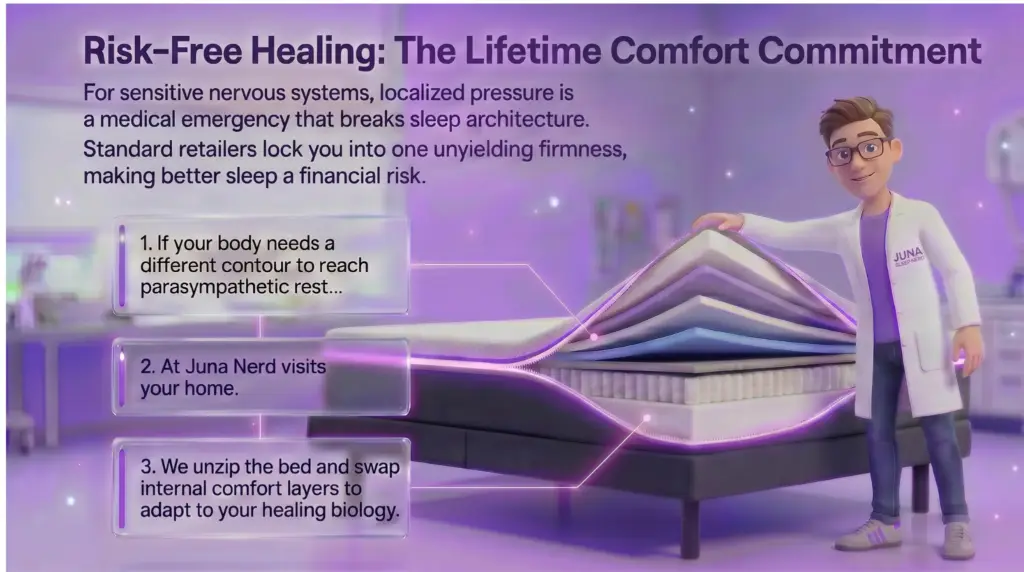
Standard mattress retailers sell you a bed and immediately lock you into a single, unyielding firmness setting. If you realize after two months that the surface is too rigid and is exacerbating your fight or flight sleep patterns, you are typically out of luck or forced to go through an expensive return process.
At Juna Sleep, our foundational motto is that better sleep should feel less risky. This is why we created our exclusive Lifetime Comfort Commitment. You are not stuck. If your nervous system is hyper-sensitive and needs a softer, deeper contouring feel to ease into parasympathetic dominance—or conversely, if your spine requires targeted, firmer alignment to prevent muscle tension—you simply call a Juna Mattress Nerd.
We come directly to your home and physically unzip the mattress cover to re-arrange or swap out the internal comfort layers. By refining your comfort over time instead of forcing you to start over from scratch, Juna reduces the risk of buying the wrong mattress, giving your body a true opportunity to wind down and heal.
Isolating the Survival Response with the Juna H-Bed
When a person is struggling with chronic insomnia, they become highly sensitive to environmental stimuli, especially partner movement. If your partner rolls over, shifts position, or gets up in the middle of the night, the resulting motion waves travel through a traditional mattress. For a relaxed sleeper, this might cause a brief stir. But for someone with an overactive sympathetic nervous system, that sudden movement acts as an immediate alarm, spiking adrenaline and making it impossible to drift back into deep rest.
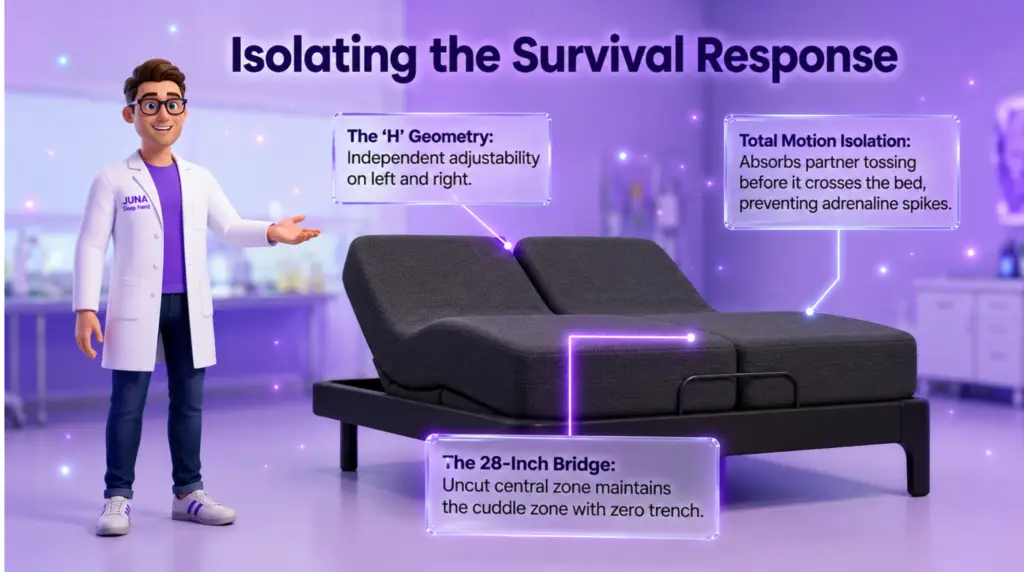
The Juna H-Bed is specifically designed to eliminate partner disturbance while preserving closeness for couples. It is a single, unified King-sized mattress, NOT two individual mattresses pushed together. It utilizes a brilliant “H” geometry: a deep vertical slit at the center-head and a deep vertical slit at the center-foot, while the middle 28 inches remains a completely uncut, solid-foam bridge.
This design allows independent adjustability and total motion isolation on each side. If one partner is tossing or adjusting their side of the bed, the motion is absorbed and isolated before it can cross to the other side. The central 28-inch bridge prevents a hard gap or trench in the middle of the mattress, maintaining the cuddle zone while providing the hyperaroused sleeper with a completely peaceful, undisturbed sleep surface.
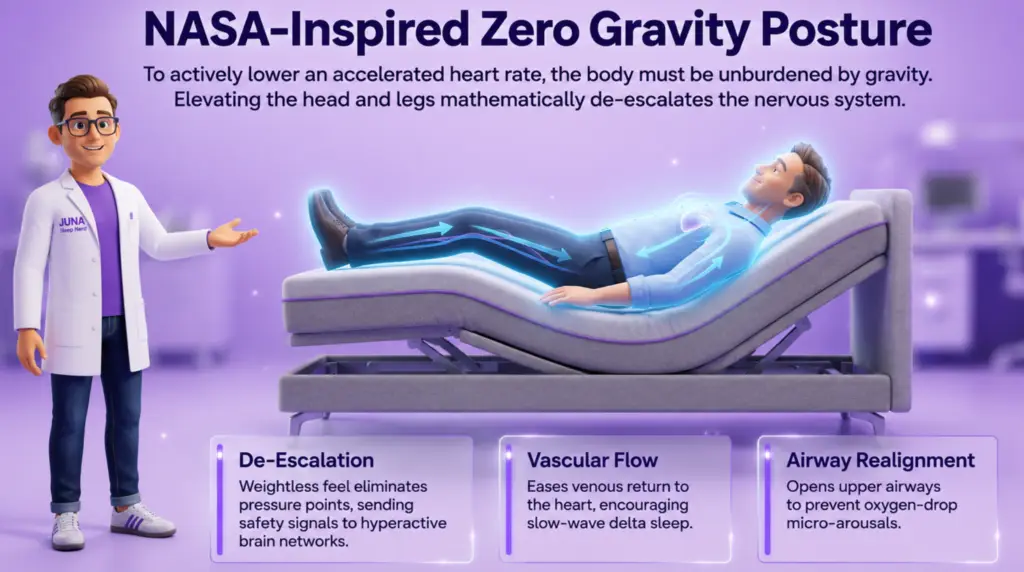
NASA-Inspired Zero Gravity Posture Engineering
To actively lower an accelerated heart rate and reduce physical tension, your body posture must be completely unburdened by gravity. This is why we recommend pairing your Juna mattress with an Advanced Adjustable Base. By engaging the preset “Zero Gravity” position, your upper body and legs are slightly elevated above the level of your heart, placing your body in a weightless, neutral posture originally developed by NASA.
De-Escalating the Nervous System: This floating, weightless feel eliminates pressure points on your lower back and joints, sending immediate safety signals to the brain’s hyperactive networks.
Optimal Vascular Circulation: Elevating your limbs eases venous blood return to the heart, helping lower a racing pulse and encouraging a smooth transition into slow-wave delta sleep.
Airway Posture Realignment: Gently elevating the head opens the upper airways. This reduces airway resistance and snoring, keeping your blood oxygen stable and preventing the micro-arousals that trigger midnight stress hormones.
For residents living in the Des Moines metro area, including communities like Altoona, Johnston, or Urbandale, visiting our Rapid City showroom to test a Juna bed paired with an adjustable base is the first step toward physically down-regulating a stressed-out nervous system.
The Factory-Direct Paradigm: Premium Densities for Real Rest
How is Juna able to manufacture mattresses using ultra-premium 2.5-5 lb density foam, while the mass market relies on cheap 1.2-1.8 lb commodity alternatives? It comes down to our factory-direct advantage. The traditional mattress industry relies on an outdated middleman model. A mattress goes from a manufacturer to a distributor, to a third-party brand, and finally to a retail store, with each layer adding heavy markups to the final consumer price. To maintain profit margins, those brands are forced to slash the material quality in the bed.
At Juna, we believe that more of the purchase price should go into the actual materials, not the middlemen. We build our mattresses closer to our customers and sell them directly through our own regional showrooms. This allows us to use superior, long-lasting high-density layers designed to resist sagging and softening over decades of real-world use.
Furthermore, our revolutionary Infinity Edge support system combines a 6-inch high-resiliency core with 2-inch ultra-firm side rails and a 2.5-inch butterfly quad coil unit. This creates a stable, fully usable sleep surface all the way to the absolute edge. If your room is tight or you sleep near the perimeter, you never experience that insecure “roll-off” feeling that can trigger an unexpected fight-or-flight startle response. You get consistent, predictable orthotic support from edge to edge.
Conclusion: Take the Threat Out of Your Bed
Chronic insomnia is a challenging physiological condition driven by genuine insomnia biology, an overactive sympathetic nervous system, and disruptive nighttime cortisol spikes. It is not a mindset failure, and your body is not failing on purpose—it is simply trapped in an outdated evolutionary survival loop.
To break this cycle, you must remove the physical triggers that your brain interprets as threats. By choosing a custom-tailored Juna Sleep System, you provide your body with the ultra-premium materials, adaptive comfort, and perfect motion isolation required to silence the internal alarms. Stop fighting your survival biology and let a Juna mattress help you transition back into a natural state of rest.
Frequently Asked Questions (FAQ)
- What is the biological relationship between insomnia and fight-or-flight?
Chronic insomnia is driven by a physiological state of hyperarousal within your insomnia biology. When your sympathetic nervous system remains overactive at night, it triggers a survival response that floods your system with adrenaline and cortisol. This overrides your homeostatic sleep drive, forcing your brain to stay awake to scan the environment for perceived dangers.
- Why do nighttime cortisol spikes leave me feeling wired and racing?
Cortisol is a powerful stress and alertness hormone. While it should drop to its lowest point around midnight to allow melatonin production, an overactive HPA axis causes abnormal nighttime cortisol spikes. This surge raises blood glucose, elevates core body temperature, and alerts the brain’s emotional center, making you feel completely wide awake even when physically exhausted.
- How does the Juna H-Bed help reduce nighttime hyperarousal for couples?
The Juna H-Bed provides complete motion isolation using a unique “H” geometry featuring independent head and foot articulation separated by a solid 28-inch central foam bridge. This allows a hyper-sensitive sleeper to rest completely undisturbed by their partner’s tossing, turning, or schedule shifts, eliminating the sudden physical startle responses that cause adrenaline spikes.
- What does “non-prorated” mean regarding Juna’s 12-year and 18-year warranties?
A non-prorated warranty means your protective coverage value does not decrease or depreciate as the mattress ages. Whether a covered structural defect in workmanship or materials occurs in year three or year fifteen, Juna provides the exact same full repair or replacement protection without charging you a fee based on the mattress’s age.
- Can a Juna Mattress Nerd actually adjust the firmness of my bed after purchase?
Yes! Through our unique Lifetime Comfort Commitment, our Juna Mattress Nerds can come directly to your home to unzip the mattress cover and adjust the internal foam layers. We can make the mattress firmer, softer, or enhance the built-in lumbar support to continuously adapt to your body’s changing physiological and neurological needs over time.
- How does the Infinity Edge support system protect my sleep quality?
Traditional beds use cheap foam edge rails that collapse when you get near the perimeter, causing an unsettling rolling-off sensation that can startle a sensitive nervous system awake. Juna’s Infinity Edge integrates a 6-inch support core, firm side rails, and butterfly quad coils to provide a completely stable, supportive, and usable sleep surface across the entire mattress.
- Where are the factory-direct Juna Sleep Systems showrooms located?
You can work directly with a knowledgeable Mattress Nerd and experience our premium materials in person at three factory-direct regional showrooms: Juna Sleep Systems in Sioux Falls, South Dakota and Juna Sleep Systems in Rapid City, South Dakota.
Visit a Juna Showroom Near You
Are you ready to silence your body’s survival loop and experience true parasympathetic rest? Visit one of our three regional factory-direct showrooms to speak face-to-face with an expert Juna Mattress Nerd and try a sleep system custom-tailored to your life.
Juna Sleep Systems – Sioux Falls, SD: Easily accessible for families driving in from Brandon, Harrisburg, or Tea.
Juna Sleep Systems – Rapid City, SD: Conveniently located for West River communities, including Box Elder, Summerset, and Sturgis.
Stop by a showroom today or explore our full collection online to take your first real step toward conquering hyperarousal and reclaiming your
Learn more about https://junasleep.com/drift-into-dreamland-faster-with-juna-sleep-systems-your-ultimate-comfort-mattress-guide/
