
The Quick Answer
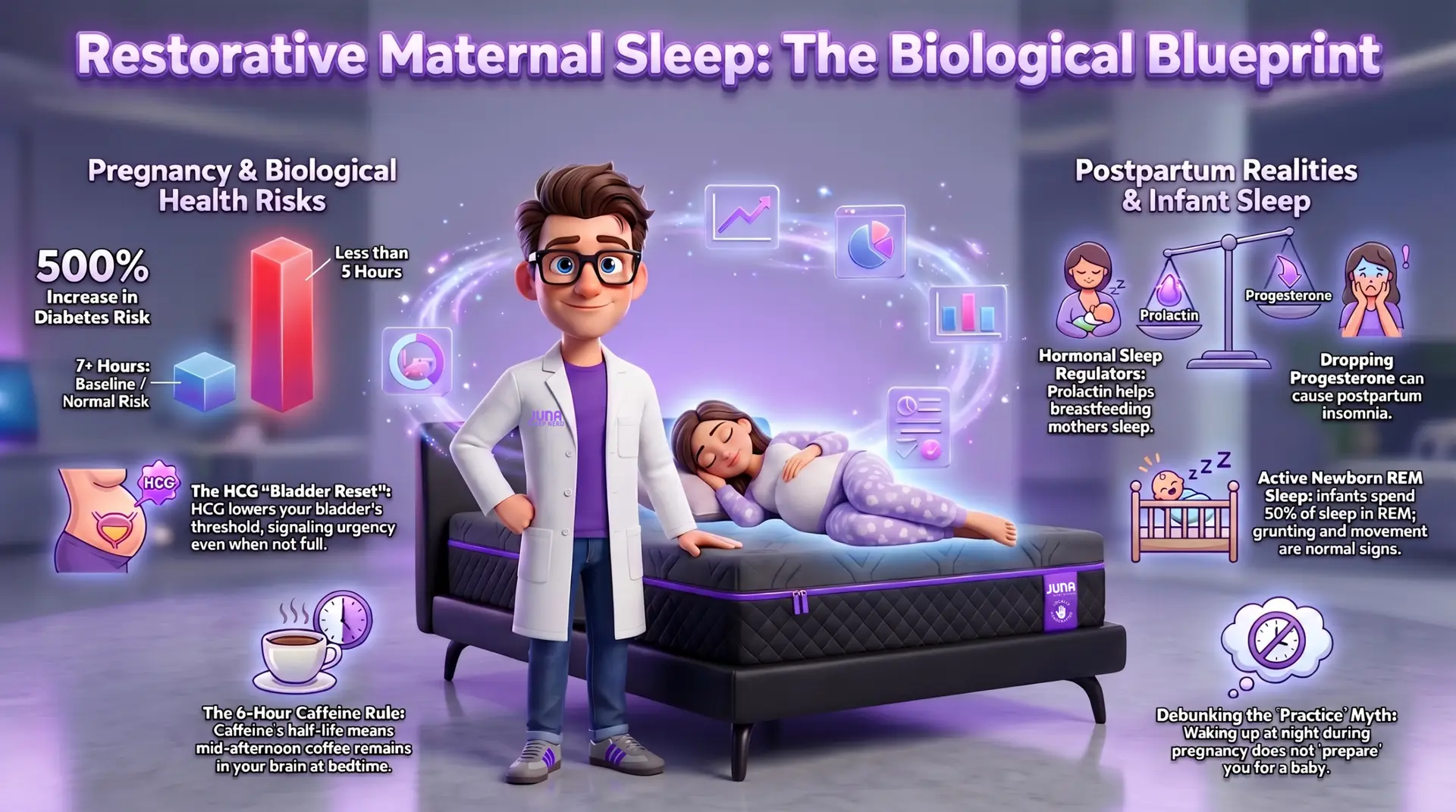
Pregnancy sleep disruption is primarily caused by physical discomfort, frequent urination triggered by the hormone HCG, and metabolic shifts. Despite popular belief, frequent nighttime awakenings during pregnancy do not biologically prepare a mother for postnatal sleep deprivation—this is a debunked myth with no scientific support.
Introduction
If you are currently expecting, you have likely realized that sleep is no longer a given; it is a hard-won battle. Pregnancy sleep disruption is an almost universal experience, yet it remains one of the most misunderstood aspects of the maternal journey. Many women are told that their tossing and turning is just “practice” for when the baby arrives, but as a Juna Sleep Nerd, I am here to tell you that biology does not work that way. Your body is undergoing a massive physiological transformation, and the resulting sleep loss has real consequences for your mood, your health, and your recovery.

Whether you are navigating the first trimester or the final weeks, understanding the “why” behind your restlessness is the first step toward reclaiming your rest. From the surge of HCG affecting your bladder to the vital role of prolactin in the middle of the night, we are diving deep into the science of maternal sleep.
The Three Pillars of Pregnancy Sleep Disruption
Sleep disturbances are common both during pregnancy and the postnatal period. While every woman’s journey is unique, the research highlights three primary drivers of sleep fragmentation:
- Physical Discomfort: As the body changes form, finding a supportive position becomes increasingly difficult.
- Hormonal Volatility: Significant shifts in hormones such as progesterone and estrogen directly alter sleep architecture.
- Frequent Urination: This is often the most persistent disruptor, occurring throughout all three trimesters.
For families, these physical changes often mean it’s time to re-evaluate your sleep surface. A mattress that felt fine a year ago may now be the primary source of your back pain during the second trimester.
Prenatal Sleep Health and Risk of Offspring Neurodevelopmental Issues.
Comparison: Pregnancy Sleep Factors
| Feature | Impact on Sleep | Biological Driver |
| Urination Frequency | High Fragmentation | HCG hormone and blood volume |
| Physical Form | Difficulty with Onset | Growing fetus and skeletal pressure |
| Core Temperature | Restlessness | Progesterone surge (up to 0.5°C increase) |
| Postpartum Mood | Insomnia Risk | Progesterone crash and 2x depression risk |
Many pregnant women assume frequent nighttime trips to the bathroom are caused solely by the mechanical pressure of the baby on the bladder. While the fetus does eventually act like a “balloon expanding in a confined space,” pressing against bladder capacity, there are actually four or five other reasons for this disruption.
The Thermostat Analogy

One of the most fascinating drivers is Human Chorionic Gonadotropin (HCG). This is the hormone detected by home pregnancy tests around week six. HCG acts like a “recalibration of the bladder activity”.
Think of it like adjusting the thermostat in your home. If you lower the threshold, the heat turns on more frequently. HCG resets the “thermostatic threshold” of your bladder, leading to more frequent urges to urinate, especially at night.
Blood Volume and Waste
Additionally, a pregnant woman’s blood volume increases significantly, thereby enhancing kidney function and directing more fluid toward the bladder. Furthermore, you are now excreting waste for two organisms—yourself and the growing fetus—leading to an upscaled production of urine.
If you are a resident of Des Moines, Ames, or Altoona, IA, you know that winter nights are long, but they feel even longer when you are getting out of bed every 90 minutes. Managing your fluid intake in the evening is a standard recommendation, but understanding that this is a hormonal shift can help reduce the frustration associated with these awakenings.
There is a popular notion that the frequent awakenings of pregnancy serve a purpose: “sleep training” the mother for the postnatal sleep deprivation to come. This theory has been largely debunked.
In the world of sleep science, we rarely—if ever—find evidence of biology deliberately sabotaging sleep to provide a future benefit. Sleep is a non-negotiable life-support system. There are only two extreme circumstances in biology where the brain deliberately restricts its own sleep:
- Starvation: The brain limits sleep to allow for more foraging time in a larger perimeter to avoid death.
- Protection of Young: In species like killer whales, mothers and calves endure extended periods of total sleep deprivation while trekking back to the safety of the pod to avoid predation.
Aside from these life-or-death scenarios, biology prioritizes sleep. The idea that your body is “practicing” for exhaustion is a myth that can lead to unnecessary stress.
Check out our Mattress Size Guide
When pregnancy sleep disruption becomes severe, it moves from an inconvenience to a clinical concern.
Mood and Depression
Sleep disturbances are directly linked to irritability and higher rates of depression during pregnancy. Pioneering research from the mid-2000s found that 73% of pregnant women with sleep problems also suffered from depression, compared to a significantly lower rate in those who slept well. This is likely a causal link, as sleep deprivation triggers the brain’s emotional centers.
Birth Interventions and Labor
While the evidence is correlational, severe sleep disruption is associated with an increased risk of prolonged labor and the need for cesarean deliveries. Women with the most severe disturbances were found to be twice as likely to require a C-section.
Pregnancy & Rheum
The 5-Hour Threshold for Gestational Diabetes
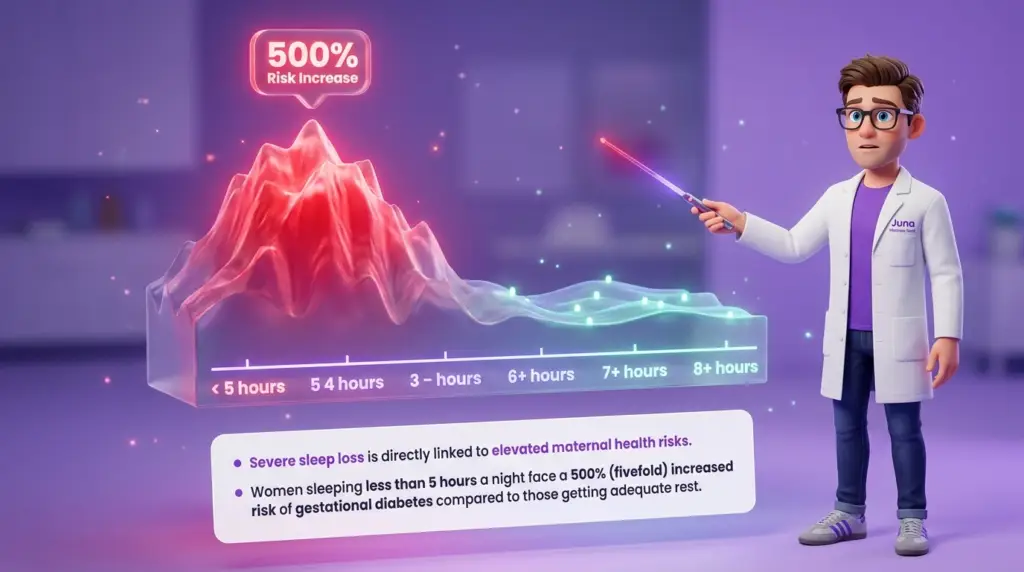
Perhaps the most striking finding involves blood sugar regulation. Studies indicate that pregnant women sleeping less than 5 hours a night have a fivefold (500%) increased risk of developing gestational diabetes compared to those sleeping more than 5 hours.
For expectant mothers, prioritizing those five hours is a critical health directive.
The postnatal period brings its own set of challenges, often starting with the fact that a baby’s circadian rhythm is not “glued into the neural architecture” of the brain until around six months of age.
The Progesterone Crash
During pregnancy, progesterone acts as a natural sedative. Postpartum, these levels crash. This sudden decrease in a sleep-promoting hormone is a major contributor to the sleep disturbances mothers face after birth.
Prolactin: The Nighttime Bonus
However, biology offers a “feedback bonus” in the form of prolactin. Prolactin is essential for milk production and reaches its highest levels at night and in the early morning.
Crucially, prolactin also has a sleep-promoting benefit. When the baby wakes to feed at 3:00 AM, breastfeeding stimulates increased prolactin production, which helps the mother fall back asleep more quickly despite frequent awakenings. It is an intricate dance of hormonal changes designed to help the mother survive the demands of the next generation.
Choosing a mattress while navigating pregnancy sleep disruption is a unique challenge because your body’s needs are changing literally by the week. At Juna Sleep Systems, we believe that better sleep should feel less risky, especially during such a transformational time. You should not be stuck with a mattress that no longer fits your needs just because it felt good in a showroom months ago.
The Juna H-Bed and Adjustable Bases
For couples, the Juna H-Bed is a revolutionary solution. Unlike traditional split-king setups that leave a frustrating “trench” in the middle, the H-Bed is a unified King-sized unit with a solid-foam “cuddle zone” bridge. This allows independent movement on each side—essential when one partner is dealing with postpartum insomnia or the need to sit upright for acid reflux.
Pairing the H-Bed with one of our adjustable bases offers features like Zero Gravity and Anti-Snore presets. Elevating the head side of your bed by just three to five degrees can be a game-changer for those suffering from pregnancy-induced acid reflux.
The Ultimate Factory Direct Mattress Authority Guide
The Critical Importance of Sleep Position in the Third Trimester
While most of this guide focuses on the reasons for pregnancy sleep disruption, we must address the most consequential finding regarding sleep position.
Research involving over 3,100 participants across multiple continents has found that women who go to sleep on their backs in the third trimester are more than two and a half times as likely to experience a late stillbirth compared to those who sleep on their side. This is not a controversial finding; it has been replicated in five independent studies.
The Mechanism of Back Sleeping
The reason for this risk is straightforward: in late pregnancy, the uterus is heavy enough to press on the large vein that returns blood from the lower body to the heart. It acts like a “slow kink in a fuel line” for hours while the mother sleeps.
Side Sleeping: Left or Right?
Public health campaigns, such as “Sleep on Side,” emphasize that either the left or right side is acceptable, as the risk is essentially identical regardless of which side is chosen. To help maintain this position, many women find that placing a pillow behind their backs or between their legs can provide the support needed to stay off their backs throughout the night.
Improving the quality of your sleep during pregnancy requires a multi-pronged approach. Here are expert-informed protocols to help manage pregnancy sleep disruption:
- The Warm Bath Effect: Taking a warm bath (roughly 40–41°C or 105°F) about 90 minutes before bed can help you fall asleep up to 30% faster. As you exit the bath, your blood vessels dilate, causing your core body temperature to plummet, which is a key biological signal to fall asleep.
- Light and Darkness: We are a “dark-deprived society”. In the last hour before bed, dim at least 50% of the lights in your home to trigger the natural release of melatonin.
- Temperature Control: Your bedroom should feel like a cave—cool, dark, and quiet. Aim for an ambient temperature between 65 and 68°F (18–18.5°C).
- Regularity is King: Try to keep your wake-up and bedtime within a 30-minute window every day, even on weekends. This anchors your circadian rhythm and improves both the quantity and quality of sleep.
- Caffeine Awareness: Remember that caffeine has a half-life of 6 hours. If you have a coffee at 2:00 PM, a quarter of that caffeine is still in your brain at 10:00 PM.
Q: Does waking up at night prepare me for having a baby? A: No. This is a debunked myth. Sleep is a non-negotiable biological necessity, and there is no scientific evidence that “practicing” sleep deprivation provides any benefit.
Q: Why does the hormone HCG cause more bathroom trips? A: HCG recalibrates bladder activity by lowering the “thermostatic threshold,” meaning your bladder signals the need to urinate more frequently, even when it isn’t full.
Q: Is it normal to have insomnia after the baby is born? A: Yes. Postpartum insomnia is often triggered by the baby’s erratic schedule and the sharp drop in progesterone, which has sedative properties.
Q: How does breastfeeding help me sleep? A: Breastfeeding stimulates the production of prolactin, which peaks at night. Prolactin has sleep-promoting effects that can help a mother fall back asleep more quickly after a nighttime feeding.
Q: Can pregnancy sleep disruption lead to gestational diabetes? A: Severe sleep loss is linked to an elevated risk. Women sleeping less than 5 hours a night have been found to have a fivefold (500%) increased risk relative to those sleeping more.
Q: Should I worry about my baby’s grunting during sleep? A: Generally, no. Newborns spend about 50% of their sleep in REM (active sleep). Because they have incomplete muscle paralysis, they often grunt, pause, or move during this stage.
Q: Is it safe to Sleep Train my baby? A: While controversial, clinical research suggests that techniques like Extinction are safe for infants older than 4 months. Studies found no changes in attachment or cortisol levels five years later.
Reclaim Your Night Today
Pregnancy sleep disruption is a heavy burden, but you don’t have to carry it alone. By understanding the hormonal drivers behind your restlessness and optimizing your sleep environment, you can protect your mood, your health, and your journey into motherhood.
Don’t let a poorly fitted mattress add to the challenge. Visit a Juna Sleep Systems showroom in Sioux Falls, Rapid City to experience the difference a truly adjustable, handcrafted mattress can make. Your future self—and your baby—will thank you.
- Juna Sleep Systems – Sioux Falls, South Dakota: Proudly serving Brandon, SD, Sioux City, IA, and Watertown, SD.
- Juna Sleep Systems – Rapid City, South Dakota: Dedicated to the sleep health of Box Elder, SD, Spearfish, SD, and Wall, SD.
