
The Quick Answer
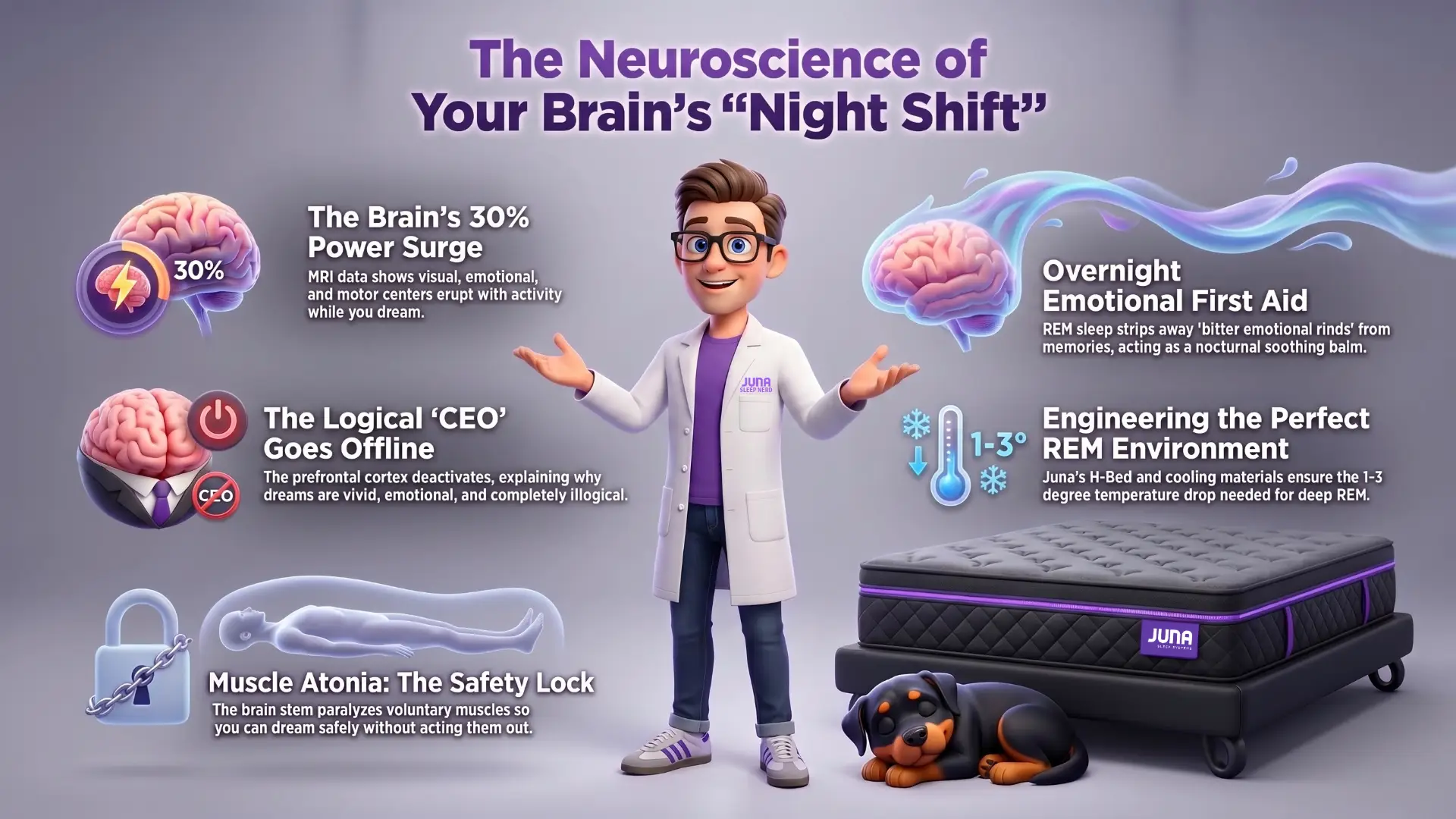
The neuroscience of REM sleep reveals that dreaming is an incredibly active cerebral state where the brain becomes up to 30% more active than during wakefulness. MRI data show heightened activity in visual, emotional, and motor centers, while the logical prefrontal cortex deactivates, which helps explain why dreams are vivid yet illogical.

Introduction: Why Your Brain Goes “Psychotic” Every Night
If you have ever woken up from a vivid dream—one where you were flying over your childhood home or talking to a long-lost relative—only to realize the plot made absolutely no sense, you have experienced the paradox of the dreaming mind. From a clinical perspective, every human being who enters rapid eye movement sleep becomes “flagrantly psychotic” for a portion of the night.
According to the latest neuroscience of REM sleep, you experience five specific symptoms of psychosis while dreaming: you hallucinate (seeing things not there), you are delusional (believing impossible things), you are disoriented (confused about time and place), you are affectively labile (wildly fluctuating emotions), and you suffer from amnesia (forgetting the experience upon waking).
Understanding what is happening inside your skull during these periods is not just a matter of curiosity; it is essential for optimizing your mental health, learning, and physical recovery. At Juna Sleep Systems, we believe that a mattress should be an investment in this biological “night shift,” ensuring your brain has the perfect environment to perform its most complex work.
The Biology of REM Sleep
The Architecture of the Night: Understanding Sleep Cycles
Sleep is not a single, monolithic state of unconsciousness. Instead, your brain goes on a “remarkable roller coaster ride” through different stages. These stages are broadly categorized into non-rapid eye movement (non-REM) and rapid eye movement sleep (REM).
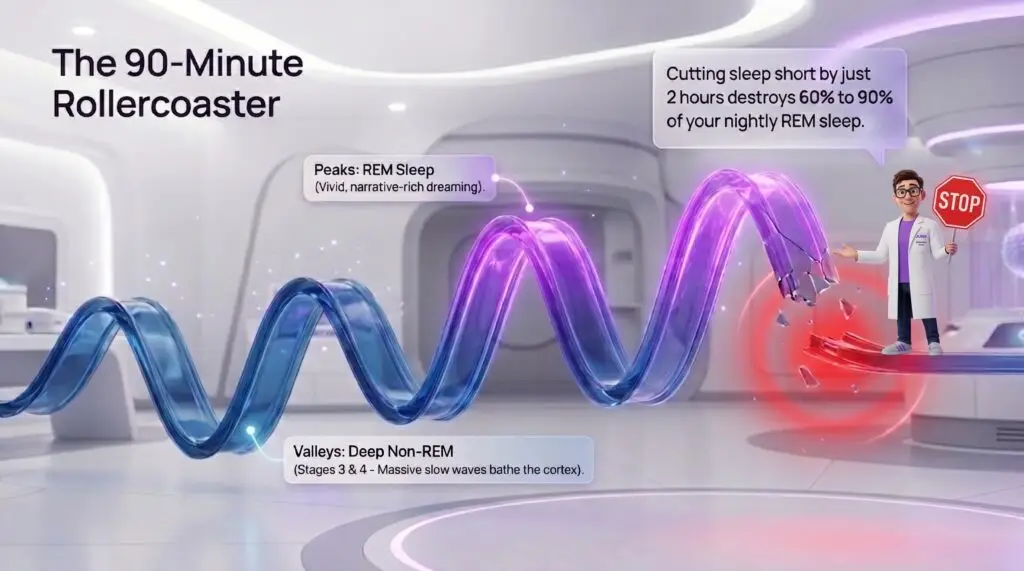
For the average adult, these two types of sleep play out in a “cerebral war” for brain dominance, with the outcome won and lost every 90 minutes. In the first half of the night, your 90-minute cycles are dominated by deep non-REM sleep. However, as you push into the second half of the night, the “seesaw balance” shifts, and you spend significantly more time in REM sleep.
The 90-Minute Rhythm
- Stage 1 & 2: Light non-REM sleep.
- Stage 3 & 4: Deep non-REM sleep, characterized by massive, slow waves that “bathe” the cortex.
- REM Sleep: The stage of vivid, narrative-rich dreaming.
The Science & Practice of Perfecting Your Sleep
MRI Data: A 3D Visualization of the Dreaming Brain
Before the advent of advanced MRI brain scans in the early 2000s, scientists had to rely on subjective reports. Today, we can see exactly which “neighborhoods” of the brain light up during REM sleep.
When you transition from deep sleep into REM, numerous brain regions erupt with massive spikes of activity. The neuroscience of REM sleep identifies four primary areas that fire up:
- Visual-Spatial Regions: Located at the back of the brain, these enable complex visual perception even though your eyes are closed.
- The Motor Cortex: This area normally initiates movement when you are awake. During REM, it is “blazing” while rehearsing movement patterns.
- The Hippocampus: This memory-related structure enables autobiographical memory, allowing your dreams to be filled with your personal history.
- Deep Emotional Centers (Amygdala & Cingulate Cortex): These regions are up to 30% more active during REM than when you are awake.
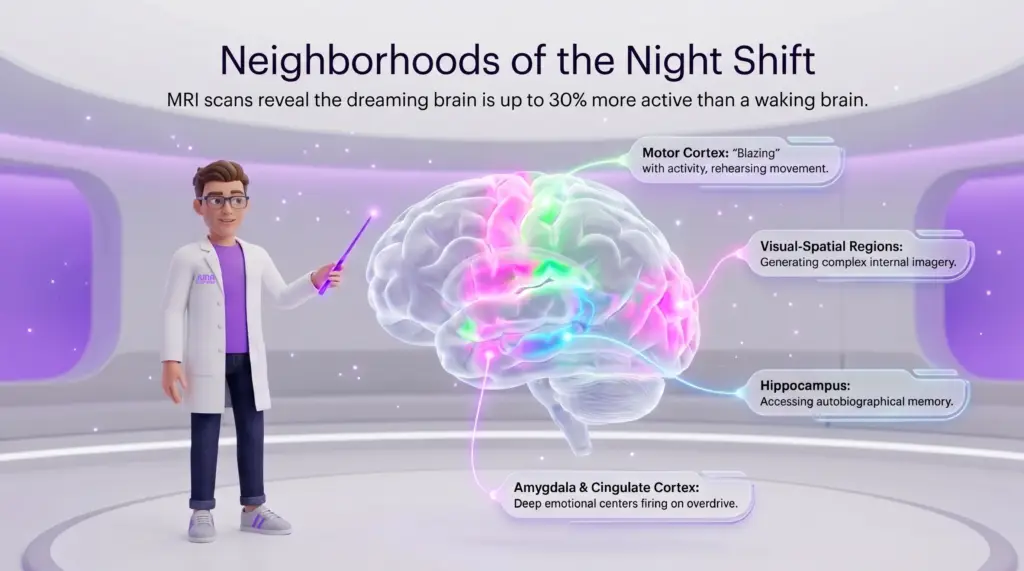
MRI scans indicate that the dreaming brain can be up to 30% more active than when awake, specifically in regions governing movement, imagery, memory, and emotion.
Comparison of Brain States: Waking vs. REM Sleep
| Feature | Waking State | REM Sleep State |
| Brain Activity | Chaotic/Frenetic | Highly Active (up to 30% more) |
| Visual Cortex | Processes the external world | Generates internal imagery |
| Amygdala | Regulated by logic | Hyper-responsive |
| Prefrontal Cortex | Active (The “CEO”) | Utterly Deactivated |
| Muscle Tone | Present | Absent (Atonia) |
The CEO is Offline: Why Dreams Are Illogical
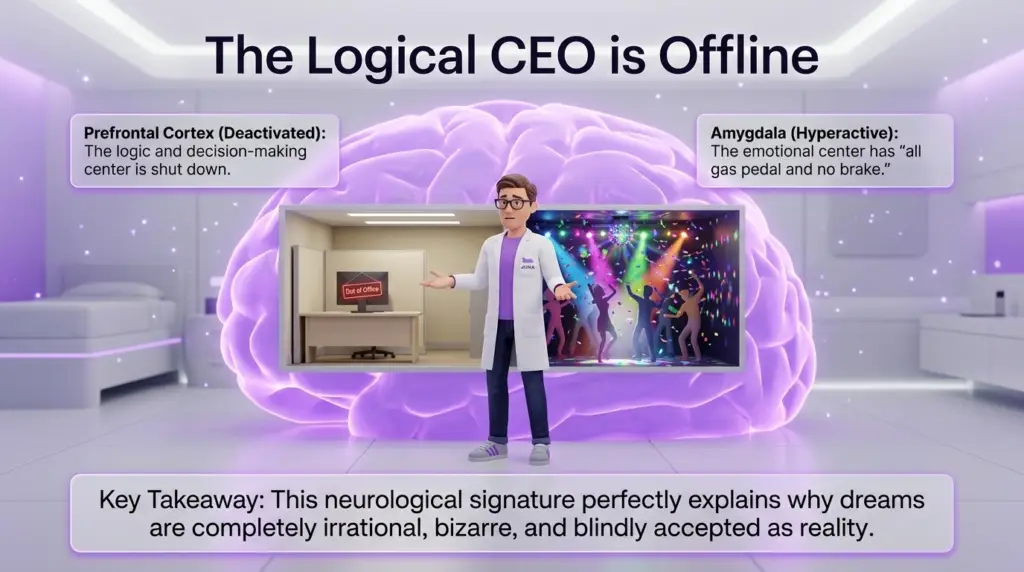
Perhaps the most “stunning surprise” from MRI data is the deactivation of the lateral prefrontal cortex.
In a waking brain, the prefrontal cortex acts as the “CEO.” it is responsible for structuring rational thoughts, making logical decisions, and controlling emotional reactions. However, when you enter the dreaming state, this region is taken offline.
This neurological signature explains precisely why REM sleep dreams are:
- Bizarre: There is no logic center to tell you that a flying elephant is impossible.
- Illogical: Time and space can warp instantly.
- Irrational: You accept the most “utterly bizarre” scenarios as ground truth.
Without the regulatory control of the prefrontal cortex, the emotional centers (the amygdala) have “all gas pedal and no brake”.
Muscle Atonia: The Body’s Physical Incarceration
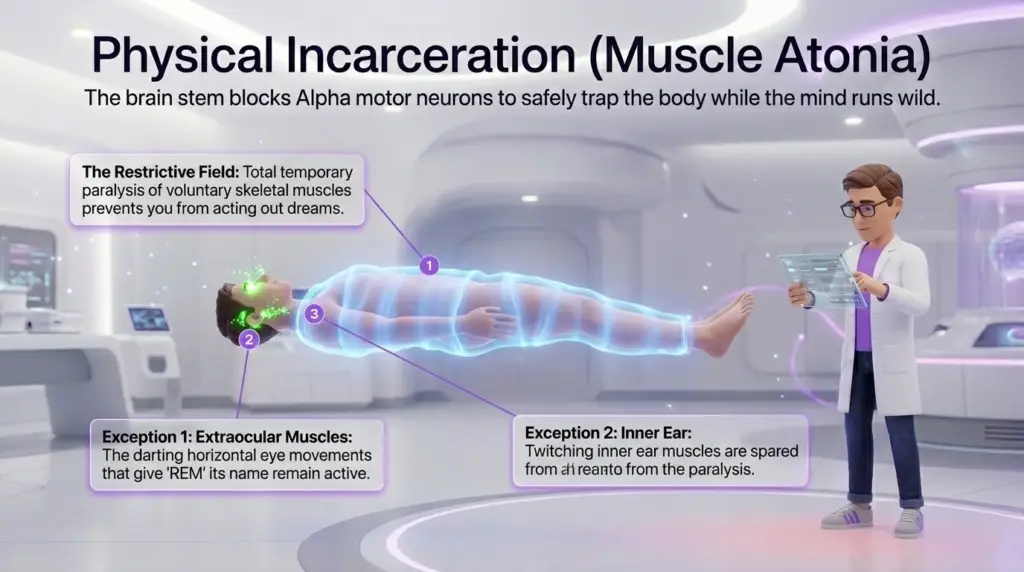
Because your brain is so active—rehearsing motor patterns and experiencing intense emotions—your body must be protected from acting these dreams out. The brain stem sends a powerful signal down the spinal cord to the Alpha motor neurons, resulting in “muscle atonia”.
This state is a form of temporary paralysis of your voluntary skeletal muscles. It is an “elegant neurobiological solution” that ensures the mind can dream safely while the body remains immobilized.
Exceptions to the Rule:
There are two sets of voluntary muscles that are spared from this paralysis:
- Extraocular Muscles: These allow for the “darting horizontal movements” that give REM sleep its name.
- Inner Ear Muscles: These also continue to twitch during the dream state.

Juna is a dynamic sleep system engineered to protect the neuroscience of sleep by providing more than just a single feel.
The Juna mattress colection!
The Functions of REM: Emotional First Aid and Creativity
Why did evolution preserve such a dangerous and “idiotic” state where we are vulnerable to predation? The neuroscience of REM sleep suggests it serves vital functions for both the brain and the body.
1. Emotional First Aid (Overnight Therapy)
REM sleep acts as a “nocturnal soothing balm”. It helps us process difficult or traumatic experiences by “stripping away the bitter emotional rind from the informational orange”. This allows you to remember the fact of an event without the “visceral emotional reaction” that accompanied it.
2. Information Alchemy and Creativity
While deep sleep helps cement individual memories, REM sleep “Crosslinks” them. It builds associations between non-obvious, distant ideas—a process described as “informational alchemy”. This is why people “sleep on a problem” to find creative solutions.
3. Physical Restoration
Beyond the brain, REM sleep is essential for:
- Testosterone & Growth Hormone: Peak levels are released during this stage, aiding in muscle repair and bone density.
- Cardiovascular Health: Heart rate variability increases during REM, giving the heart a “nightly workout”.
- Immune Strength: REM sleep stimulates the “restocking of the weaponry in your immune arsenal”.
The Juna Advantage: Engineering the Perfect REM Environment
If better sleep feels like a risk, it’s because most mattresses lock you into a single feel. At Juna, we have spent years engineering systems that protect the neuroscience of REM sleep.
Lifetime Comfort Commitment
Your body and sleep needs change over time. Our Lifetime Comfort Commitment means you are never stuck with a mattress that no longer fits. If your mattress needs to be firmer or softer, or to provide more lumbar support, a Juna Mattress Nerd will come to your home to adjust the internal layers. This ensures your mattress adapts with you, reducing the risk of “mattress regret.”
Learn about how Juna services you long after the purchase.
Cooling for Deep REM
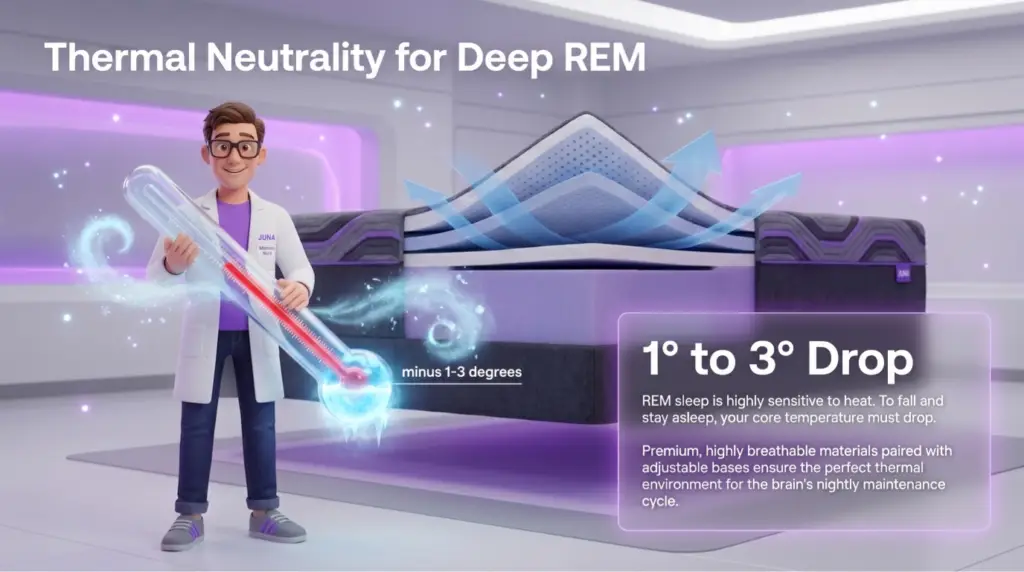
The research is clear: to fall and stay asleep, your body temperature needs to drop by about 1 to 3 degrees. REM sleep is particularly sensitive to temperature. Juna mattresses use premium, breathable materials and can be paired with adjustable bases to help you reach that “Goldilocks” thermal neutrality required for the “nightly maintenance cycle” of the brain.
The neuroscience of REM sleep has undergone a revolution in the last two decades, moving from abstract theories to high-resolution visualizations of the dreaming mind. At Juna Sleep Systems, we believe that understanding this “nocturnal theater” is the key to appreciating why your mattress choice is a fundamental decision for your long-term health.
The Role of the Hippocampus
The hippocampus, your brain’s “USB stick” for new memories, is central to this process. During REM, the hippocampus fires in the same sequences it did during the day, but at a vastly accelerated rate—sometimes 10 to 20 times faster. This “neural replay” is how your brain decides which information to keep and which to discard.
REM Sleep: The “Overnight Therapy” Session
Beyond memory, the neuroscience of REM sleep highlights its role as a form of “emotional first aid”. Every night, your brain enters a unique neurochemical state that exists at no other time: the stress-related chemical norepinephrine is completely shut off in the brain.
This creates a “safe zone” for emotional processing. During REM, you replay difficult or even traumatic memories, but in a neurochemically calm environment. This allows the brain to:
- Strip the Emotion: It “strips away the bitter emotional rind from the informational orange”.
- Recalibrate Mood: MRI data show that after a full night of REM sleep, the amygdala (the brain’s emotional “gas pedal”) is less reactive to negative stimuli the next day.
- Build Equity: You wake up with a “revised mind-wide web of associations,” allowing you to see old problems in a new light.
As the entrepreneur E. Joseph Cosman once said, “The best bridge between despair and hope is a good night of sleep”. If you are not getting sufficient REM sleep—perhaps because your mattress is causing frequent wake-ups—you are effectively skipping your nightly therapy session.
The “CEO” Goes Home: The Logic of Illogical Dreams
Why are dreams so weird? The answer lies in the prefrontal cortex, particularly the lateral portions that handle rational, logical thought. MRI brain scans show that while the brain’s emotional and visual centers are “blazing” with activity, the prefrontal cortex is almost entirely shut down.
This deactivation creates a state of “un-tethering”. Your brain is no longer bound by the rigid, linear rules of waking logic. This allows for:
- Bizarre Associations: Linking a field hockey game in Utah to a conversation about physics—distant, non-obvious connections that lead to “Aha!” moments.
- Creative Problem Solving: Studies show that people are up to 30% more effective at solving puzzles when woken directly from REM sleep than from non-REM sleep.
- Insight Integration: You don’t just learn “facts” (knowledge); you learn “what it all means” (wisdom).
REM and the Body: More Than Just a Brain State
Many people assume that deep non-REM sleep is for the body and REM sleep is for the mind. However, the neuroscience of REM sleep reveals that this stage is “richly necessary” for almost all bodily functions.
1. The Cardiovascular Workout
During REM, your heart rate and breathing become irregular, and your heart rate variability (HRV) increases. This essentially gives your heart a “nightly workout,” and a lack of REM sleep has been linked to a higher risk of cardiac events.
2. Hormonal Regulation
REM sleep is a peak time for the release of testosterone and growth hormone. These are essential for muscle repair, bone density, and maintaining a healthy metabolic rate. If your sleep is fragmented, your growth hormone secretion can drop by up to 50%.
3. Immune Armor
While you dream, your brain signals your immune system to restock its “weaponry”. Selectively depriving someone of REM sleep causes an immediate weakening of the immune response, making them more susceptible to infection the following day.
When REM Goes Wrong: Sleep Disorders and Safety
Understanding the neuroscience of REM sleep also means recognizing when the system fails.
REM Sleep Behavior Disorder (RBD)
Normally, your brain paralyzes your body during REM to keep you safe (muscle atonia). In patients with RBD, this “switch” fails, and they physically act out their dreams—sometimes violently. This is more than a curiosity; it is a clinical warning sign, often preceding neurodegenerative diseases like Parkinson’s by decades.
Nightmares vs. Night Terrors
It’s important to distinguish between nightmares (which occur during REM sleep and are narrative-rich) and night terrors (which occur during deep non-REM sleep and involve a sudden “bolt” of panic with no memory of a dream).
The Juna Advantage: Designing for the Dreaming Brain
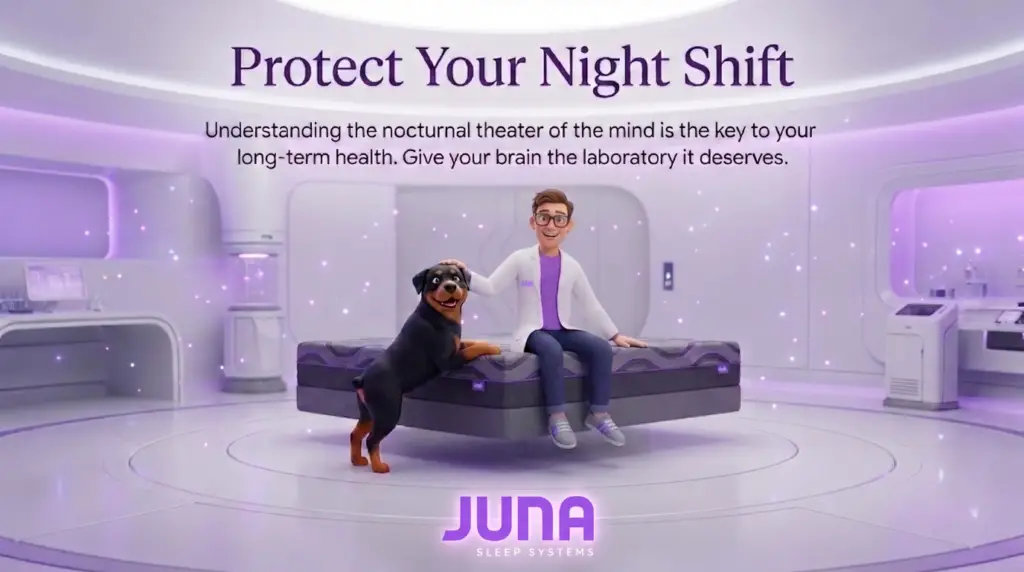
At Juna, we don’t just sell mattresses; we build Sleep Systems designed to protect these delicate neurological states.
Infinity Edge: Use Every Inch of Your Sleep Surface
If you feel like you are “rolling off” the bed, your brain stays in a state of low-level vigilance, which can prevent you from entering deep REM. Our Infinity Edge system uses a 6-inch high-resiliency support core and firm side rails to give you a stable, usable sleep surface right to the very edge. This means more room for your body to relax into the necessary paralysis of REM without fear of falling.
Handcrafted Quality in the Midwest
We are proud to be a factory-direct company. Every Juna mattress is handcrafted using premium materials that are often 10 times more durable than standard retail foams. Because we cut out the middlemen, more of your investment goes directly into the layers that support your emotional processing and physical recovery.
Try It in the Real World
A quick “showroom test” cannot tell you if a mattress will support your REM cycles over the long term. That’s why we offer our Lifetime Comfort Commitment. You are not stuck with a mattress that doesn’t work for you. Whether you need to adjust the firmness or the lumbar support, we are here to support your sleep long after the sale.
Service Areas: Visit a Juna Showroom Near You
If you live in any of the following communities, a better night’s sleep—and more restorative REM cycles—is just a short drive away.
Sioux Falls Location
We serve our neighbors in Brookings, SD, Mitchell, SD, and Yankton, SD. Come visit our Sioux Falls showroom to experience the difference a science-backed mattress can make.
Rapid City Location
For those in Spearfish, SD, Hot Springs, SD, and Wall, SD, our Rapid City team is ready to help you find your “Sleep Sweet Spot.”
Frequently Asked Questions (FAQ)
1. What is the neuroscience of REM sleep?
The neuroscience of REM sleep focuses on how the brain enters a highly active dreaming state while the body remains paralyzed. MRI data shows that during this stage, visual and emotional centers are up to 30% more active than when awake, while the logical prefrontal cortex shuts down.
2. Why are dreams so visual if my eyes are closed?
MRI brain scans reveal that the visual-spatial regions at the back of the brain “light up” during REM. Your brain is generating its own internal imagery rather than processing light from the outside world.
3. How does Juna’s H-Bed help with REM sleep?
The Juna H-Bed is designed for couples with different needs. By allowing independent adjustability on each side without a gap in the middle, it reduces partner disturbance—a leading cause of fragmented sleep that cuts into your REM cycles.
4. Can a bad mattress affect my dreams?
Yes. If a mattress is uncomfortable or lacks proper support, you may experience frequent “micro-awakenings.” Since REM sleep is concentrated in the latter half of the night, even small disruptions can significantly reduce your total “dream time”.
5. Why is the prefrontal cortex deactivation important?
The deactivation of the prefrontal cortex explains the bizarre nature of dreams. Without this logical “CEO” to filter thoughts, your brain is free to make creative, non-linear associations that can lead to better problem-solving during the day.
6. What is “emotional first aid” in sleep?
This is a theory within the neuroscience of REM sleep that suggests dreaming helps process difficult emotions. By replaying experiences in a neurochemically calm state, the brain “mops up” the stress, allowing you to wake up feeling emotionally restored.
7. How long should I sleep to get enough REM?
Most adults need 7 to 9 hours of sleep. Because REM sleep duration increases with each 90-minute cycle, the majority of your dreaming happens in the final few hours of sleep. Cutting your sleep short by just 90 minutes can cost you a massive percentage of your REM sleep.
Invest in Your “Nightly Maintenance Cycle”
The neuroscience of REM sleep proves that sleep is not a luxury; it is a biological necessity as fundamental as food or water. It is the time when your genes perform maintenance, your brain flushes toxins, and your mind heals itself from the day’s stresses.
Don’t leave your recovery to chance. Visit a Juna Sleep Systems showroom today in Sioux Falls or Rapid City and let a Juna Mattress Nerd help you find the system that protects your night and empowers your day.
