
The Quick Answer
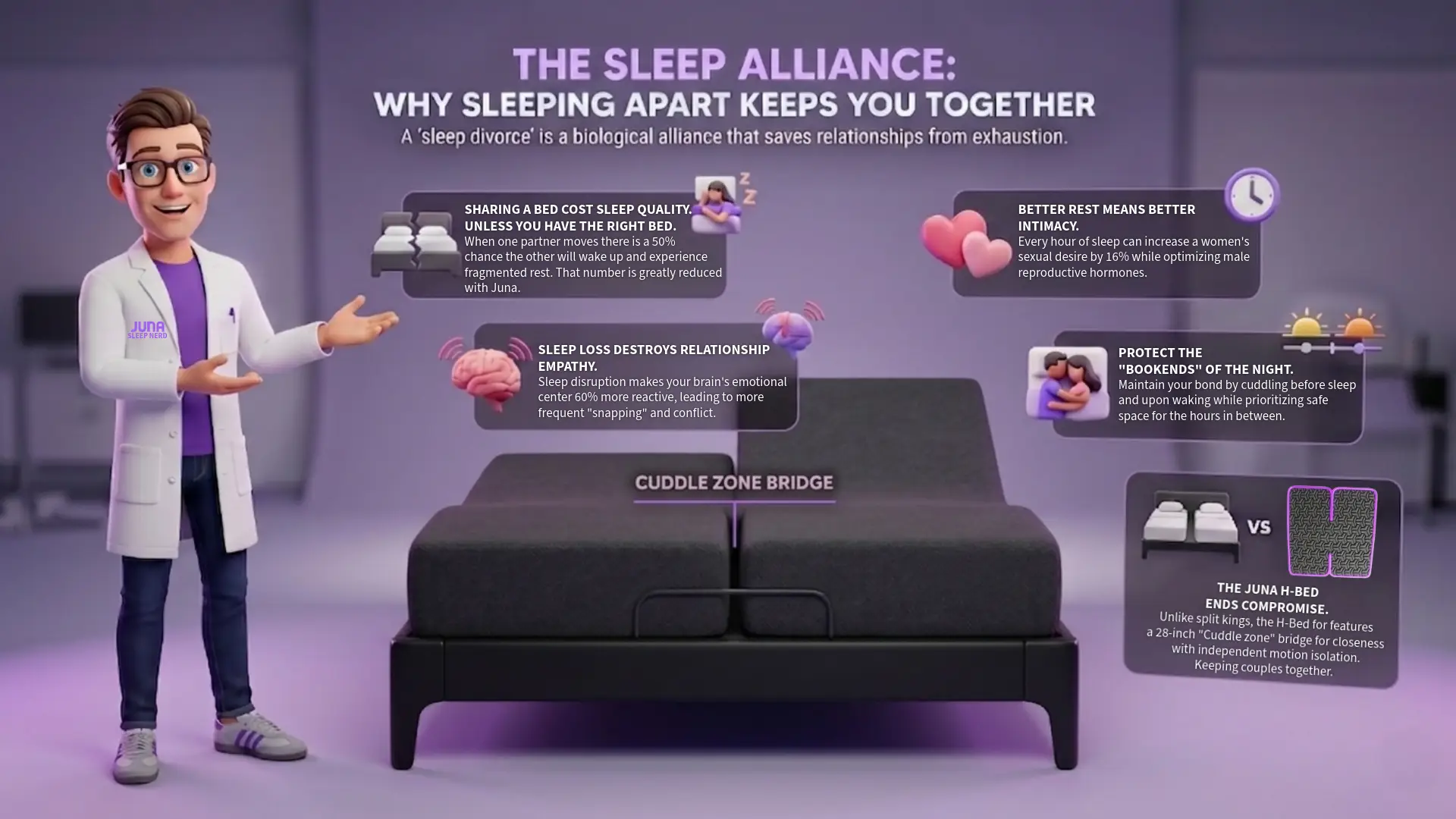
A sleep divorce (or “sleep separation”) involves partners sleeping in different beds or rooms to eliminate sleep disturbance from each other. While society often stigmatizes this arrangement, clinical research indicates that 1 in 4 couples sleep apart to improve sleep quality, relationship harmony, and individual health.

Introduction: Why “Furniture Polyamory” is Trending
For decades, the shared marital bed has been viewed as the ultimate symbol of intimacy and commitment. However, a growing number of couples are opting for a sleep divorce, a term that sounds brutal but often serves as a “sleep alliance” to prevent a real divorce. Whether it is due to snoring, different chronotypes, or restless leg syndrome, partner sleep disturbance is a leading cause of relationship friction.
At Juna Sleep Systems, we believe that choosing between your partner and your health is a false dichotomy. Whether you are navigating a sleep divorce in Sioux Falls, South Dakota, or looking for a compromise in Brandon, SD, Rapid City, or Des Moines, IA, understanding the biological mechanics of co-sleeping is the first step toward a more rested life.
The Stigma and History of Sleeping Separately
The modern expectation that couples must sleep in the same bed is a relatively recent cultural shift. Prior to the Victorian era, sleep was often a communal experience, with entire family units sharing warmth and safety. During the Victorian era, the affluent actually began sleeping separately as a sign of prestige and hygiene, fearing that infectious illnesses could spread through “morning breath”.
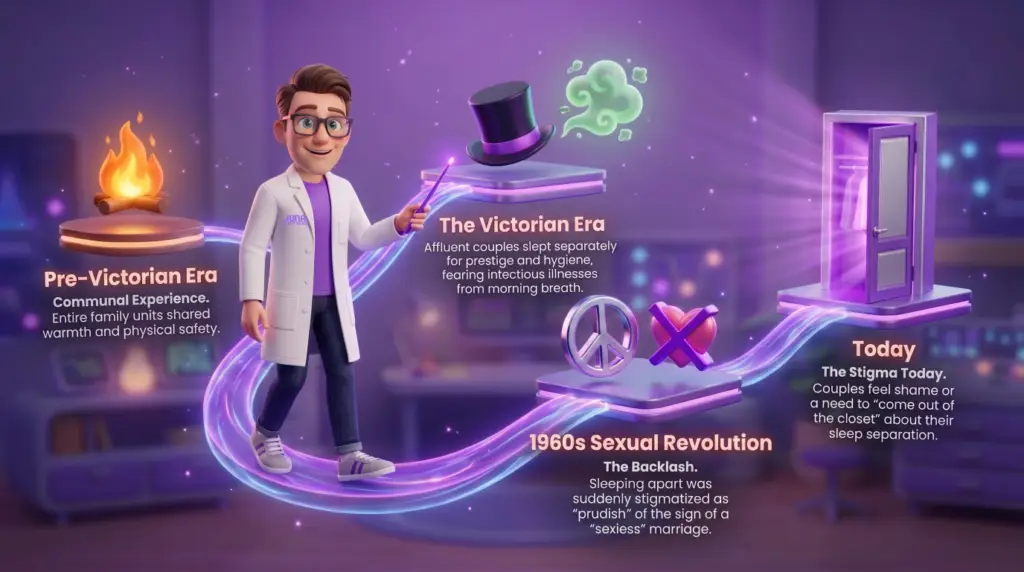
The backlash against separate beds began in the 1960s during the sexual revolution, where sleeping apart became associated with a “prudish” or “sexless” image. Today, many couples feel a sense of shame or a need to “come out of the closet” about their sleep separation. In reality, anonymous surveys suggest that 30% to 40% of couples sleep in different beds, proving that the sleep divorce is far more common than most realize.
The Objective vs. Subjective Paradox
One of the most fascinating findings in sleep science is the discrepancy between how we think we sleep and how we actually sleep when we share a bed with a partner. When researchers measure sleep objectively using wrist-worn trackers or laboratory electrodes, the results are clear: on average, individuals do not sleep as well when sharing a bed.
Why We Sleep Worse Together
Objectively, partner sleep disturbance manifests in several ways:
- Movement: When one partner moves, there is a 50% chance the other will be woken up or experience fragmented sleep.
- Sleep Onset: It typically takes longer to fall asleep when sharing a bed with a partner.
- Total Sleep Time: Couples sleeping together often lose significant minutes of rest due to spontaneous awakenings.
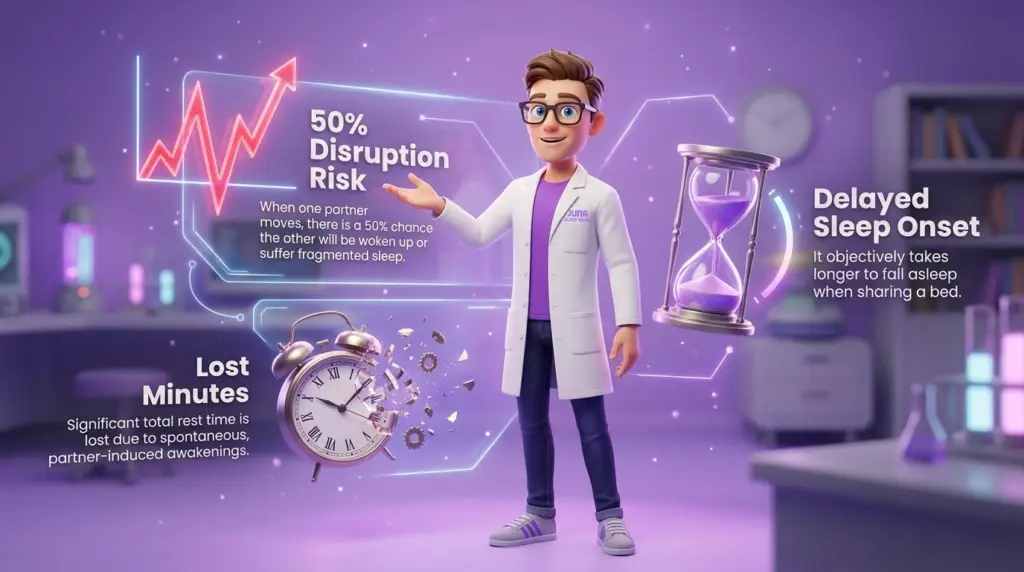
Sharing a bed can lead to a 50% risk of sleep disruption and objectively delayed sleep onset, causing significant loss of total rest time throughout the night.
The Subjective Twist
Despite these objective metrics, many couples report feeling more satisfied with their sleep when they are together. This suggests that the psychological benefits of “somato-longing”—the deep-rooted hunger for social and physical contact—can sometimes override the biological cost of poor sleep quality. For many, the sense of safety and bonding provided by a partner’s presence is worth the 10%-15% reduction in objective sleep efficiency.
Comparison: Sleeping Together vs. Sleep Divorce
| Feature | Sleeping Together | Sleep Divorce (Separate) | Juna H-Bed Compromise |
| Sleep Efficiency | Often Lower (Fragmented) | Highest (Continuous) | High (Motion Isolation) |
| Intimacy/Bonding | Continuous Access | Scheduled “Bookends” | Seamless “Cuddle Zone” |
| Motion Transfer | High (Sheet Stealing) | Zero | Isolated (Independent Rails) |
| Temperature | Shared (Thermal War) | Individualized | Independent Cooling/Heating |
The Science of REM Sleep Synchronization
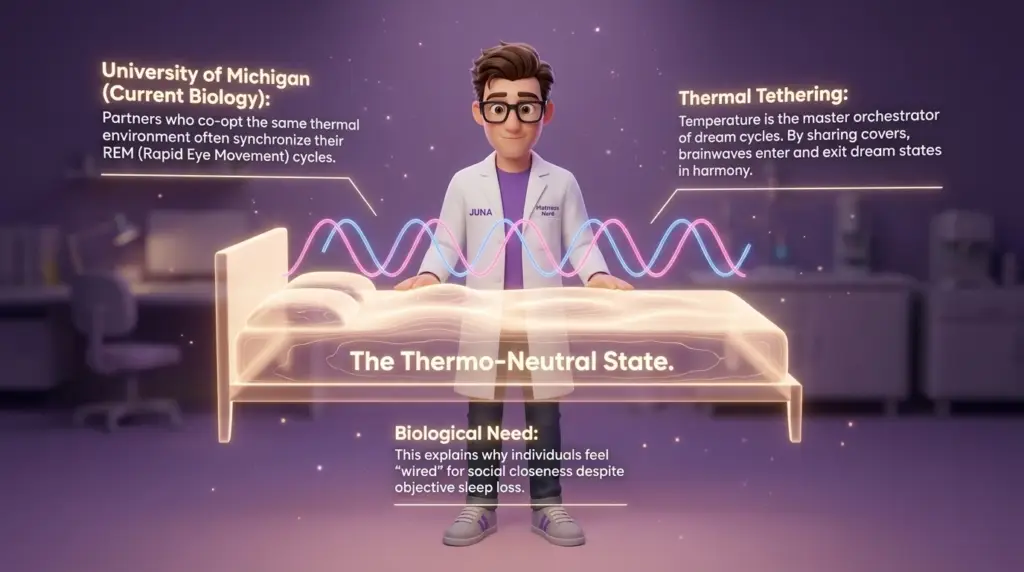
New research from the University of Michigan, published in Current Biology, has shed light on a remarkable phenomenon: couples who share a bed often synchronize their REM (Rapid Eye Movement) cycles. This means that partners may actually “dream together,” with their brain waves entering and exiting dream states in harmony.
Why Does Synchronization Happen?
While it sounds romantic, the mechanism may be more biological than mystical. Scientists suggest that co-sleeping forces couples to co-opt the same thermal environment. Temperature is a master orchestrator of REM sleep cycles; by sharing the same space under the covers, couples reach a “thermo-neutral” state that dictates when dream cycles occur.
Interestingly, this synchronization is more pronounced in males than in females, though the reasons remain under investigation. This biological “tethering” may explain why some individuals feel “wired” for social closeness and prefer to share a bed even when their sleep is objectively worse.
How Sleep Loss Destroys Relationship Empathy
If you are considering a sleep divorce, the impact on your emotional health should be your primary concern. Research at UC Berkeley by Dr. Serena Chen and others has demonstrated that sleep disruption is a toxic catalyst for relationship conflict.
The “Four Horsemen” of Sleep Deprivation
When you are underslept, you are more likely to engage in the “Four Horsemen of the Apocalypse” (criticism, contempt, defensiveness, and stonewalling).
- Reduced Empathy: Sleep loss kills your ability to accurately read your partner’s emotions.
- Increased Reactivity: The amygdala—the brain’s emotional center—becomes 60% more reactive, causing you to “snap” at minor provocations.
- Conflict Resolution: Sleep-deprived couples are less able to resolve conflicts and more likely to lash out with damaging or hurtful comments.
Improving your sleep through a temporary separation or a better mattress system can actually boost your empathy, making you a better, more loving partner during your waking hours.
Compromise Solutions: The Scandinavian Method
If the idea of a full sleep divorce (sleeping in entirely different rooms) feels too drastic, many couples are turning to the “Scandinavian Method”.
How the Scandinavian Method Works
This approach involves using two separate mattresses or two separate sets of bedding (blankets and duvets) within the same bed frame. This effectively ends the “war over cover territory” and ensures that if one partner thrashes or “blanket burritos” themselves, the other remains undisturbed.
While this solves for motion and temperature, it doesn’t always solve for the “snoring war.” If snoring or sleep apnea is the primary disruptor, a physical separation or professional medical intervention is often necessary.
How to sleep like your relationship depends on it | Wendy Troxel | TEDxManhattanBeach
How to Have “The Talk” Without Getting a Real Divorce
Initiating a conversation about a sleep divorce is inherently sensitive because the shared bed is often viewed as the cornerstone of marital intimacy. If handled poorly, the suggestion can leave a partner feeling rejected, hurt, or abandoned. However, clinical experts like Dr. Wendy Troxel emphasize that the quality of your waking relationship depends entirely on the quality of your nocturnal rest.
Timing is Everything: Avoid “Slangry” Debates
The worst time to discuss a sleep divorce is at 2:00 AM while you are actively being nudged by a snorer or having the sheets stolen. You should also avoid the discussion first thing in the morning when you are both groggy and “slangry”—the sleep-deprived version of hungry.
Instead, wait until you are both well-rested and in a neutral environment. This allows you to optimize your emotion regulation skills and communicate with curiosity rather than defensiveness.
The “I” Statement Strategy
To avoid making your partner feel criticized, use “I” statements. Instead of wagging a finger and saying, “Your snoring is driving me crazy,” try: “I really want us to talk about our sleeping arrangement because when I don’t get the sleep I need, I can’t be the partner to you that I want to be”. By framing it as a “we problem” with a “we solution,” you shift the focus toward relationship enhancement.
The Two-Week Experiment
Commitment can be scary. Instead of suggesting a permanent move to the guest room, propose a two-week experiment. Frame it as a test to see if individual energy levels, attraction, and emotional connectivity improve. This reduces the pressure and allows both parties to evaluate the benefits objectively before making a long-term decision.
Preserving the “Bookends” of the Night
Many couples fear that a sleep divorce means losing the physical closeness of bedtime. You can “bootstrap” this by focusing on the “bookends” of sleep—the time spent together before drifting off and immediately upon waking.
- The Goodnight Ritual: Spend time together in one bed for a “kiss and a cuddle” until the person with the earlier bedtime is ready to sleep.
- The Morning Welcome: Whoever wakes up second can text their partner to come back into bed for a morning embrace.
During the middle of the night, most people are unconscious and unaware of their partner anyway. By protecting the bookends, you maintain the bond without the 3:00 AM disturbances.
Sleep is the New Sex: The Biological Connection
A common myth surrounding the sleep divorce is that it marks the end of a couple’s sex life. Scientific evidence suggests the exact opposite: superior sleep often leads to superior intimacy.
Hormonal Optimization
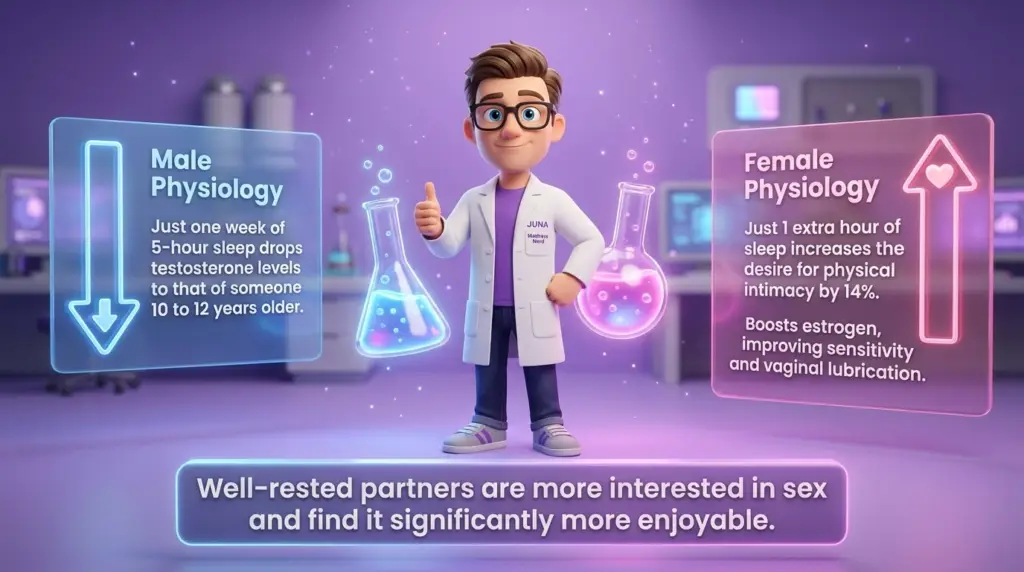
Sleep is the primary regulator of reproductive hormones. For men, just one week of restricted sleep (5 hours per night) can drop testosterone levels to that of someone 10 to 12 years their senior. In women, quality sleep is essential for maintaining estrogen and progesterone levels, which directly influence sexual wellness and fertility.
Sensitivity and Libido
Research indicates that for every one extra hour of sleep a woman obtains, her desire to be physically intimate with her partner increases by 14%. Furthermore, well-slept women report greater sensitivity of the sexual genitalia and increased vaginal lubrication due to boosted estrogen levels.
When you are well-rested, you are not only more interested in sex, but you find it more enjoyable. By eliminating partner sleep disturbance through a sleep divorce, you may actually be revitalizing your physical relationship.
The Juna Advantage: A Better Way to Sleep Together (and Apart)
At Juna Sleep Systems, we understand that every couple is a “unique snowflake” with different biological needs. If you live near our showroom in Rapid City, South Dakota, you don’t have to choose between a full sleep divorce and a night of tossing and turning. We serve communities from Hot Springs, SD; Lead, SD; and Spearfish, SD providing handcrafted solutions designed for real life.
The Innovation of the Juna H-Bed
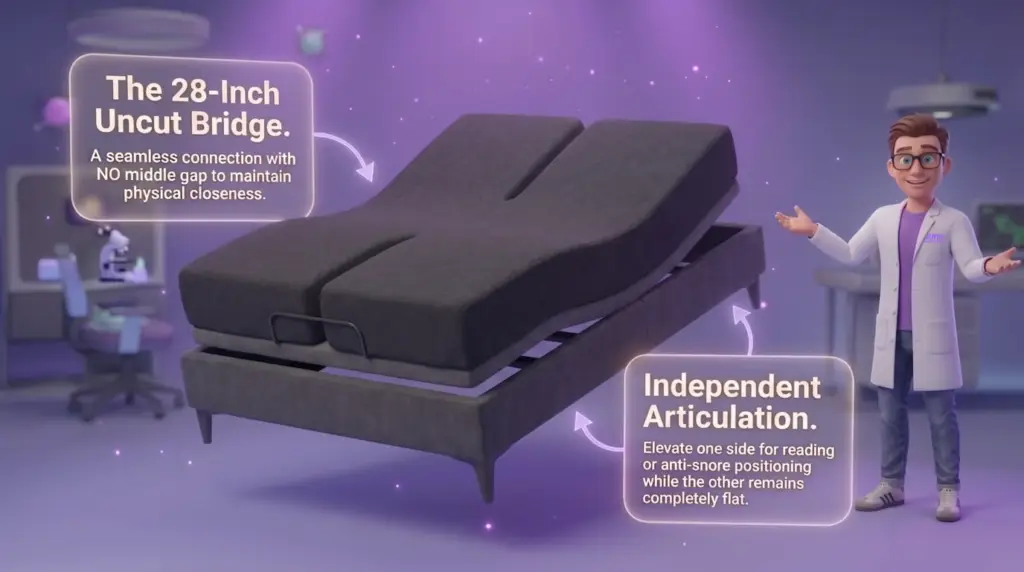
The traditional “Split King” often creates a frustrating trench in the middle of the bed, killing the “cuddle zone.” The Juna H-Bed is a game-changer. It is a single, unified King-sized unit featuring a unique ‘H’ geometry:
- Independent Articulation: Deep vertical slits at the center-head and center-foot allow one side to be elevated for reading or anti-snore positioning while the other remains flat.
- The Solid-Foam Bridge: The middle 28 inches remains a completely uncut bridge. This seamless connection ensures there is NO gap, allowing you to maintain physical closeness while enjoying independent movement.
Understanding the biology of sleep is the first step; giving your relationship the “Sleep Alliance” it deserves is the final step toward long-term health and connection.
Lifetime Comfort Commitment: You Are Not Stuck
Traditional mattresses lock you into a single firmness level. If your needs change—perhaps due to pregnancy, weight shifts, or aging—you are usually forced to buy a new bed. Juna’s Lifetime Comfort Commitment removes that risk.
If your mattress isn’t just right, a Juna Mattress Nerd will come to your home and adjust the internal layers to make it firmer or softer. This modular approach ensures your mattress adapts with you over the decades.
Infinity Edge and Motion Isolation
Many mass-produced mattresses use cheap foam encasements that break down or feel like a hard “brick” around the perimeter. Our Infinity Edge system combines a high-resiliency support core with reinforced butterfly quad coils to give you a stable, usable sleep surface all the way to the edge. Paired with our pocketed coil construction, Juna beds offer excellent motion isolation, ensuring that even if your partner is a restless sleeper, you stay in deep, restorative Slumber.
Frequently Asked Questions (FAQ)
1. Does a sleep divorce mean we aren’t having sex?
Absolutely not. In fact, better sleep often leads to a higher libido and more frequent intimacy. Well-rested partners are more interested in sex and find it more enjoyable.
2. Is partner sleep disturbance really that big of a deal?
Yes. Studies show that when one partner moves, there is a 50% chance the other will be disturbed. Chronically disrupted sleep can lead to high blood pressure, increased conflict, and reduced empathy in the relationship.
3. What is the Juna H-Bed?
The Juna H-Bed is a unified king mattress with independent head and foot articulation. Unlike a standard split king, it has a 28-inch solid-foam bridge in the center to maintain the cuddle zone and eliminate the “middle gap”.
4. How can I try a sleep divorce as an experiment?
Experts recommend a two-week trial. Maintain “bookend” rituals like cuddling before sleep and meeting in the morning to preserve the emotional bond while enjoying solo sleep.
5. Why do we feel more satisfied sleeping together if our trackers say our sleep is worse?
This is a biological paradox called “somato-longing”—a deep-seated hunger for social and physical contact. The psychological sense of safety and bonding can sometimes feel more important to the individual than objective sleep metrics.
6. What if my partner snores, but I don’t want a sleep divorce?
You might consider an adjustable base with an “Anti-Snore” preset, which slightly elevates the head to keep the airway open. This works best when paired with a Juna H-Bed for independent control.
7. How does the Juna Lifetime Comfort Commitment work?
If your comfort needs change, Juna doesn’t make you buy a new bed. We send a technician to your home to swap internal foam layers, making your mattress firmer or softer for the lifetime of the product.
Conclusion: Prioritize the Relationship, Not the Furniture
Whether you choose a full sleep divorce, the Scandinavian Method, or a high-tech compromise like the Juna H-Bed, the goal remains the same: reclaiming your health to better love your partner. Sleep is not a luxury or a sign of laziness; it is the biological bedrock of your physical and mental well-being.
Don’t let societal stigma or a “saggy” mattress dictate your relationship quality. Visit a Juna Sleep Systems showroom in Sioux Falls, Rapid City today. Experience the difference of a bed built for real life, backed by a team that supports you long after the sale.
What Is A Sleep Divorce? | Matthew Walker
