

The Quick Answer
What is the science of lucid dreaming? The science of lucid dreaming reveals that the rational prefrontal cortex reactivates during REM sleep, allowing sleepers to consciously control their night narrative. However, medical experts heavily debate whether this intense neurological activity disrupts deep restorative rest and causes severe, unrefreshing sleep.
Introduction: Waking Up Inside Your Own Mind
If you have ever realized you were dreaming while still fast asleep, you have experienced a phenomenon that has baffled researchers for decades. For years, the ability to control your night narrative was considered an internet myth or pure science fiction. Today, the science of lucid dreaming is a heavily researched and highly debated topic in clinical sleep medicine.
Understanding the science of lucid dreaming requires a deep dive into the complex architecture of our nightly rest. What exactly happens when the rational part of your brain suddenly “wakes up” while your physical body remains paralyzed in deep slumber? Is being the active director of your own nighttime movie actually good for your health, or does it leave you waking up exhausted?
In this comprehensive guide, the Juna Sleep Nerd will explore the neurobiology behind the science of lucid dreaming, the debate over unrefreshing sleep, and how optimizing your physical sleep environment can help you master your sleep cycles.

Table of Contents
The Architecture of the Night Narrative
Before we can properly analyze the science of lucid dreaming, we must establish a foundational understanding of standard sleep architecture. Every night, a healthy human brain cycles through multiple, distinct stages of sleep.
These stages are broadly categorized into Non-Rapid Eye Movement (NREM) sleep and Rapid Eye Movement (REM) sleep. During NREM sleep, your body focuses on physical restoration, immune system repair, and tissue growth. However, as the night progresses, the REM sleep stages become significantly longer and more dominant.
REM sleep is the stage during which the vast majority of our vivid, story-like dreams occur. It is an intensely active state for the brain, primarily dedicated to emotional regulation and memory consolidation. The science of lucid dreaming focuses almost entirely on this specific REM stage, as this is the biological theater where your conscious mind will eventually make its grand entrance.

The Neurobiology Behind the Science of Lucid Dreaming
During standard REM sleep, your brain is remarkably active. In fact, a summary of clinical research shows that it is burning glucose and consuming oxygen at rates very similar to those when you are fully awake. However, a specific and highly crucial region, the dorsolateral prefrontal cortex, remains largely deactivated.
This region is your brain’s executive command center. It is entirely responsible for the development of logic, self-awareness, linear time processing, and critical thinking. Because this logic center is asleep during normal REM, we blindly accept the bizarre, physics-defying events of our dreams as absolute reality.
We do not question why we are suddenly back in high school, or why we are having a conversation with a dog. The science of lucid dreaming hinges entirely on what happens when this biological default gets overridden, and the brain decides to completely break its own neurological rules.

How the Prefrontal Cortex Reactivates During REM
The true breakthrough in the science of lucid dreaming came when researchers used functional MRI to observe the brains of active lucid dreamers. A summary of clinical research indicates a sudden, massive surge in gamma-wave activity in the frontal regions of the sleeping brain during these events.
Gamma waves are the fastest measurable brain waves, typically associated with high-level cognitive functioning, intense focus, problem-solving, and waking self-awareness. When these gamma waves spike during the REM stage, the prefrontal cortex effectively boots up while the rest of the brain continues to generate the hallucinatory dream state.
This is the exact biological moment you realize you are dreaming. It is a spectacular hybrid state of consciousness in the science of lucid dreaming. Your physical body is entirely asleep, but your logic center is completely awake, granting you the unprecedented ability to consciously control your night narrative.

The Critical Role of REM Atonia
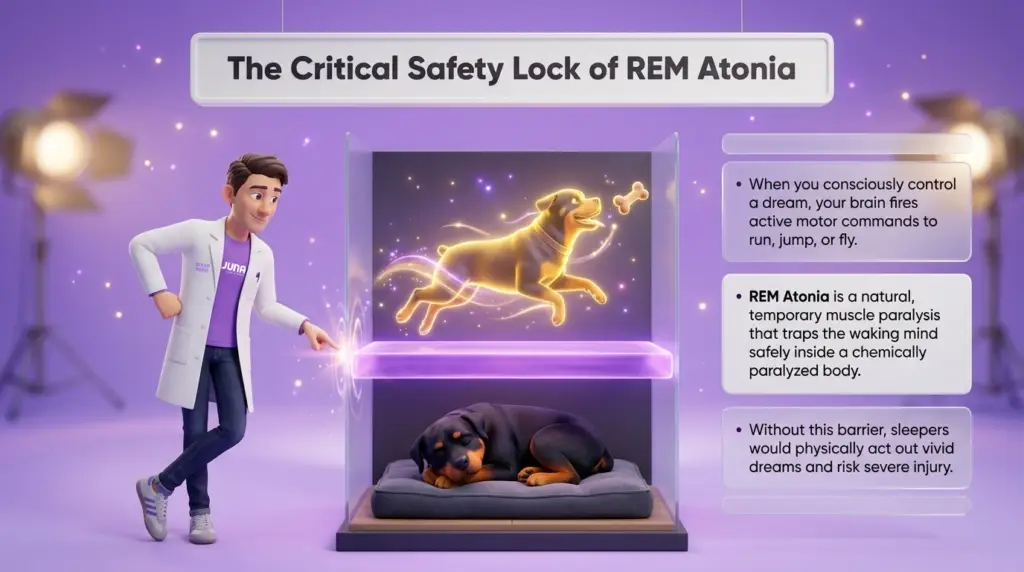
During this intense neurological process, your body relies on a vital, built-in safety mechanism called REM atonia. This is a temporary, natural muscle paralysis that prevents you from physically acting out your vivid dreams.
Expert insights from Juna’s Medical Advisors emphasize that maintaining this paralysis is absolutely crucial. If you are actively trying to control your night narrative, your brain is firing off conscious motor commands to run, jump, or fly. Without REM atonia, you would physically leap out of bed and potentially injure yourself. The delicate balance of the science of lucid dreaming is maintaining a fully waking mind trapped safely inside a chemically paralyzed body.
The Great Debate: Does Lucid Dreaming Cause Unrefreshing Sleep?
While flying through the sky and creating fantasy worlds may sound like an incredible psychological superpower, sleep experts raise a highly important question: Does this high-level brain activity disrupt your physical rest?
There is a growing, intense debate about the science of lucid dreaming and its overall impact on long-term sleep quality. Sleep is fundamentally designed for bodily recovery and mental restoration. During normal REM sleep, the brain passively processes complex emotions and clears out neurotoxic cellular waste.
The Cognitive Load of Dream Control
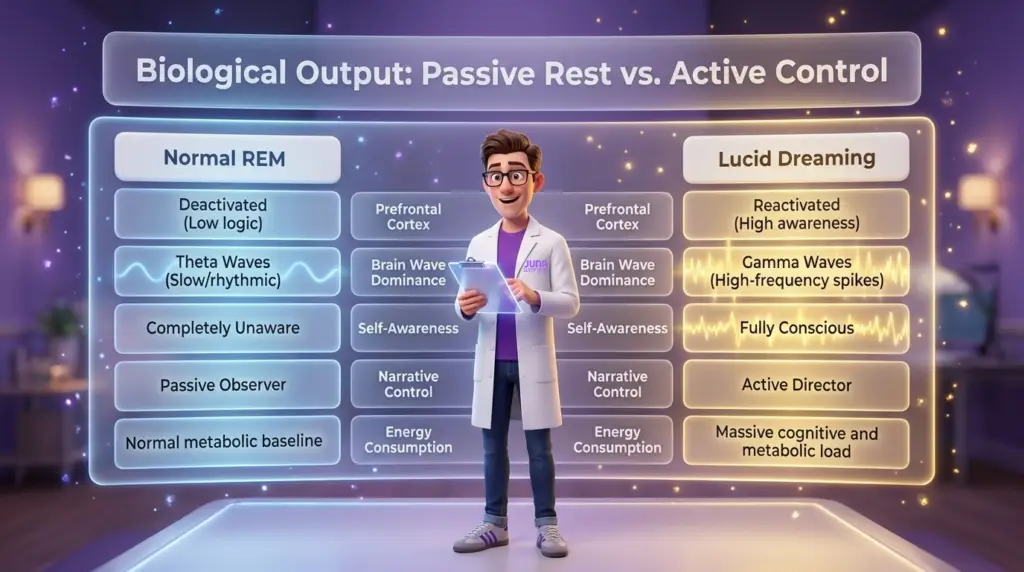
When you introduce massive gamma-wave activity and prefrontal cortex engagement into REM sleep, you are demanding a very high energy output from your brain. A summary of clinical research suggests that frequent lucid dreamers often report waking up feeling severely drained, mentally foggy, and exhausted.
This phenomenon is clinically known as unrefreshing sleep. Because the brain was practically awake and working incredibly hard to analyze and control the dream environment, it was denied the opportunity to passively rest. The science of lucid dreaming heavily suggests this extreme cognitive load can be exhausting over time.
Sleep Fragmentation and Waking Fatigue
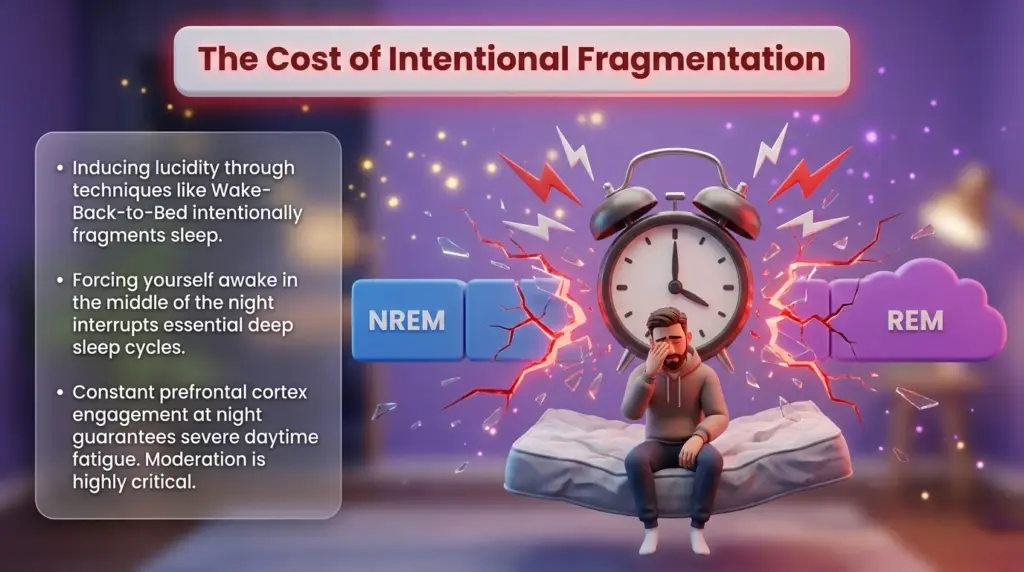
If you intentionally practice the science of lucid dreaming, moderation is highly critical. Inducing lucid dreams every single night may severely disrupt your natural sleep architecture.
For those who use common induction techniques like “Wake-Back-to-Bed,” the intentional fragmentation of sleep can further degrade restorative rest. Forcing yourself awake in the middle of the night to trigger a conscious state interrupts essential deep sleep. If your prefrontal cortex is constantly engaged and alert during the night, you may experience significant daytime fatigue. If you frequently experience unrefreshing sleep, your focus should immediately shift back toward optimizing deep, uninterrupted sleep cycles.
Comparing Normal Dreaming vs. Lucid Dreaming
To clearly visualize the intense biological differences highlighted by the science of lucid dreaming, review the detailed comparison table below.
| Feature / Metric | Normal REM Dreaming | Lucid Dreaming |
| Prefrontal Cortex Activity | Deactivated (Low logic and reason) | Reactivated (High logic and awareness) |
| Brain Wave Dominance | Theta waves (Slow and rhythmic) | Gamma waves (High-frequency spike) |
| Dreamer’s Self-Awareness | Completely unaware they are dreaming | Fully aware of the active dream state |
| Ability to Control Narrative | A passive observer of the events | Active director and conscious participant |
| Energy Consumption | Normal metabolic baseline | High metabolic and cognitive load |
| Impact on Sleep Quality | Highly restorative and natural | Debated; can cause unrefreshing sleep |
The Physical Environment for the Science of Lucid Dreaming
When examining the science of lucid dreaming, we absolutely cannot ignore the physical environment. To even reach the deep REM stages where conscious dream control is biologically possible, your body must be entirely free from physical disruptions.
If you sleep near the edge of the bed and feel like you are constantly slipping off, or if your partner’s movements constantly wake you, your sleep cycles will rapidly fragment. You will be aggressively pulled out of sleep before the prefrontal cortex ever has a chance to safely engage. Maintaining an unbroken, deeply restorative state of sleep is the foundational requirement for exploring the science of lucid dreaming.
Dr. Matt Walker: The Science of Dreams, Nightmares & Lucid Dreaming
The Juna Advantage: Engineering the Perfect REM Environment
If you have ever worried about choosing the wrong mattress, you are certainly not alone. A mattress should be built for real life, not just a quick showroom test. This is where Juna Sleep Systems completely changes the game for your health, wellness, and sleep cycles. Better sleep should feel less risky, especially when you are actively trying to optimize your REM sleep to explore the science of lucid dreaming.
Unmatched Comfort for Couples: The Juna H-Bed
For couples trying to optimize their sleep architecture, partner disturbance is a massive barrier. If you and your partner have different sleep needs, or if you sleep lightly, every single toss and turn can wake you up. This prevents the deep, sustained REM sleep required for memory consolidation and effectively practicing the science of lucid dreaming.
Z-Gravity and Adjustable Base Benefits
To further support healthy sleep cycles, pairing the H-Bed with an adjustable base provides massive health and wellness benefits. By elevating the head and legs into a Zero Gravity (Z-gravity) position, you create a deeply weightless, pressure-relieving feel.
This slight elevation helps drastically reduce pressure on the lower back and joints, lowering the physical stress on your body. When your body is entirely free of pressure points, it requires far fewer micro-adjustments throughout the night. This undisturbed physical state is the ideal foundation for the science of lucid dreaming. Features like lumbar support, Anti-Snore settings, and head and foot articulation offer better relaxation and can help some sleepers breathe much more comfortably.
Factory-Direct Quality Near You
More of the purchase price should go into the premium materials, not the greedy middlemen. Juna operates on a strictly factory-direct model, meaning far fewer markups and significantly more value in the mattress materials themselves.
Juna does not just sell a mattress and disappear; we support the customer long after the sale. Whether you are visiting Juna Sleep Systems – Sioux Falls, South Dakota (proudly serving Brandon, SD; Tea, SD; and Brookings, SD) or browsing at Juna Sleep Systems – Rapid City, South Dakota (serving Sturgis, SD; Spearfish, SD; and Deadwood, SD), factory-direct quality is always just a short drive away.
Frequently Asked Questions (FAQ)
- What exactly is the science of lucid dreaming?
The science of lucid dreaming explores the neurobiology behind conscious dream control. It specifically studies how the rational prefrontal cortex suddenly reactivates during deep REM sleep, allowing sleepers to safely control their night narrative while their bodies remain completely asleep.
- Does the science of lucid dreaming cause unrefreshing sleep?
Medical experts heavily debate this issue. A summary of clinical research indicates that the intense gamma-wave activity required by the prefrontal cortex to consciously control your night narrative creates a severe cognitive load. This immense brain activity during REM sleep often disrupts natural restoration, leading to unrefreshing sleep and severe daytime fatigue.
- What part of the brain is responsible for the science of lucid dreaming?
The dorsolateral prefrontal cortex is the primary region involved. While this critical logic and reasoning center is entirely deactivated during normal REM sleep, the science of lucid dreaming reveals that high-frequency gamma waves can reactivate it suddenly, sparking full conscious self-awareness within the dream.
- How does REM atonia keep me safe when I control my night narrative?
Expert insights from Juna’s Medical Advisors explain that REM atonia is a natural, temporary muscle paralysis that strictly occurs during deep sleep. If your active prefrontal cortex is sending physical motor commands to run or fly in your dream, this paralysis absolutely ensures you do not physically jump out of bed or injure yourself.
- Why is motion isolation crucial for reaching deep REM sleep?
To successfully reach the deep REM stages required for conscious dream exploration, your sleep must be completely uninterrupted. Juna mattresses provide excellent motion isolation, which drastically reduces partner disturbance, allowing your brain to safely and naturally transition into these highly restorative sleep stages.
- How can an adjustable base paired with an H-Bed improve my sleep cycles?
Resting in a Zero Gravity position on an adjustable base paired with the Juna H-Bed offers immense pressure relief and a weightless, floating feel. Because it reduces physical stress on your joints, your body requires far fewer micro-adjustments at night, promoting longer, deeper, and more uninterrupted sleep cycles.
- How does Juna’s Lifetime Comfort Commitment reduce my risk?
Juna helps drastically reduce the risk of buying the wrong mattress because our beds are explicitly designed to be adjustable after purchase. If a mattress isn’t just right, a Juna Mattress Nerd will come to your home and adjust the internal layers to make the mattress firmer, softer, or adjust lumbar support. Comfort can be refined over time instead of forcing you to start over. You are not stuck.
Conversion-Focused Closing: Reclaim Your Night Narrative
Understanding the complex biology behind the science of lucid dreaming is incredibly fascinating, but prioritizing the physical quality of your nightly rest is far more critical for your long-term health and wellness. If you are constantly struggling with unrefreshing sleep, frequent night disruptions, heavy partner disturbance, or a mattress that leaves you waking in pain, it is time to take absolute control of your sleep architecture.
A mattress should be built for real life, not just a quick showroom test. Better sleep should feel less risky, and with Juna’s factory-direct model, more of the purchase price goes into the premium materials that actually support your body.
Visit a Juna Sleep Systems showroom today to experience the incredible pressure relief of a Zero Gravity adjustable base and the completely unified comfort of our revolutionary H-Bed. Let our team of Mattress Nerds help you master your sleep cycles, eliminate unrefreshing sleep, and build the perfect foundation to fully control your night narrative. [Click here to browse our collections and build your perfect sleep system online today!]
