
The Quick Answer
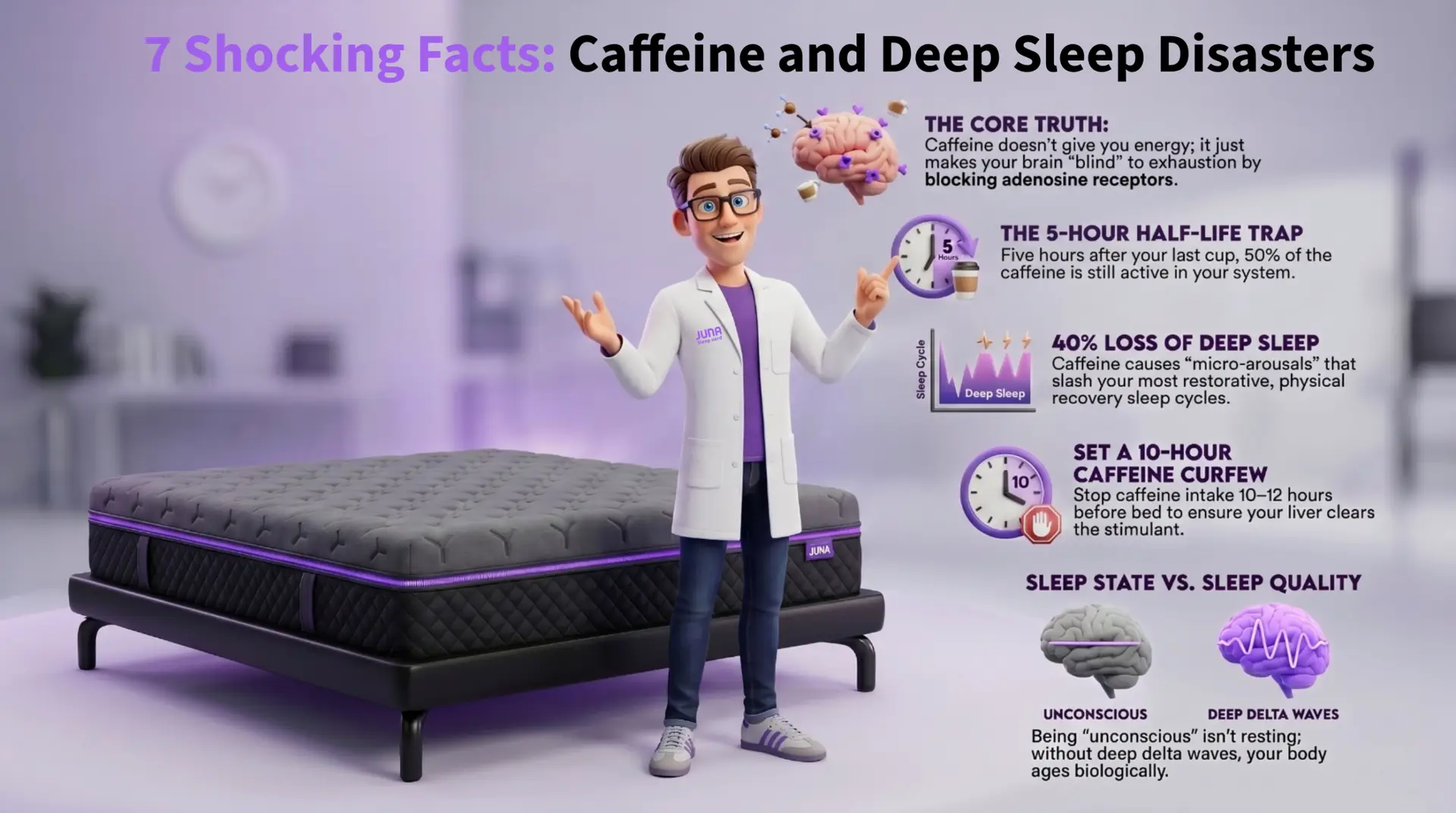
How does the relationship between caffeine and deep sleep affect your rest? Clinical research shows that caffeine blocks adenosine receptors, masking sleep pressure. Because of its 5- to 6-hour half-life, late-day caffeine consumption leads to severe sleep fragmentation and a massive 20%-40% loss of restorative deep slow-wave sleep.
Introduction
If you have ever worried about choosing the wrong mattress or wondered why you constantly wake up exhausted despite spending eight full hours in bed, your daily coffee habit could be the hidden culprit. As the Juna Sleep Nerd, I frequently dive into the science of sleep cycles. The relationship between caffeine and deep sleep is one of the most misunderstood aspects of modern wellness.
Many people believe that if they can fall asleep after an evening espresso, their caffeine and deep sleep balance is perfectly fine. However, falling asleep is only the very first step. The real damage happens entirely beneath the surface. The coffee paradox reveals that while you may feel unconscious, the residual chemical stimulant is actively blocking your brain from entering the critical stages of physical restoration. In this comprehensive guide, we will break down how caffeine sabotages your slow-wave sleep, why the timing of your last cup matters, and how optimizing your sleep environment can help.
Understanding the Coffee Paradox
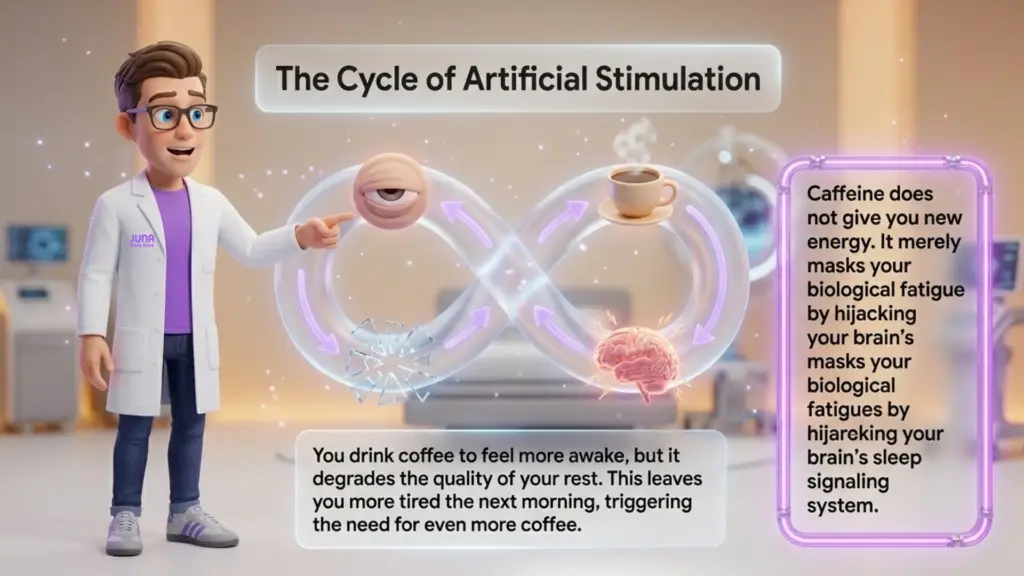
The fundamental conflict between caffeine and deep sleep is what sleep scientists call the “Coffee Paradox.” You drink coffee to feel more awake, but that very same coffee degrades the quality of your rest, leaving you feeling more tired when you wake up. This leads to consuming even more coffee the next day to combat the exhaustion, trapping you in a perpetual cycle of sleep fragmentation and artificial stimulation.
When you consume caffeine, it does not actually give you new energy; it merely masks your biological fatigue by hijacking your brain’s sleep signaling system. Understanding how this happens requires a deep dive into the specific neurochemicals that govern our wakefulness and sleepiness throughout a 24-hour cycle. The collision of caffeine and deep sleep is an invisible battle fought at the microscopic level inside your nervous system.
The Science of Adenosine Receptors
To fully grasp the intricate relationship between caffeine and deep sleep, you must first understand a vital neurochemical called adenosine. From the moment you wake up in the morning, your brain begins producing adenosine. This chemical builds up continuously throughout the day in a process sleep scientists refer to as “sleep pressure.”
Think of adenosine like a biological hourglass. As the sand (adenosine) accumulates at the bottom, your biological urge to sleep grows stronger. When adenosine binds to specific adenosine receptors in your brain—primarily the A1 and A2A receptors—it turns down the volume on your brain’s wake-promoting regions and turns up the dial on your sleep-inducing centers.
By the time the evening rolls around, the buildup of adenosine should leave you feeling overwhelmingly ready for bed. This is how the body naturally prepares for a night of restorative recovery.
How Caffeine Hijacks Your Sleep Drive
However, caffeine throws a massive wrench into this biological machinery. Caffeine is a psychoactive stimulant with a molecular structure that is nearly identical to adenosine. Because of this structural similarity, caffeine can seamlessly slot into your brain’s adenosine receptors, effectively blocking them.
When caffeine blocks your adenosine receptors, the actual adenosine your body has produced cannot bind to your brain cells. The sleep pressure is still there—the sand is still piling up in the hourglass—but your brain is chemically blind to it.
You feel alert, energized, and hyper-focused. This is why the dynamic between caffeine and deep sleep is so fragile. Your brain is not producing new energy; it is simply ignoring the signals that tell you to rest.
The 5-to-6 Hour Half-Life Trap
One of the most misunderstood concepts regarding caffeine and deep sleep is how long the chemical actually stays in your body. When we talk about a “caffeine half-life,” we are referring to the amount of time it takes for your liver to break down exactly 50% of the substance.
The summary of clinical research indicates that for the average healthy adult, the caffeine half-life is approximately five to six hours. This biological math is shocking to most people and fundamentally alters the harmony between caffeine and deep sleep.
If you drink a large cup of coffee containing 200 milligrams of caffeine at 4:00 PM to get through an afternoon slump, you are setting yourself up for an invisible nighttime disaster.
The Math of Midnight Stimulation
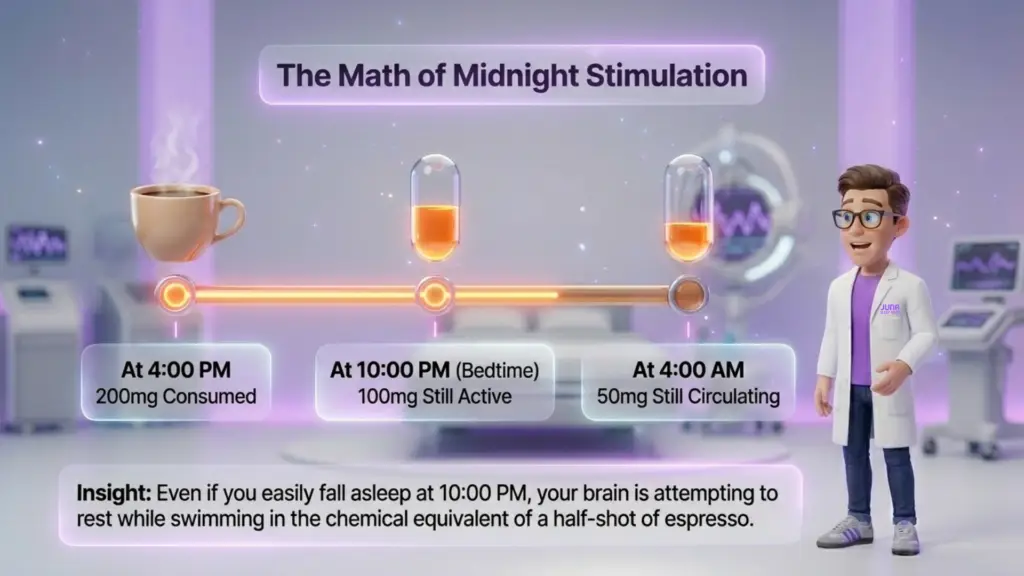
Let’s do the biological math on how this half-life affects caffeine and deep sleep:
- 4:00 PM: You consume 200mg of caffeine.
- 10:00 PM (Bedtime): A full 5 to 6 hours have passed. However, because of the half-life, 100mg of caffeine is still active in your brain.
- 4:00 AM: Another 6 hours have passed, and 50mg of caffeine is still circulating in your system, actively binding to receptors.
Even if you easily fall asleep at 10:00 PM, your brain is attempting to rest while swimming in the chemical equivalent of a half-shot of espresso. This hidden stimulant load severely impacts the quality and architecture of your sleep, destroying your caffeine and deep sleep optimization, even if the total duration of your sleep seems normal.
How Caffeine Fragments Your Sleep Architecture
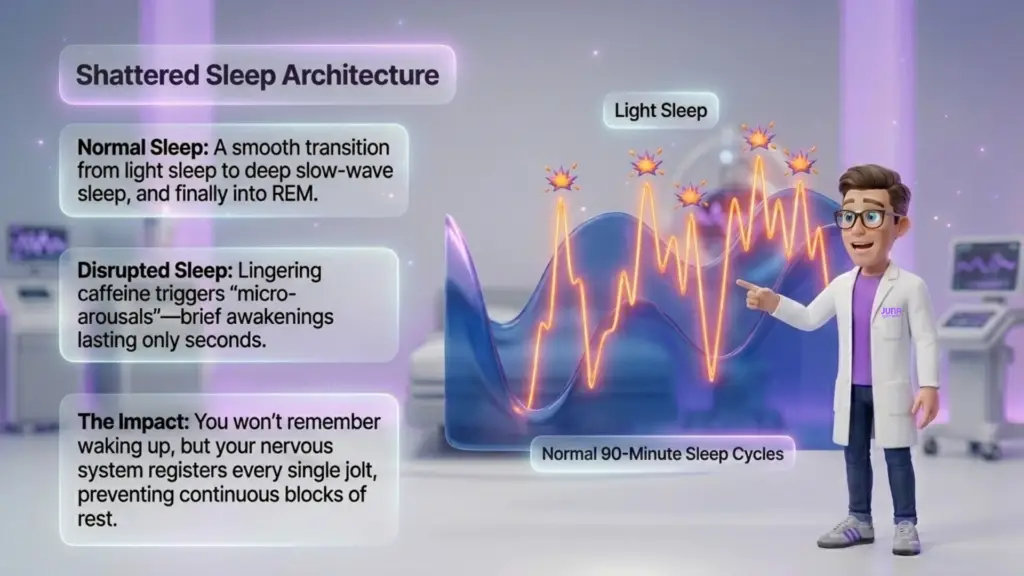
Your nightly rest is not a uniform block of unconsciousness. It is composed of highly structured, 90-minute sleep cycles that alternate between light sleep, deep slow-wave sleep, and REM (Rapid Eye Movement) sleep. The battle between caffeine and deep sleep destroys the structural integrity of this architecture.
The lingering presence of caffeine in your bloodstream is a primary trigger for sleep fragmentation. You might not fully wake up, open your eyes, and stare at the ceiling, but your brain is constantly being nudged out of its deeper cycles into lighter stages of sleep.
In a healthy sleep cycle, you transition smoothly from light sleep into deep slow-wave sleep, and finally into REM sleep. However, when you introduce poor caffeine and deep sleep habits to a brain still processing a late-afternoon latte, the cycles shatter.
Your brain experiences “micro-arousals”—brief awakenings that last only a few seconds. You will not consciously remember them in the morning, but your nervous system registers every single one. These micro-arousals prevent you from sustaining the continuous, uninterrupted blocks of rest required for optimal cellular repair.
The 20-40% Loss of Slow-Wave Sleep
The most critical stage of the night is deep slow-wave sleep. This is the physical restoration phase of your 24-hour cycle. During deep sleep, your brain waves slow down to massive, sweeping delta waves. Your blood pressure drops, your muscles receive a surge of blood and growth hormone, and your immune system recharges.
The summary of clinical research indicates that the collision of late-day caffeine and deep sleep can result in a staggering 20% to 40% reduction in your nightly deep sleep.
To put this into perspective, losing 40% of your deep sleep is the biological equivalent of aging your body by 10 to 15 years in a single night. You wake up with stiff joints, a foggy mind, and a blunted immune response. Because you feel terrible, you immediately reach for a massive dose of morning coffee to jump-start your system, perfectly resetting the Coffee Paradox for another day and ruining your caffeine and deep-sleep baseline.
The Illusion of Falling Asleep Fast
A common defense among heavy coffee drinkers is: “I can drink a shot of espresso after dinner and fall right to sleep!” While this may be true for some individuals who have developed a high tolerance, falling asleep is not the same as staying asleep or achieving quality rest. The relationship between caffeine and deep sleep isn’t just about sleep onset latency (how fast your eyes close).
When you fall asleep with a high caffeine load, your brain completely skips the vital plunge into the deep delta waves. You spend the majority of your night hovering in light sleep. You are unconscious, but you are not resting. This is why you can sleep for nine hours and still wake up feeling like you ran a marathon. Your brain was chemically blocked from entering the restorative maintenance bay.
Comparison Table: Everyday Stimulants and Sleep Impact
To better understand how different beverages affect your rest and your balance of caffeine and deep sleep, here is a detailed breakdown of common caffeine sources and their potential disruption levels.
| Beverage Source | Average Caffeine (mg) | Estimated Clearance Time (100%) | Risk to Deep Sleep | Impact on Sleep Fragmentation |
| Drip Coffee (12 oz) | 150 – 200mg | 10 – 12 Hours | Extremely High | Severe micro-arousals |
| Energy Drink (16 oz) | 160 – 300mg | 12 – 14 Hours | Extremely High | Prolonged shallow sleep |
| Black Tea (8 oz) | 40 – 70mg | 6 – 8 Hours | Moderate | Moderate cycle disruption |
| Soda (12 oz) | 35 – 50mg | 5 – 7 Hours | Low to Moderate | Mild restorative loss |
| Decaf Coffee (12 oz) | 2 – 5mg | < 2 Hours | Very Low | Normal sleep architecture |
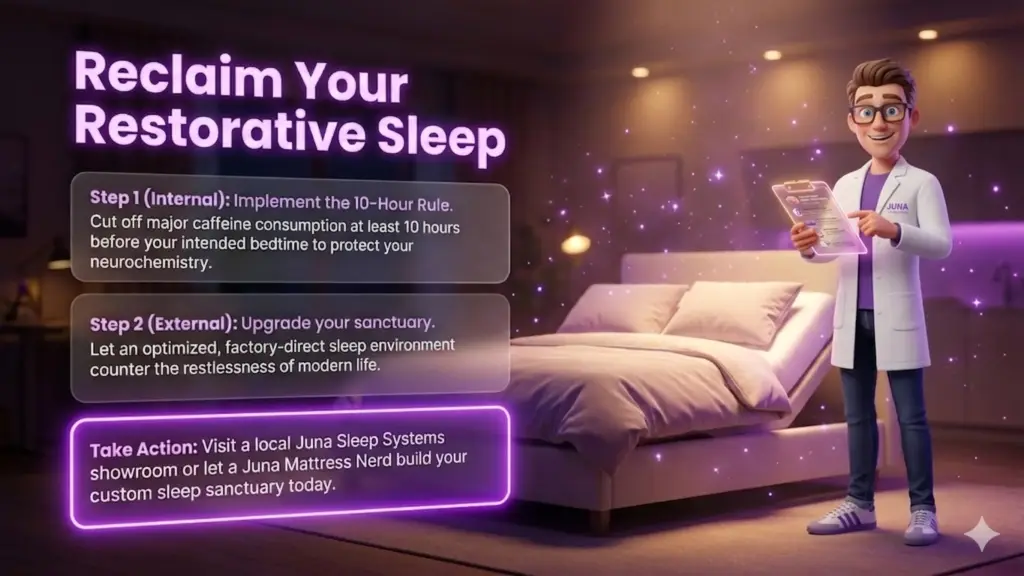
Expert Insights from Juna’s Medical Advisors suggest cutting off all major caffeine consumption at least 10 hours before your intended bedtime to preserve your slow-wave sleep phases.
Andrew Huberman / Matthew Walker for more info
The Juna Advantage: Your Sleep Environment Countermeasure
When residual caffeine disrupts your internal chemistry, your external sleep environment becomes absolutely critical. You simply cannot afford to lose more rest to physical discomfort or partner disturbance. Juna Sleep Systems believes better sleep should feel less risky. Operating with a factory-direct advantage, you get more of your money into premium materials engineered for physical recovery rather than middleman markups.
The Lifetime Comfort Commitment
Traditional mattresses lock you into one feel. If you buy a bed that is too firm, you are stuck with it—exacerbating sleep fragmentation as your caffeinated body fights to get comfortable.
With Juna’s Lifetime Comfort Commitment, you are not stuck. If your mattress isn’t just right, a Juna Mattress Nerd will come to your home to adjust the internal layers, making it firmer, softer, or refining the lumbar support. Your mattress adapts to you over time, reducing the risk of buying the wrong one as you optimize your caffeine and deep sleep balance.
Meaningful Warranty Protection
Because we emphasize higher-density materials for lasting support, we back our beds with 12-year and 18-year non-prorated warranties. “Non-prorated” means you do not lose coverage value over time just because the mattress gets older. This provides meaningful, long-term protection, reflecting our absolute confidence in our construction, so you can focus on recovery.
Learn More About Juna’s Warranty
Serving Our Local Communities
We don’t just sell a mattress and disappear; we support you long after the sale. We are proud to provide handcrafted quality to our local regions, ensuring superior sleep health is always a short drive from the Juna showroom:
- Juna Sleep Systems – Sioux Falls, South Dakota: Proudly serving Harrisburg, SD, Tea, SD, and Brookings, SD.
- Juna Sleep Systems – Rapid City, South Dakota: Bringing better sleep to Summerset, SD, Sturgis, SD, and Spearfish, SD.
Frequently Asked Questions (FAQ)
- How does caffeine affect my deep sleep?
The summary of clinical research indicates that caffeine and deep sleep are strongly antagonistic. Caffeine physically blocks your brain’s adenosine receptors, masking your natural “sleep pressure.” This chemical blockade causes severe sleep fragmentation, pulling you out of restorative deep sleep cycles and resulting in a 20% to 40% loss of slow-wave sleep.
- What is the half-life of caffeine?
For an average healthy adult, caffeine has a half-life of roughly 5 to 6 hours. This means that 6 hours after drinking a cup of coffee, 50% of the caffeine is still actively circulating in your bloodstream, blocking receptors and disrupting your sleep architecture.
- Why do I wake up tired after drinking coffee the day before?
This is known as the Coffee Paradox. Because caffeine masks your exhaustion and fragments your sleep throughout the night, you spend the majority of your time in unrefreshing light sleep. You miss out on the physical recovery phases, which ruins your caffeine and deep sleep optimization and leaves you waking up feeling even more exhausted.
- Can I still get deep sleep if I fall asleep easily after drinking espresso?
Sleep onset latency (how fast you fall asleep) is completely different from sleep quality. Expert Insights from Juna’s Medical Advisors suggest that even if you are unconscious, the residual stimulant prevents your brain from entering restorative delta-wave stages, silently destroying your caffeine-and-deep-sleep balance without you even realizing it.
- How long before bed should I stop drinking caffeine?
To protect your slow-wave sleep phases, it is highly recommended to implement a strict caffeine curfew. Based on the summary of clinical research regarding half-lives, you should cease all major caffeine consumption at least 10 to 12 hours before your intended bedtime.
- Does decaf coffee block adenosine receptors?
Generally, no. Decaf coffee contains a very small amount of caffeine (usually 2 to 5 milligrams). This negligible amount clears the body rapidly and is highly unlikely to block adenosine receptors or negatively impact your nighttime sleep cycles.
- Can an adjustable bed help if caffeine makes me restless?
Yes. An adjustable base paired with a mattress like the Juna H-Bed allows you to utilize the Zero Gravity position. This provides incredible pressure relief and a weightless feel, reducing physical tossing and turning and minimizing physical sleep disruptions when your internal sleep architecture is already fragile.
Reclaim Your Restorative Sleep Today
You do not have to settle for fragmented sleep, exhausted mornings, and a reliance on artificial stimulants to get through the day. By understanding the science behind the Coffee Paradox and respecting the delicate balance of your neurochemistry, you can reclaim those vital hours of deep, slow-wave rest. But chemical alignment is only half the battle; your physical environment must be perfectly optimized to support uninterrupted recovery.
If you are tired of waking up sore or feeling like your mattress is actively working against your health goals, it is time to experience the Juna difference. With our Lifetime Comfort Commitment, premium factory-direct materials, and the revolutionary H-Bed designed for couples, we take the risk out of buying a mattress.
Take action today: Browse the Juna Sleep Systems website to explore our custom sleep solutions, or visit one of our local showrooms to feel the Zero Gravity difference for yourself. Let a Juna Mattress Nerd help you build the ultimate sleep sanctuary!
