
The Quick Answer
The proliferation of mattress stores is driven by a high-margin, low-overhead business model in which a showroom needs to sell only 20 to 30 mattresses monthly to be profitable. Clustering occurs under Hotelling’s Law, while industry consolidation ensures that these stores serve as physical billboards for vertically integrated manufacturers.
Introduction: The Mystery of the Ubiquitous Mattress Showroom
It is a common sight for the modern American commuter: a single suburban intersection occupied by two, three, or even four competing mattress retailers. Often, these showrooms appear eerily quiet, with few cars in the parking lot and no visible customers through the large glass windows. This leads many to ask the cynical yet logical question: Why are there so many mattress stores if no one seems to be shopping in them? The answer is not a single conspiracy but a complex tapestry of retail economics, psychological pricing, and a massive shift in how the global bedding market operates.
For the average consumer, buying a bed is an infrequent and often stressful event, occurring only once every eight to ten years. This infrequency creates a unique market dynamic where retailers must maximize the value of every visitor. To understand the underlying forces, one must look beyond the “Grand Opening” and “Liquidation” signs and into the public financial filings of industry giants such as Somnigroup International and Sleep Number. These documents reveal an industry characterized by aggressive debt-fueled acquisitions, staggering marketing budgets, and a transition toward vertical integration that has fundamentally changed the consumer experience.
In this exhaustive guide, the truth behind the mattress industry curtain is pulled back to reveal the mechanics of the “empty” store, the legal battles of the Federal Trade Commission (FTC), and the material science that differentiates a commodity bed from a handcrafted sleep system. The investigation begins with the showroom’s fundamental math and explores why the current retail landscape is designed as it is.
The Economics of the “Empty” Store
The primary reason why there are so many mattress stores lies in the disproportionate relationship between profit margins and overhead costs. Unlike a high-frequency retailer—such as a grocery store or a coffee shop—a mattress showroom does not require a constant stream of foot traffic to achieve financial sustainability. The high-ticket nature of the product means that a handful of successful sales can sustain an entire month of operations.
Inventory and “Just-in-Time” Logistics
Another factor contributing to the proliferation of these stores is the “inventory-light” model. A mattress showroom does not actually stock the beds it sells. The 20 to 40 models on the floor are “floor samples.” When a customer makes a purchase, the order is fulfilled from a regional warehouse or shipped directly from the manufacturer. This eliminates the need for expensive back-of-house storage and minimizes the capital tied up in sitting inventory. Consequently, opening a new location requires relatively little capital compared to other retail sectors, encouraging rapid expansion by large corporate entities.
Hotelling’s Law: Why Competitors Cluster
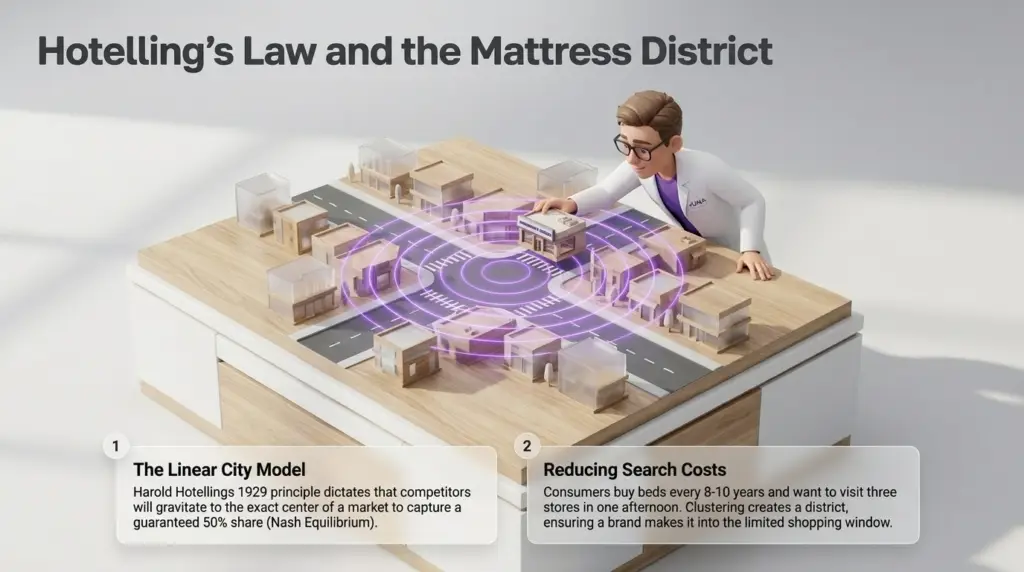
The sight of a Mattress Firm directly across the street from a local sleep shop or a competitor like Sleep Number is not a mistake; it is a manifestation of Harold Hotelling’s 1929 economic observation known as the “Principle of Minimum Differentiation”. To answer why there are so many mattress stores in one place, one must understand the Nash Equilibrium of retail location.
The Linear City Model
Hotelling’s Law suggests that in many markets, it is rational for producers to make their products and locations as similar as possible. In a “linear city” (represented by a long suburban road), if one vendor sets up shop in the middle, they can serve the entire population. If a second vendor enters, they will both gravitate toward the center to capture exactly 50% of the market. If one moves away from the center, they lose more customers to the competitor than they gain from their own “territory”.
Agglomeration and Search Costs
Clustering also serves a vital function for the consumer by reducing “search costs.” When a customer decides it is time to replace a mattress, they rarely visit just one store. By grouping together, mattress retailers create a “mattress district.” A consumer is more likely to drive to a location where they can visit three showrooms in one afternoon than to an isolated store. For retailers, being part of a cluster ensures they are included in the customer’s “consideration set” during the customer’s limited shopping window.
The Big Retail Shell Game: Bankruptcy and Consolidation
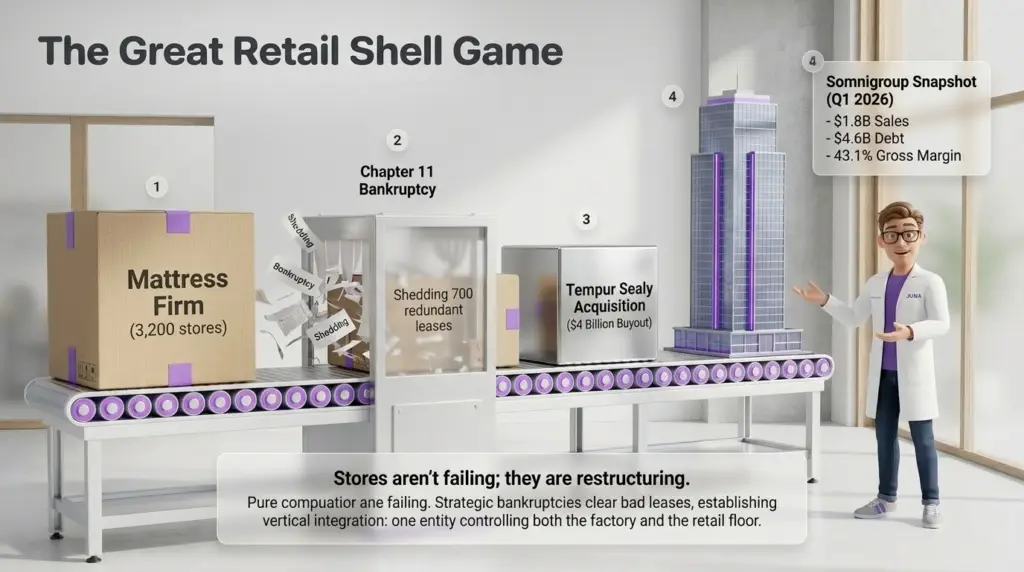
The question of why there are so many mattress stores is also tied to the aggressive expansion and subsequent restructuring of national chains. The history of Mattress Firm is particularly instructive. At its peak, the company operated more than 3,200 stores. This massive footprint was achieved through the acquisition of dozens of smaller regional competitors, such as Sleepy’s and Sleep Train.
Strategic Bankruptcy
In 2018, Mattress Firm filed for Chapter 11 bankruptcy. This was not necessarily a sign of a dying business, but rather a strategic move to exit approximately 700 unprofitable leases. Because the company had acquired so many competitors, it often found itself owning three stores at a single intersection—effectively competing with itself. The bankruptcy process allowed the company to shed these redundant locations and focus on high-performing markets.
The Birth of Somnigroup International
The consolidation did not stop with bankruptcy. In 2025, Tempur Sealy International completed a $4 billion acquisition of Mattress Firm, forming a new parent company, Somnigroup International (SGI). This merger represented a massive shift toward vertical integration, in which a single company controls the manufacturing of brands such as Tempur-Pedic, Sealy, and Stearns & Foster while simultaneously controlling the largest retail distribution channel in the country.
By the first quarter of 2026, Somnigroup International reported:
- Net Sales: $1.801 Billion.
- Gross Margin: Expanded to 43.1%.
- Debt Load: $4.6 Billion in total debt.
This level of financial engineering allows the company to maintain a massive store presence even if individual locations are not high performers, simply because the stores act as physical billboards and prevent competitors from occupying that retail space.
Learn more about the birth of Somnigroup International
The FTC vs. The Titans: Analyzing the Somnigroup Merger
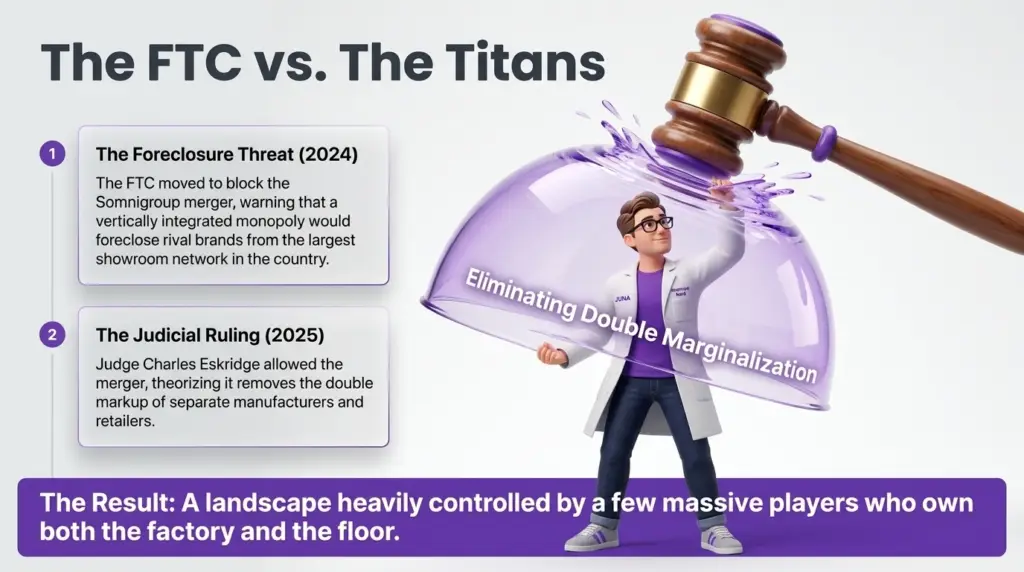
The consolidation of the mattress industry has not occurred without significant government scrutiny. In 2024, the Federal Trade Commission (FTC) moved to block Tempur Sealy’s acquisition of Mattress Firm, arguing that the vertical merger would substantially lessen competition and lead to higher prices for consumers.
The “Foreclosure” Argument
The FTC’s primary concern was that as a vertically integrated manufacturer-retailer, Somnigroup would “foreclose” rival mattress brands from Mattress Firm’s retail space. If a manufacturer like Purple or Serta Simmons wanted to reach consumers, they might find themselves locked out of the country’s largest showroom network or relegated to the back of the store with less favorable pricing.
Judge Eskridge’s Ruling
In January 2025, U.S. District Judge Charles Eskridge denied the FTC’s motion for a preliminary injunction, allowing the merger to close on February 5, 2025. The court found that the mattress market was sufficiently competitive and that consumers would likely benefit from “the elimination of double marginalization”—a situation where a separate manufacturer and retailer each add their own markup. By combining, the company could theoretically offer lower prices to the end consumer.
However, for the consumer who asks why there are so many mattress stores, this ruling confirms that the landscape is increasingly dominated by a few massive players who own both the factory and the floor. This makes the search for independent, quality-focused alternatives like Juna Sleep Systems even more critical.
The Marketing Tax: Analyzing Sleep Number’s High-Cost Model
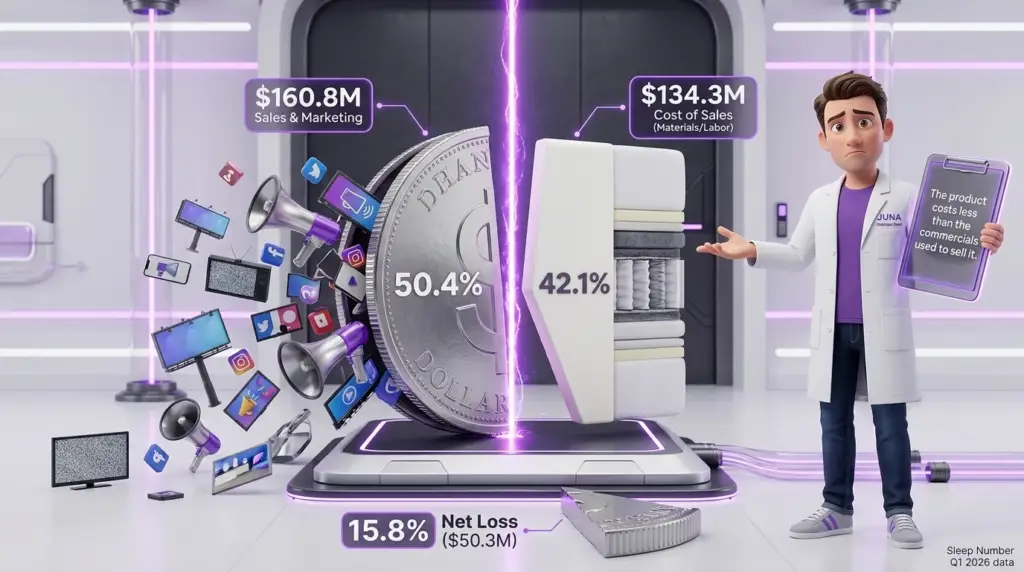
While some stores survive on high margins and low volume, others—like Sleep Number—rely on a high-intensity marketing model that significantly inflates the final product’s cost. When looking at why there are so many mattress stores, one must consider the “marketing tax” embedded in every purchase.
50.4% Marketing Expense
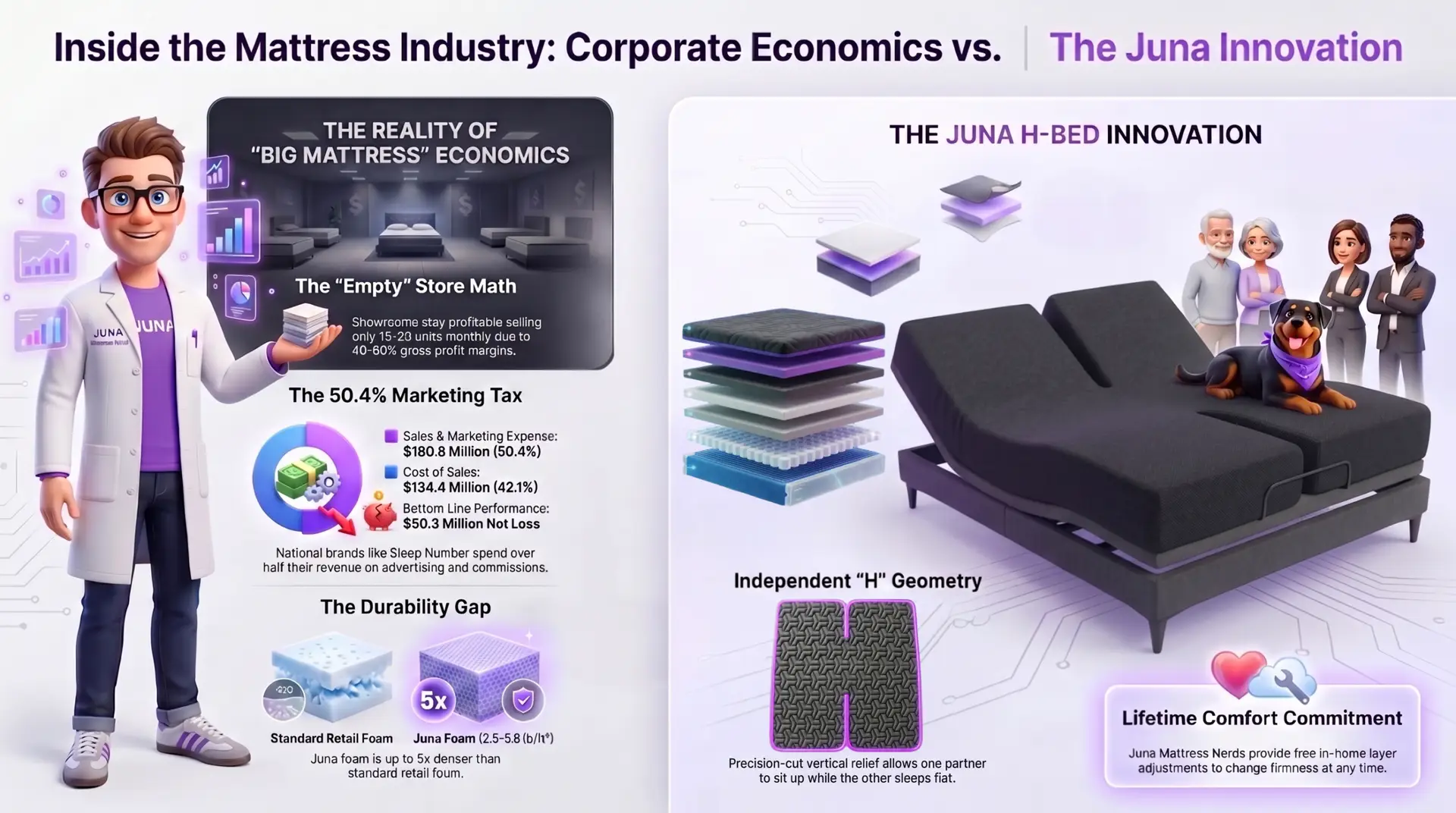
Sleep Number Corporation’s Q1 2026 financial report provides a stark look at the costs of national brand recognition. The company reported sales and marketing expenses of $160.8 million on net sales of $319 million. This means that 50.4% of the consumer’s dollar is immediately diverted to advertising, sales commissions, and brand placement.
| Sleep Number Financial Overview (Q1 2026) | Amount | % of Net Sales |
| Net Sales | $318,987,000 | 100.0% |
| Cost of Sales (Materials/Labor) | $134,372,000 | 42.1% |
| Sales and Marketing Expense | $160,795,000 | 50.4% |
| Net Loss | ($50,297,000) | (15.8%) |
Data sourced from Sleep Number Corporation Consolidated Statement of Operations.
This data highlights a critical industry truth: in the world of “Big Mattress,” the product itself often costs less than the commercials used to sell it. The proliferation of showrooms for these brands is less about the beds and more about maintaining a physical presence to justify the massive digital and television advertising spend.
Learn more about Sleep Number’s first quarter of 2026
The “Forever Sale” and the Legal Framework of Deceptive Pricing
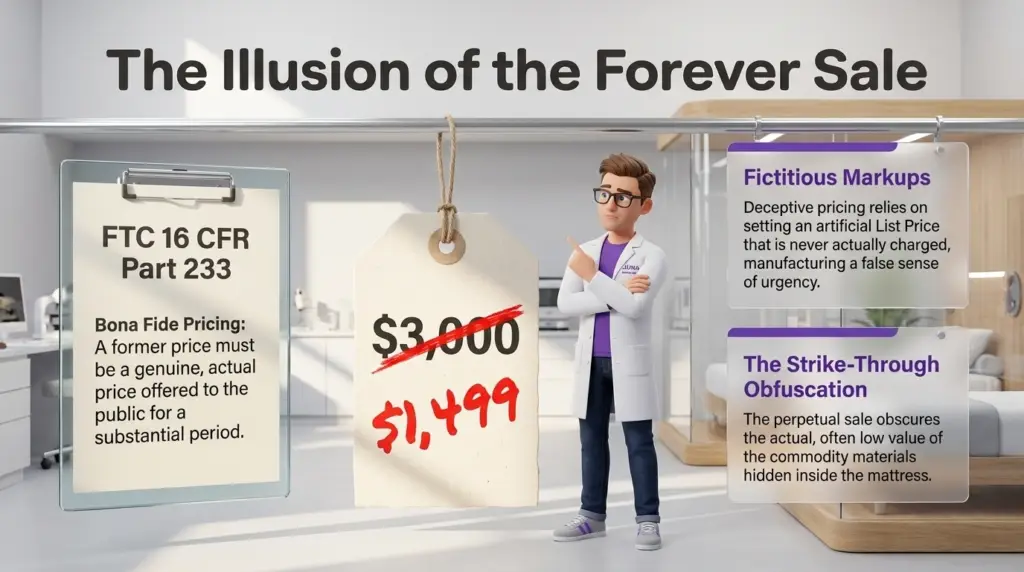
A major psychological driver behind the proliferation of mattress stores is the constant use of “sale” pricing. Consumers are often conditioned to never pay “full price,” but the legal reality of these sales is frequently gray.
The FTC Deceptive Pricing Guides (16 CFR Part 233)
The Federal Trade Commission has established strict guidelines to prevent retailers from using fictitious “regular” prices to make discounts appear larger than they are. According to the guides:
- Bona Fide Pricing: A former price must be the “actual, bona fide price at which the article was offered to the public on a regular basis for a reasonably substantial period of time”.
- Fictitious Markup: It is deceptive to set an artificial price and then offer a “sale” price that is actually just the standard retail price.
- Meaningful Reductions: Reductions should be significant enough that consumers believe they are receiving a genuine bargain. The FTC notes that a reduction from $10.00 to $9.99 is misleading.
Despite these rules, many national retailers engage in “strike-through pricing,” in which the “List Price” is almost never charged. This creates a sense of urgency for the consumer but obscures the true value of the materials being purchased.
The Juna Advantage: Redefining Quality in a Consolidated Market
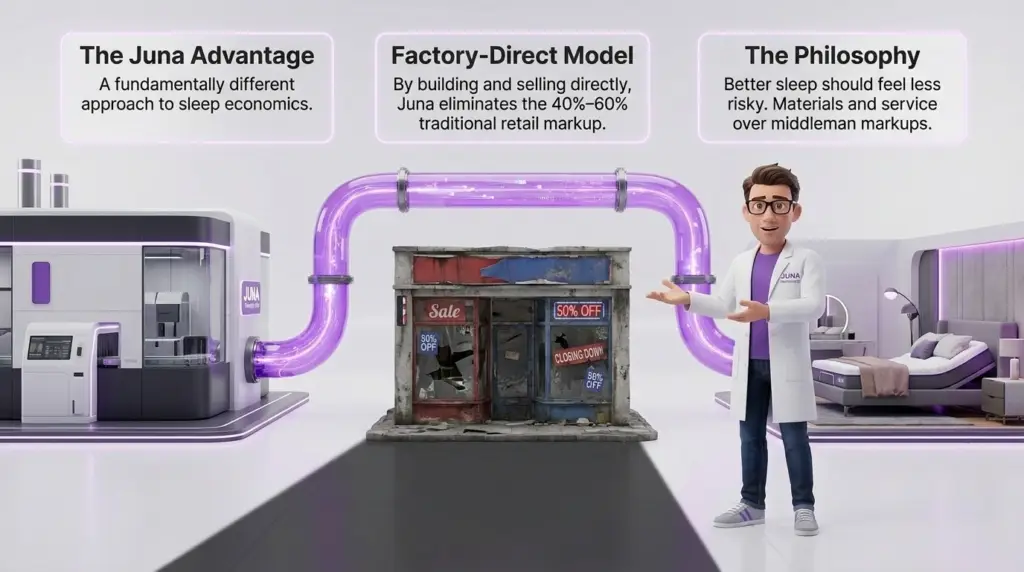
In an industry dominated by private equity debt, vertical monopolies, and 50% marketing taxes, Juna Sleep Systems offers a fundamentally different approach. We believe that better sleep should feel less risky, and that starts with the Juna Advantage—a commitment to materials and service over middleman markups.
The Factory-Direct Model
Juna operates as a factory-direct manufacturer. By building our mattresses in our own facilities and selling them through our own showrooms, we eliminate the 40% to 60% markups found in traditional retail chains. This allows us to reassign that budget toward higher-quality materials that national brands often find too expensive to incorporate.
Learn more about Junas Factory-Direct Model
The Juna Lifetime Comfort Commitment
One of the biggest differentiators in the market is Juna’s Lifetime Comfort Commitment. Most mattress stores lock you into a firmness level the moment you sign the receipt. If your body changes or you realize the bed is too firm after six months, you are usually stuck paying a “comfort exchange” fee.
At Juna, we recognize that your mattress should adapt with you.
- In-Home Adjustments: If your mattress isn’t just right, a Juna Mattress Nerd will come to your home and professionally adjust the layers to make the bed firmer or softer, or to provide more lumbar support.
- Free Labor for Life: We do not charge for the labor of these adjustments for as long as you own the mattress.
- Zip & Flip System: Our patented design allows us to access and reconfigure the internal foam and coil layers in just 5 to 10 minutes.
This commitment reduces the risk of buying the wrong mattress and ensures that your investment provides long-term value, rather than just a good first impression in the showroom.
Learn more
Material Science: Foam Density and the Durability Gap
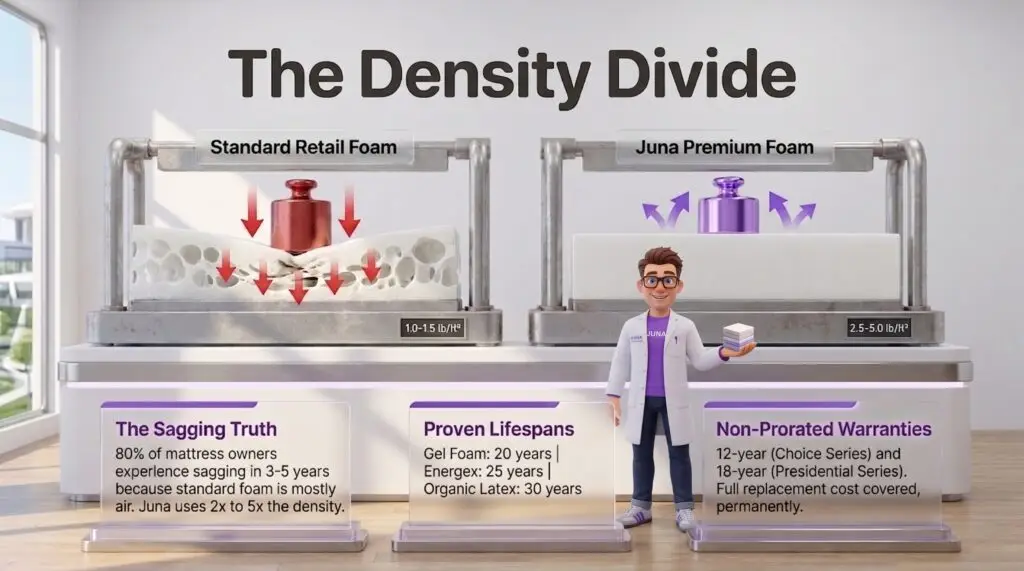
While asking why there are so many mattress stores, it is important to ask what is actually inside the beds they sell. Most traditional retailers use low-density polyurethane foam that feels soft in the showroom but quickly breaks down, leading to the “sagging” and body impressions that plague 80% of mattress owners.
The Density Difference
- Standard Retail Foam: Typically has a density of 1.0-1.5 lb/ft³. This foam is mostly air and can lose its supportive properties within 3 to 5 years.
- Juna Premium Foam: Every foam layer in a Juna mattress features a density of at least 2.5 lb/ft³ and as much as 5.0 lb/ft³.
Because our foams have 2 to 5 times the density of commodity foam, they are extremely resilient. Independent testing indicates that Juna’s materials are built to last:
- Gel Foam: 20-year lifespan.
- Energex™ Foam: 25-year lifespan.
- Organic Latex: 30-year lifespan.
Juna’s Non-Prorated Warranties
Our confidence in these materials is reflected in our warranty structure, which is kept entirely separate from our Lifetime Comfort Commitment.
- Choice Series: 12-year non-prorated warranty.
- Presidential Series: 18-year non-prorated warranty. “Non-prorated” means that Juna covers the full cost of replacing defective materials for the entire duration of the warranty. Unlike other brands, your protection value does not diminish as the mattress ages.
The Juna H-Bed: Solving the Couple Compromise
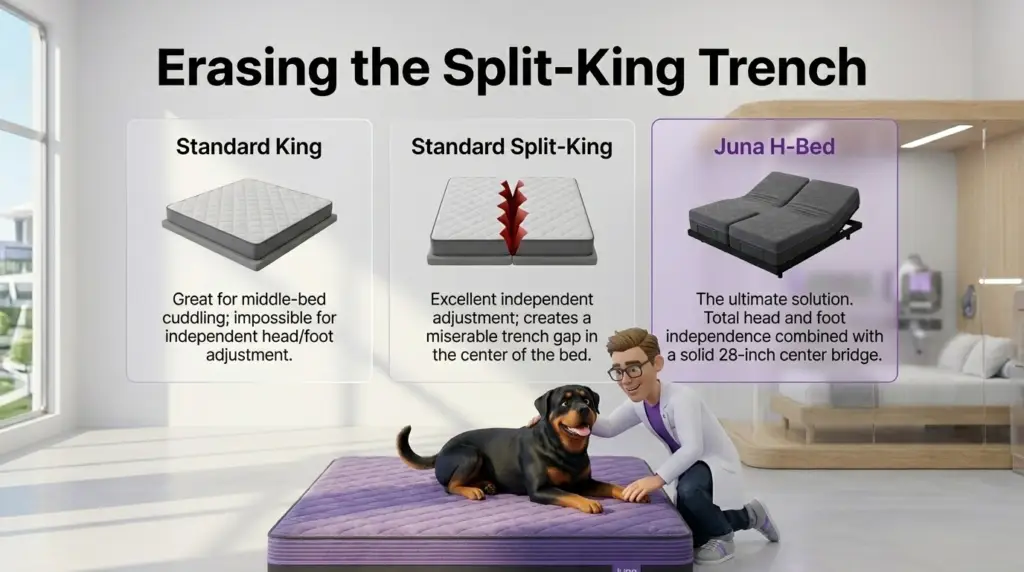
One of the primary reasons couples are dissatisfied with mattress shopping is the “compromise” required to accommodate different sleep styles. One partner may want a soft, plush feel, while the other requires firm orthopedic support. Traditional “Split King” options solve this by pushing two beds together, but they create a literal divide in the relationship.
The Problem with Traditional Split Kings
Standard split adjustable beds leave a “trench” or “gap” in the center. This makes it impossible to cuddle or sleep in the middle of the bed without falling between the two mattresses. This is a common reason couples search for answers about why there are so many mattress stores—hoping to find a better solution.
The Juna H-Bed Innovation
The Juna H-Bed is a profound, industry-disrupting innovation designed to offer independence without the gap.
- Unified King Surface: The H-Bed is a single, unified mattress, not two separate pieces.
- “H” Geometry: Precision-cut vertical relief at the head and foot of the mattress allows each side to move independently.
- The 28-Inch Bridge: The central torso region of the mattress remains a solid, uncut bridge of foam. This design retains the “cuddle zone” while allowing one partner to sit up and read while the other sleeps flat. It provides independent adjustability without sacrificing intimacy.
Ergonomics and Innovation: Zero Gravity and Adjustable Bases
As the mattress industry evolves, the “static” bed is being replaced by the “sleep system.” At Juna, we pair our H-Bed with premium adjustable bases to provide therapeutic benefits that traditional flat beds cannot match.
Zero Gravity and Pressure Relief
The Zero Gravity preset on Juna adjustable bases elevates the head and legs to a specific angle that mimics a weightless environment. This posture helps to:
- Reduce Lower Back Pressure: Decompresses the spine and relaxes the surrounding muscles.
- Improve Circulation: Slightly elevating the legs assists blood flow back to the heart.
- Mitigate Acid Reflux: Keeping the head elevated prevents stomach acid from entering the esophagus during the night.
The Anti-Snore Solution
Snoring is one of the leading causes of partner disturbance. The Anti-Snore setting on a Juna base slightly elevates the head to open the airways, which can significantly reduce or eliminate snoring without the need for intrusive medical devices. When paired with the H-Bed, the snoring partner can be tilted up while the other remains in their preferred position.
Learn more about the Juna H-Bed
Local Impact: Serving Sioux Falls and Rapid City
Juna Sleep Systems is not a nameless conglomerate like Somnigroup; we are a Midwest-based company with deep roots in the communities we serve. When you visit a Juna showroom, you are shopping local and receiving support from a team that actually builds the product.
We are proud to serve the following areas from our factory-direct showrooms:
Sioux Falls, SD Location
A short drive from:
- Brandon, SD
- Harrisburg, SD
- Tea, SD
The Sioux Falls showroom is the heart of Juna’s South Dakota operations, providing personalized fitting for the entire region
Rapid City, SD Location
A short drive from:
- Spearfish, SD
- Sturgis, SD
- Box Elder, SD
Our Rapid City showroom provides the Black Hills region with access to handcrafted, adjustable sleep systems designed for the rugged demands of real life.
