

Quick Answer: THC and Sleep: The Short-Term Win and Long-Term Loss
In an era where cannabis and THC products are increasingly legalized and widely accessible, millions of people have turned to cannabis as a natural sleep aid. For anyone who has struggled with a racing mind at midnight, the effect of a nightcap edible or vape can feel like a miracle: within 30 to 60 minutes, the body heavy-sinks into the mattress, anxiety recedes, and sleep comes effortlessly.
This initial relief is real, but it is also a biological trap.
While cannabis is exceptionally effective at short-circuiting the time it takes to fall asleep, modern neurobiology reveals a stark tradeoff. THC does not induce true, natural sleep architecture; instead, it acts as a central nervous system sedative that alters your brain’s sleep cycles. Over time, daily reliance on THC leads to rapid receptor desensitization, severe suppression of REM sleep, nighttime awakenings, and a rebound withdrawal insomnia that can make unmedicated sleep feel impossible.
Navigating sleep hygiene in the modern world requires looking past the “herbal remedy” label to understand how exogenous cannabinoids interact with your brain’s delicate neurochemistry.
The Short-Term Win (Sleep Onset): Tetrahydrocannabinol (THC) binds to CB1 receptors in the basal forebrain, increasing adenosine levels and dampening physiological arousal. This reduces sleep latency (how fast you fall asleep) and temporarily increases slow-wave (deep) sleep.
- The Rapid Tolerance Trap: Within days to weeks of daily use, CB1 receptors downregulate and desensitize. The same dose no longer induces drowsiness, prompting users to increase intake and setting off a cycle of chemical dependence.
- REM Sleep Erasure: THC severely suppresses Rapid Eye Movement (REM) sleep—the stage critical for emotional processing, memory consolidation, and trauma recovery. Chronic users live in a state of long-term REM deprivation.
- Withdrawal Insomnia & REM Rebound: Discontinuing THC triggers a surge in central nervous system arousal and an intense “REM rebound.” This results in severe insomnia, night sweats, and vivid, terrifying nightmares that often drive users back to cannabis.
- The Environmental Fix: Reclaiming natural, unmedicated sleep architecture requires stabilizing your bedroom environment. Eliminating physical micro-arousals caused by mattress heat, sag, and motion transfer is essential while your neurochemistry recalibrates.
THC and Sleep: The Short-Term Benefit and the Long-Term
Introduction: The Sedative Illusion
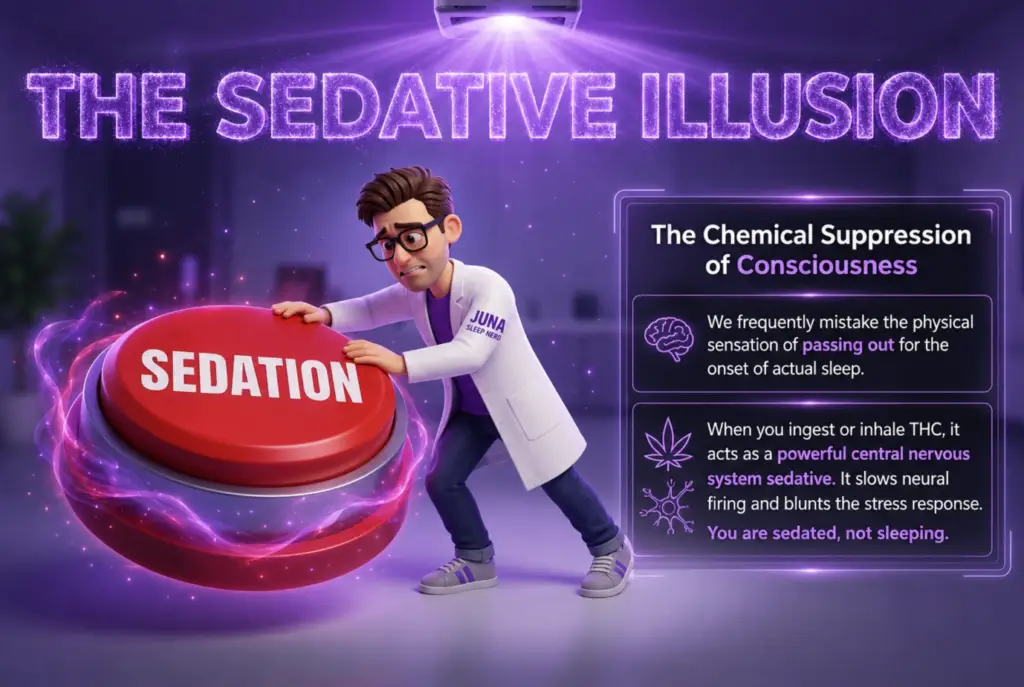
There is a fundamental difference between sedation and restorative sleep.
When you ingest or inhale THC, the drug acts as a powerful central nervous system sedative. It slows neural firing, blunts the stress response, and lulls the brain into early-stage non-REM sleep. To someone who has suffered from chronic stress or insomnia, this sedated state feels like a victory.
However, sedation is merely the chemical suppression of consciousness—it is not identical to the complex, multi-stage recovery process that occurs during natural sleep.
- [Sedation (THC Ingestion)] ──► Suppresses Brainstem Activity & Accelerates Sleep Onse
- [Altered Architecture] ──► Blocks REM Sleep & Causes 2nd-Half Nighttime Fragmentation
- [Chemical Reliance] ──► Downregulates CB1 Receptors & Triggers Severe Withdrawal Insomnia
Natural sleep is a finely tuned neurological sequence where the brain cycles smoothly through Light NREM, Deep Slow-Wave, and REM sleep roughly every 90 minutes. Each phase performs crucial housekeeping: deep sleep repairs tissues and flushes metabolic waste via the glymphatic system, while REM sleep restores emotional regulation and recalibrates neural networks.
By replacing this natural sequence with a heavy cannabinoid sedation, chronic cannabis use disrupts your biological sleep architecture—leaving you chronically depleted under the surface.
At Juna Sleep Systems, our philosophy is grounded in supporting natural biological sleep without relying on chemical crutches. Whether you are exploring options online or visiting our factory showrooms in Sioux Falls, South Dakotaor Rapid City, South Dakota, reclaiming your natural sleep starts with understanding your physiology.
The Short-Term Win: CB1 Agonism, Adenosine, and Accelerated Sleep Onset
To understand why cannabis is so addictive as a sleep aid, we must look at how THC interacts with the Endocannabinoid System (ECS).
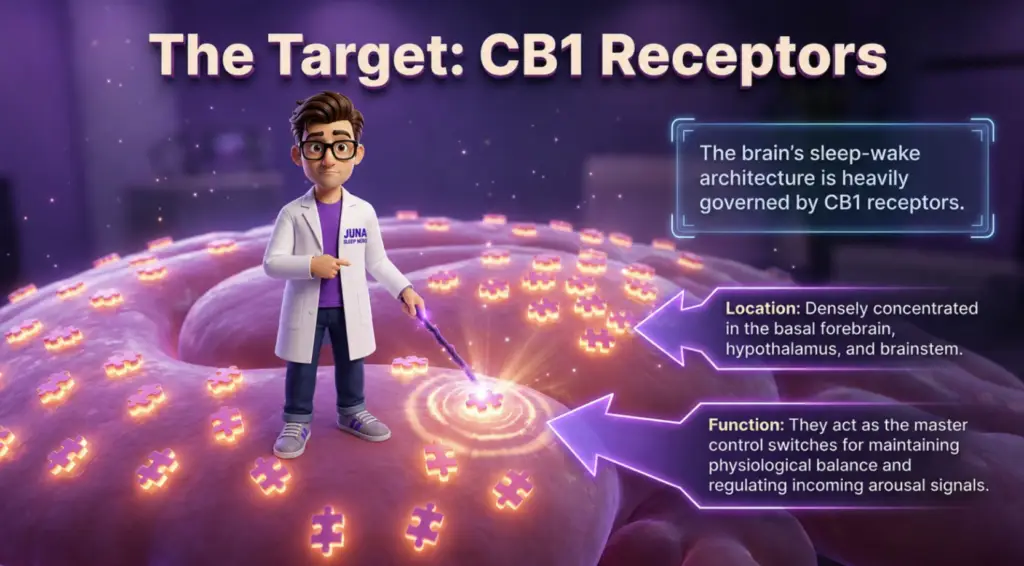
The ECS is a vast regulatory network designed to maintain physiological balance (homeostasis). Its primary receptors, CB1 receptors, are densely concentrated in brain regions that govern sleep-wake architecture, including the basal forebrain, hypothalamus, and brainstem.
When you consume THC, it mimics anandamide (a naturally occurring endocannabinoid often called the “bliss molecule”) and directly activates these CB1 receptors.
Plaintext
- [THC Ingestion] ──► Binds to CB1 Receptors in Basal Forebrain
- [Neurological Cascades] ──► Increases Adenosine & Reduces Sympathetic Flight Response
- [Short-Term Outcome] ──► Rapid Reduction in Sleep Latency (Falls Asleep Fast)
This CB1 activation triggers three immediate effects that speed up sleep onset:
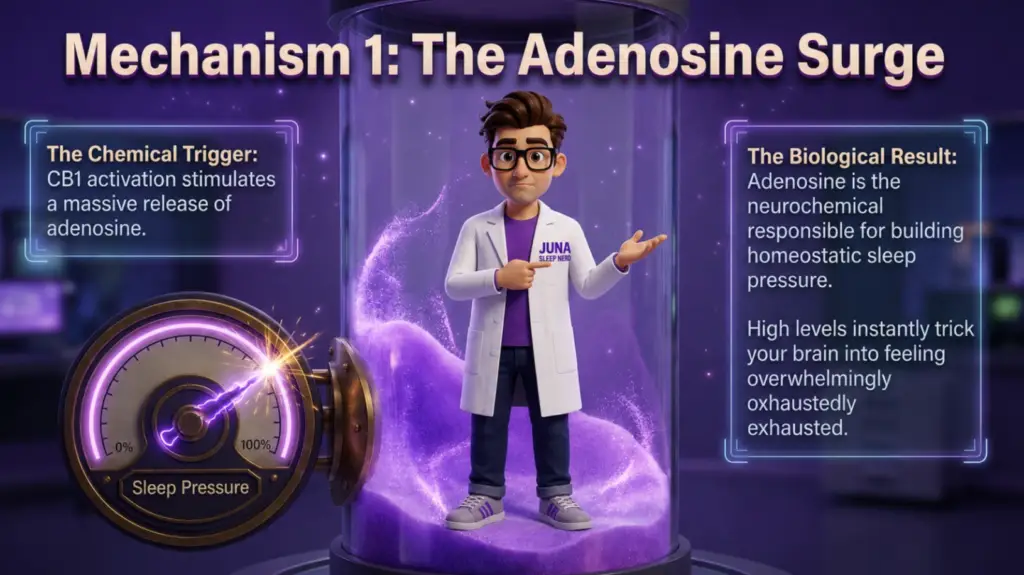
- Adenosine Surge: THC stimulates the release of adenosine, the neurochemical responsible for building homeostatic sleep pressure. High adenosine levels signal to the brain that it is exhausted.
- Amuting the Amygdala: THC reduces activity in the amygdala (the brain’s threat center), shutting down racing thoughts, anxiety, and physical tension.
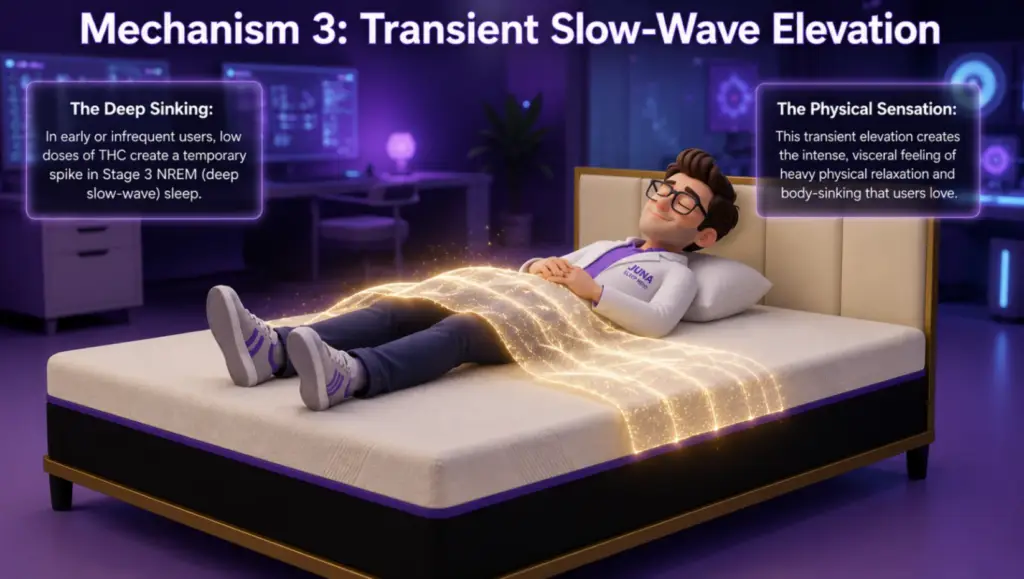
- Transient Slow-Wave Elevation: In early or infrequent users, low doses of THC slightly increase Stage 3 NREM (deep slow-wave) sleep, creating a feeling of heavy physical relaxation.
For the occasional user, this mechanism provides a fast track to sleep. The problem arises when this acute intervention becomes a nightly habit.
Discover ( the Short-Term Win: CB1 Agonism, Adenosine, and Faster Sleep Onset )
The Long-Term Loss: Receptor Downregulation and the Tolerance Trap
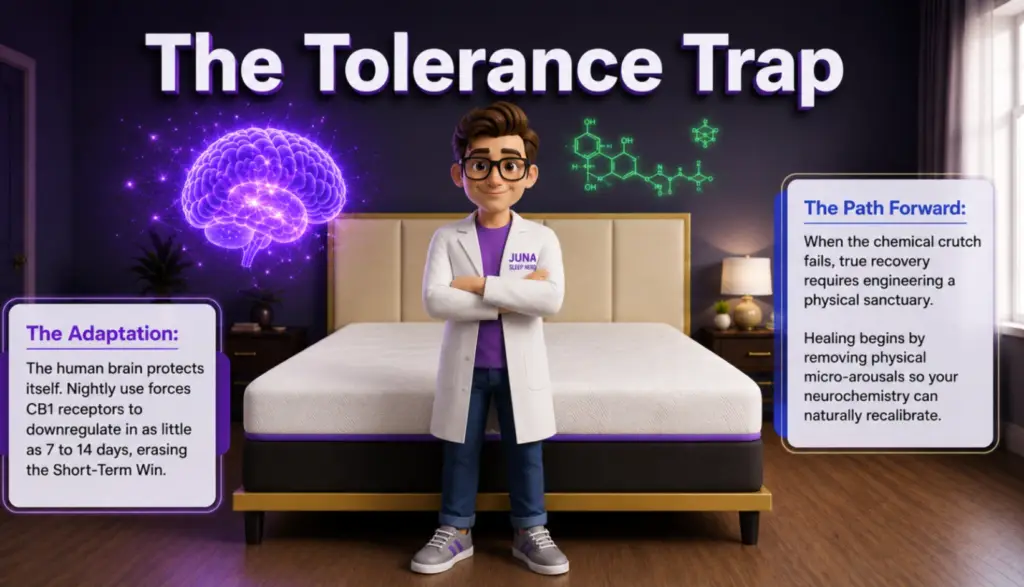
The human brain is remarkably adaptive. When exposed to constant artificial stimulation, it takes steps to protect itself from overactivation.
When you flood your CB1 receptors with high levels of exogenous THC every night, the brain responds through a process known as neuroadaptation:
- Desensitization: The CB1 receptors become less responsive to cannabinoids.
- Downregulation (Internalization): The brain physically retracts and reduces the number of active CB1 receptors on cell membranes.
- [Nightly High-Dose THC Use] ──► Floods CB1 Receptors
- [Neuroadaptation Response] ──► Downregulates & Retracts CB1 Recepto
- [Escalating Dose Loop] ──► Loss of Sleep Initiation & Chemical Dependence
Research shows that significant CB1 receptor downregulation can occur in as little as 7 to 14 days of consecutive daily cannabis use.
As receptor density drops, your baseline sensitivity to both THC and your natural endocannabinoids (like anandamide) collapses. The 5mg edible that once put you to sleep no longer works; you need 10mg, then 20mg, then higher concentrations. You are no longer using cannabis to enhance sleep; you are using it simply to avoid the severe insomnia caused by a depleted endocannabinoid system.
Discover ( the Long-Term Loss: Receptor Downregulation and the Tolerance Trap )
REM Sleep Erasure: The Cognitive and Emotional Cost of Cannabis Use
Of all the impacts THC has on sleep architecture, its suppression of Rapid Eye Movement (REM) sleep is the most damaging long-term.
REM sleep is the stage where dreams occur. During REM, your brain stem paralyzes your voluntary muscles while your cerebral cortex fires intensely. This stage is non-negotiable for psychological health:
- Emotional Processing: REM sleep strips the painful emotional edge off difficult memories, acting as a nightly psychological therapy session.
- Memory Consolidation: It synthesizes daily experiences, connecting new knowledge with existing neural networks.
- Neuroplasticity: It stimulates brain-derived neurotrophic factor (BDNF), supporting learning and mental flexibility.
- [Chronic THC Presence] ──► Suppresses Cholinergic Firing in Brainstem
- [REM Sleep Elimination] ──► Deprives Brain of Emotional Integration Processing
- [Long-Term Impact] ──► Increased Emotional Volatility, Anxiety, & Chronic Brain Fog
THC directly suppresses REM sleep by altering cholinergic signaling in the brainstem. While a chronic cannabis user may sleep for 8 hours, they often experience almost zero REM sleep.
Over months and years, this selective REM sleep deprivation leads to noticeable cognitive and emotional costs. Users often report waking up with persistent “brain fog,” reduced emotional resilience, increased daytime irritability, and difficulties with short-term memory recall.
Discover ( the Cognitive and Emotional Cost of Cannabis Use )
Sleep Fragmentation: The Second-Half Nighttime Awakening
A common myth among cannabis users is that because THC helps them fall asleep, it keeps them asleep all night. Physiology tells a different story.
THC has a relatively short metabolic half-life in terms of acute psychoactive action. As you sleep through the first four hours of the night, your liver processes and clears circulating THC from your bloodstream.
Plaintext
- [First 4 Hours: High THC Blood Levels] ──► Heavy NREM Sedation / Blocked REM
- [Second 4 Hours: THC Blood Levels Crash] ──► Acute Mini-Withdrawal & Sympathetic Spike.
- [Nighttime Micro-Arousals] ──► Tossing, Turning, Light Sleep, & Fragmentation
As blood THC concentrations drop during the second half of the night:
- The brain experiences a mild, acute withdrawal state mid-sleep.
- Sympathetic nervous system activity spikes, raising heart rate and body temperature.
- The depth of sleep thins out dramatically, leading to repeated micro-arousals or full awakenings around 3:00 AM or 4:00 AM.
Because users remember falling asleep quickly, they rarely attribute these middle-of-the-night awakenings to their evening cannabis use—often leading them to consume more cannabis to fall back asleep, compounding the cycle.

Discover ( the Second-Half Nighttime Awakening )
Withdrawal Insomnia and the REM Rebound Nightmare
When a chronic cannabis user decides to quit or take a tolerance break, they face a predictable physiological hurdle: THC Withdrawal Insomnia.
Because the brain’s CB1 receptors have been downregulated and natural endocannabinoid production has been suppressed, stopping THC leaves the central nervous system without its primary dampening mechanism.
Plaintext
- [Abrupt Cannabis Cessation] ──► Unmasks Downregulated CB1 Receptors
- [Neurochemical Surge] ──► Excessive Acetylcholine & Norepinephrine Releas3
- [REM Rebound Effect] ──► Extreme Latency, Night Sweats, & Terrifying Dreams
This sudden absence of CB1 signaling leads to two distinct withdrawal phenomena:
1. Severe Sleep Onset Insomnia
Without exogenous THC to force adenosine release and calm the amygdala—and without enough functioning CB1 receptors to utilize natural anandamide the brain enters a state of hyper-arousal. Heart rate rises, anxiety spikes, and falling asleep can take hours.
2. The REM Rebound Nightmare Phase
Having been starved of REM sleep for months or years, the brain attempts to recover its accumulated “REM debt.” When THC is removed, cholinergic pathways fire intensely, driving the brain into prolonged, abnormally dense REM sleep.
This results in REM Rebound: extremely vivid, chaotic, and often terrifying nightmares accompanied by physical thrashing and severe night sweats. Faced with intense dreams and hours of tossing and turning, many individuals conclude that they “need” cannabis to sleep, restarting the usage cycle.
Somatic Matrix: Cannabis & THC Impact Across Usage Timelines
The matrix below tracks how cannabis transforms from a short-term sedative into a chronic sleep disruptor over time.
| Phase / Timeline | CB1 Receptor State | Impact on Sleep Onset | Impact on REM & Slow-Wave Sleep | Primary Physical & Cognitive Risks |
| Acute / Occasional (1–3 uses) | Fully sensitive; high density | Sleep latency reduced by 30–50%; rapid onset | Mild REM suppression; slight increase in slow-wave sleep | Morning grogginess; mild dry mouth |
| Short-Term Daily (2–4 weeks) | Initial desensitization begins | Onset benefits decline; baseline dose feels weaker | Significant REM suppression; shortened dream states | Early tolerance; subtle memory fog |
| Chronic Daily (3+ months) | Heavy downregulation (30–50% loss) | Inability to sleep without THC; high sleep latency unmedicated | Near-complete REM erasure; fragmented NREM sleep | Cognitive blunting; emotional irritability; midnight awakenings |
| Acute Withdrawal (Days 1–14 post-quit) | Receptors downregulated; unmasked deficit | Severe withdrawal insomnia (1–3 hours to fall asleep) | Massive REM Rebound; intense, vivid nightmares | Profuse night sweats; elevated resting heart rate; high relapse risk |
| Recovery (Weeks 3–6 post-quit) | $CB_1$ density normalizes back to baseline | Natural sleep latency restores gradually | REM sleep duration stabilizes; dream intensity normalizes | Nervous system stabilization; restored daytime mental clarity |
How Physical Stressors Compound Cannabis Withdrawal Disruption
When you choose to reset your endocannabinoid system and navigate THC withdrawal insomnia, your physical sleep environment becomes a critical factor.
During the acute withdrawal phase, your sympathetic nervous system is hyperactive. Your heart rate is elevated, your body temperature fluctuates wildly, and your brain is hyper-sensitive to every sensory input.
In this vulnerable state, a poorly built or worn-out mattress acts as an immediate stress multiplier:
- Trapped Body Heat: Night sweats are a primary symptom of THC withdrawal as the autonomic nervous system recalibrates. Standard closed-cell memory foam traps body heat, raising your skin temperature and triggering panic-like awakenings.
- Physical Pressure Points: Low-density foams sag beneath your pelvis and spine. When your brain is already hyper-aroused from a lack of THC, painful pressure points on your hips and shoulders trigger micro-arousals that prevent you from reaching deep sleep.
- Motion Transfer: Toss-and-turn restlessness is inevitable during REM rebound. On a cheap mattress, every movement transfers across the bed, disturbing your partner and keeping your nervous system on high alert.
The Juna Counter-Strategy: Engineering a Sanctuary for Natural Recovery
At Juna Sleep Systems, we don’t rely on chemical shortcuts or temporary fixes. We engineer high-performance sleep systems designed to remove physical friction from the sleep equation, giving your nervous system the quiet, cool, and supportive foundation it needs to rebuild natural sleep cycles.
Open-Cell Ventilation: Dissipating Withdrawal Night Sweats
To handle the thermoregulatory spikes and night sweats common during cannabis withdrawal and natural sleep resets, Juna completely rejects low-grade, closed-cell materials. Our sleep systems are handcrafted using commercial-grade, high-density open-cell foams ranging from 2.5 lb to 5 lb in density.
The open-cell structure acts as a passive climate control system. Under body weight, the interconnected cells pump hot, humid air out of the mattress while drawing cool air in through the core. This continuous airflow rapidly evaporates sweat and dissipates thermal energy, keeping your body at a comfortable temperature so you can rest uninterrupted.
The Juna H-Bed: Preventing Partner Arousals During Restless Recovery
Withdrawal insomnia and REM rebound can cause frequent tossing, turning, and physical restlessness. On a standard mattress, these movements create motion waves that disrupt both you and your partner.
The Juna H-Bed eliminates kinetic transfer through an innovative internal design. Built as a unified King-sized mattress, the H-Bed features deep vertical expansion cuts at the head and foot of the bed, connected by a solid 28-inch foam bridge in the center.
This construction creates an effective kinetic barrier. When you shift or change positions during a restless dream state, the physical movement is absorbed and dissipated on your side of the bed. Your partner’s side remains completely still, protecting their sleep while giving you room to recover.
The Lifetime Comfort Commitment: Supporting Skeletal Realignment
As your nervous system settles and muscle tension drops during an unmedicated sleep reset, your preference for mattress support may change. A surface that felt acceptable while sedated may feel uncomfortably firm or soft once your body regains natural sensory awareness.
Juna eliminates this issue with our Lifetime Comfort Commitment. We never lock you into a single firmness level. If your support needs change at any point, simply contact our team. Our Juna Mattress Nerds will come to your home, unzip your mattress cover, and adjust or swap the internal high-density foam layers on-site. This guarantees ideal skeletal alignment through every phase of your health journey.
Positional Therapy: Decompressing the Nervous System with Adjustable Bases
Pairing a breathable Juna mattress with our Advanced Adjustable Base provides valuable physical support for a nervous system in transition:
- Relieving Lumbar Strain: The Zero-Gravity setting elevates your legs and head slightly above the heart, removing gravitational pressure from your lower back and allowing tight core muscles to fully relax.
- Improving Airway Flow: Elevating your upper body 10 to 15 degrees keeps upper airways clear, reducing snoring and supporting stable blood oxygen levels throughout the night.
- Facilitating Thermal Balance: Elevating the torso helps lower heart rate and aids in thermal dissipation, supporting easier sleep initiation.
The Factory-Direct Advantage: Pure Value for True Recovery
How can Juna offer commercial-grade, ultra-high-density open-cell foams while maintaining accessible pricing? It comes down to our factory-direct model.
Traditional mattress brands operate through complex supply chains filled with middlemen, distributors, and retail markups. To protect their margins, mass-market manufacturers often compromise on foam density, leading to quick sagging and heat retention.
At Juna, we build our sleep systems locally and sell them directly to you in our regional showrooms. This direct model allows us to put our resources straight into high-quality materials, such as our Infinity Edge support system—which combines an ultra-firm perimeter rail with a butterfly quad coil unit for durable, edge-to-edge support.
Conclusion: Reclaim Your Natural Sleep Architecture
The belief that cannabis is a harmless long-term sleep aid ignores fundamental neurobiology. While THC offers a short-term shortcut to sedation, it collects a heavy tax in the form of $CB_1$ downregulation, REM sleep erasure, sleep fragmentation, and severe withdrawal insomnia. Sedation is not recovery.
Reclaiming true, restorative sleep requires giving your brain the time and environment it needs to rebuild its natural endocannabinoid balance. By combining steady sleep habits with a sleep surface engineered to dissipate heat, isolate movement, and align the spine, you give your body the best environment for long-term health. Stop relying on chemical crutches—visit a Juna showroom today and rediscover natural sleep.
Frequently Asked Questions (FAQ)
1. Why does cannabis help me fall asleep so fast at first?
THC directly activates CB1 receptors in the basal forebrain, triggering a surge in adenosine (the neurochemical responsible for sleep pressure) while calming the amygdala (the brain’s fear and stress center). This combination lowers physiological arousal and shortens the time it takes to fall asleep.
2. What is REM sleep suppression, and why is it harmful?
REM sleep is the stage dedicated to emotional integration, memory processing, and mental recovery. THC suppresses the brainstem pathways responsible for generating REM sleep. Over time, losing REM sleep can lead to emotional irritability, persistent brain fog, memory issues, and reduced stress resilience.
3. How long does it take for CB1 receptors to recover after quitting cannabis?
Human neuroimaging studies show that CB1 receptor density begins to recover within 2 days of stopping cannabis and typically returns to near-baseline levels within 3 to 4 weeks of continuous abstinence, depending on historical usage levels.
4. What causes the vivid nightmares during cannabis withdrawal?
This is known as REM Rebound. After being deprived of REM sleep by chronic THC use, the brain attempts to catch up on its accumulated REM debt when cannabis is stopped. This leads to longer, unusually intense REM cycles featuring vivid, active, and sometimes disturbing dreams.
5. Why do I wake up sweating when I stop using THC before bed?
Night sweats are a primary symptom of cannabis withdrawal caused by autonomic nervous system recalibration. Without THC dampening the hypothalamus (the body’s internal thermostat), sympathetic nervous system activity spikes overnight, causing heart rate increases and sudden sweats.
6. How does a Juna open-cell foam mattress help during a cannabis detox?
Juna’s high-density open-cell foams feature an interconnected cell structure that allows air to flow freely. As your body experiences temperature spikes and night sweats during detox, the mattress dissipates thermal energy and evaporates moisture rapidly, preventing the heat buildup that causes middle-of-the-night awakenings.
Visit a Juna Showroom Near You
Ready to restore your natural sleep rhythms and experience true physical recovery? Visit one of our three regional factory-direct showrooms to speak face-to-face with a Juna Sleep Nerd and test a mattress built for long-term wellness.
- Juna Sleep Systems – Sioux Falls, SD: Conveniently located for families driving in from Brandon, Harrisburg, or Tea.
- Juna Sleep Systems – Rapid City, SD: Accessible for West River communities, including Box Elder, Summerset, and Sturgis.
