

Quick Answer:
Exploding Head Syndrome and Night Terrors represent two of the most intense, deeply disruptive manifestations of non-rapid eye movement (NREM) parasomnias known to clinical sleep medicine. Far from being standard bad dreams, these conditions are driven by structural and autonomic faults during sleep-state transitions within the brainstem and thalamocortical pathways. While Exploding Head Syndrome occurs as an asynchronous sensory gating failure during the transition from wakefulness to sleep, Night Terrors involve a sudden, incomplete arousal from deep delta sleep, leaving the individual in a state of profound physiological panic with zero conscious awareness.
Learn (about Exploding Head Syndrome and Night Terrors)
When Sleep Becomes a Neurological Maze
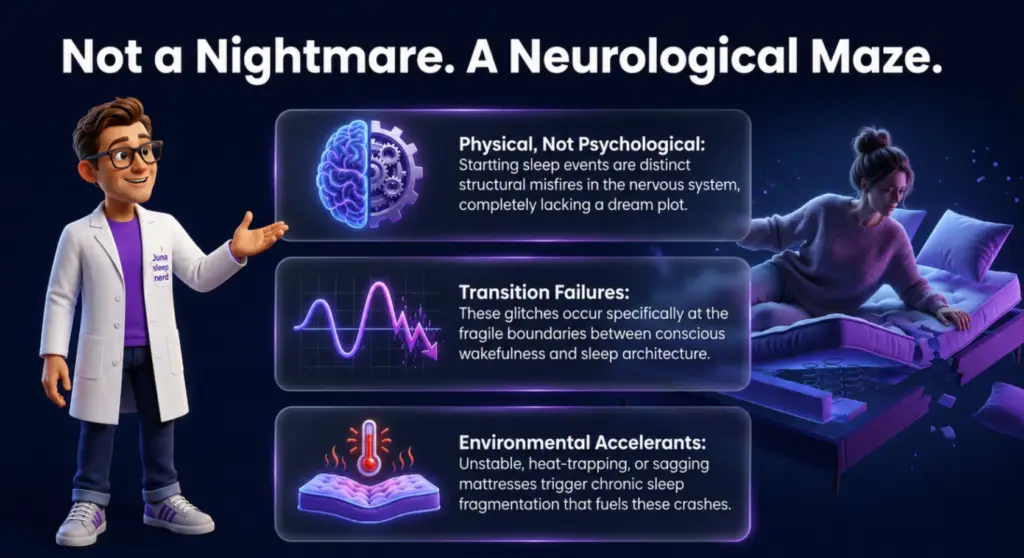
The transition from conscious wakefulness into a restorative night of sleep is designed to be a gentle, linear descent. For the vast majority of people, the sensory world fades, muscle tone relaxes, and the brain smoothly shifts through predictable frequencies of electrical activity. However, for individuals living with atypical parasomnias, this nightly transition becomes a volatile neurological maze. Imagine resting peacefully at the edge of sleep, only to be violently jarred awake by the terrifying illusion of a bomb detonating inside your skull. Alternatively, picture watching a partner suddenly sit upright in bed, eyes wide with pure panic, letting out a blood-curdling scream while completely unresponsive to your voice.
These experiences are the hallmark realities of atypical parasomnias. Historically misunderstood as psychological fractures, psychiatric emergencies, or spiritual disturbances, modern clinical neuroscience recognizes these episodes as distinct physical misfires occurring within the intricate boundaries of our sleep architecture.
At Juna Sleep Systems, we approach mattress engineering and manufacturing through the strict lens of human sleep science. We know that a physical sleep surface that sags, traps heat, or transmits partner motion leads to chronic sleep fragmentation. This fragmentation serves as the primary environmental catalyst for failures in neurological state transitions.
Whether you are searching for clinical clarity online or visiting one of our regional factory showrooms in Sioux Falls, South Dakota, or Rapid City, South Dakota, understanding the biological engines behind these peculiar disruptions is the first step toward safeguarding your central nervous system and reclaiming a peaceful night’s rest.
Discover (Sleep Becomes a Neurological Maze)
What are Parasomnias? Mapping the Sleep State Borderlands
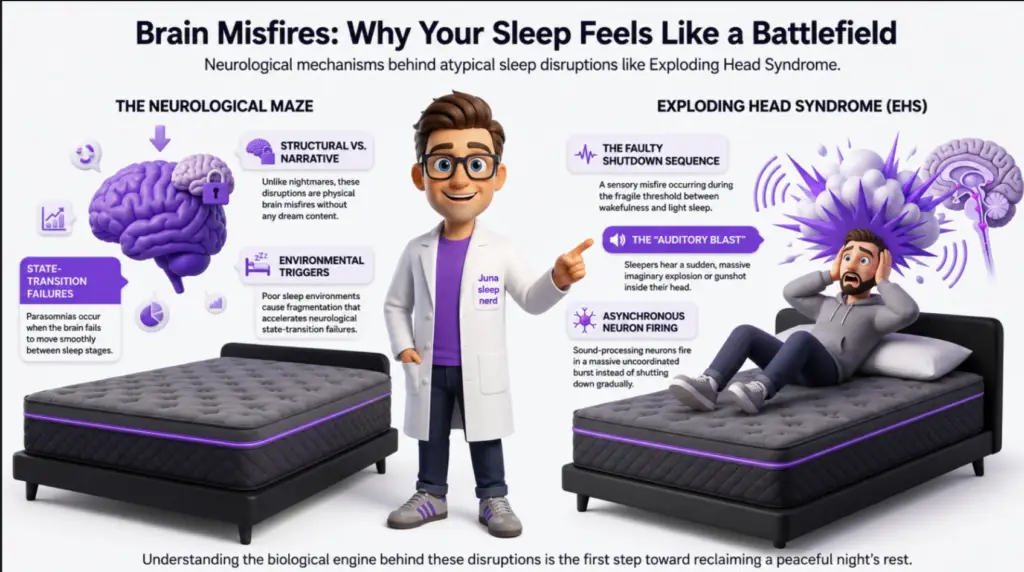
To understand the combined impact of these disruptions, one must first explore the clinical classification of parasomnias. In the Diagnostic and Statistical Manual of Mental Disorders (DSM-5) and the International Classification of Sleep Disorders (ICSD-3), parasomnias are defined as abnormal behavioral, experiential, or physiological events that occur during sleep, specific sleep stages, or sleep-state transition zones. They represent a breakdown of boundaries in which the distinct states of being—wakefulness, Non-REM sleep, and REM sleep—accidentally overlap.
Human sleep is highly structured. Throughout the night, your brain cycles through light sleep (Stages N1 and N2), deep slow-wave sleep (Stage N3), and rapid eye movement sleep (REM). Each stage is governed by a precise balance of neurotransmitters, neural networks, and structural gates.
When these gates fail to open or close in perfect harmony, the brain finds itself stuck in a borderland state. It can be physically awake enough to vocalize, walk, or experience vivid sensory inputs, while simultaneously remaining deeply asleep and cut off from executive cortical control. This boundary breakdown creates the perfect conditions for complex, distressing sleep anomalies to occur.
Exploding Head Syndrome: The Faulty Brain Shutdown Sequence
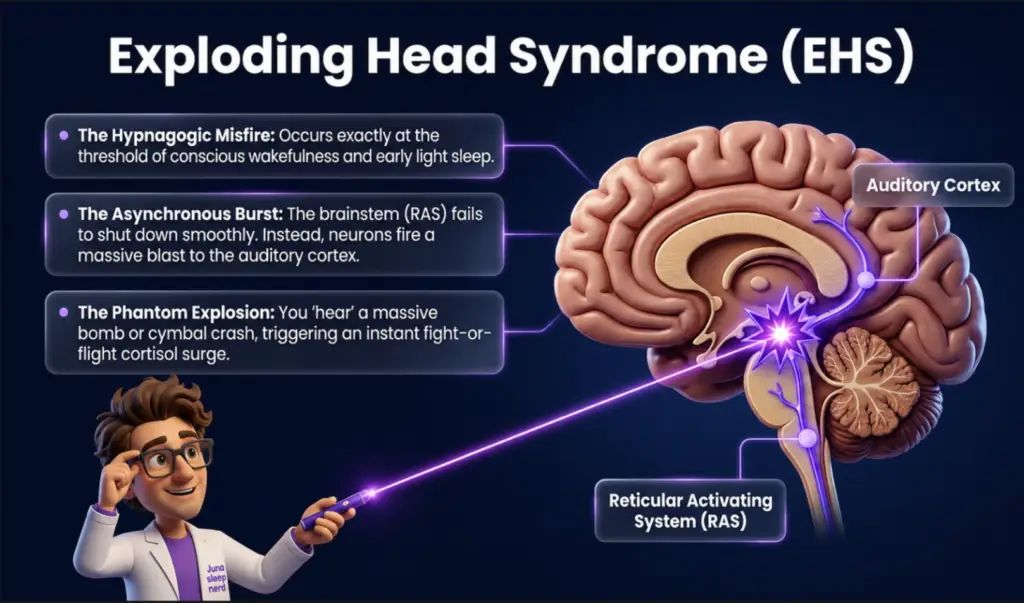
Despite its alarming clinical name, Exploding Head Syndrome (EHS) is a benign sensory parasomnia that occurs strictly during the hypnagogic transition—the fragile threshold where the mind shifts from conscious wakefulness into early N1 sleep. Individuals experiencing an EHS episode report hearing an intensely loud, sudden sound originating from deep within their own skull. These auditory hallucinations are frequently described as a massive explosion, a gunshot, a violent clash of cymbals, or an electric arc snapping violently close to the ear. In some instances, the auditory shock is accompanied by a sudden flash of white light or a localized muscle twitch.
When evaluating the causes of Exploding Head Syndrome, neuroscientists focus on a breakdown in the brain’s internal shutdown sequence. As you drift off to sleep, your brainstem’s Reticular Activating System (RAS)—the master switchboard responsible for maintaining conscious alertness—is supposed to turn off the cortical regions of the brain in a smooth, sequential wave. This includes shutting down the auditory, visual, and motor processing centers.
During an EHS episode, an asynchronous delay occurs. Instead of shutting down gradually, the neurons responsible for processing sound fire simultaneously in a massive, uncoordinated electrical burst. The auditory cortex is suddenly flooded with a massive wave of neural activity, which the sleeping mind interprets as an external, real-world explosion.
Because this occurs right as the conscious mind is letting go, the sudden burst triggers an immediate, systemic fight-or-flight response. The sleeper is instantly startled awake, left sitting upright with a racing heart, cold sweat, and surging cortisol levels.
Learn more about syndrome: the faulty brain shutdown sequence
Night Terrors: Autonomic Panic Trapped in Slow-Wave Sleep
While Exploding Head Syndrome dominates the early sleep-wake threshold, Night Terrors (Sleep Terrors) occur deep within the night’s architectural foundation. Night terrors are classified as a disorder of arousal originating from NREM slow-wave sleep, specifically during the deep N3 stage that dominates the first third of the sleep cycle. Unlike EHS, which is a fleeting sensory hallucination, a night terror is a prolonged state of profound autonomic overdrive. During an episode, the individual—most frequently a child, though sleep terrors in adults are increasingly documented—will abruptly sit up, scream out in panic, thrash violently, and display symptoms of extreme physiological stress, including heavy sweating, pupillary dilation, hyperventilation, and a racing pulse that can easily exceed 160 beats per minute.
The most unnerving element of a night terror is that the individual remains trapped in a state of incomplete arousal. Their eyes may be wide open, staring blankly into the room, but they are completely blind to their surroundings and unresponsive to external comfort. If a partner or parent attempts to shake them awake or hold them, the brain interprets the physical contact as an environmental threat, often escalating the panic or causing a violent defensive reaction.
Episodes can last anywhere from a few minutes to half an hour. Eventually, the individual falls asleep and drifts back into deep sleep. Because the cortical networks responsible for short-term memory consolidation remain completely offline throughout the event, the individual wakes up the next morning with total amnesia of the terror.
The Crucial Distinctions: Night Terrors vs. Standard Nightmares
To properly manage these conditions, it is vital to understand the structural differences between episodes of these parasomnias and standard nightmares. Many adults mistakenly categorize their severe sleep disruptions as basic nightmares, which can delay proper treatment and behavior modifications.
The core distinction lies in the timing, the sleep stage involved, and the presence of a dream narrative. A standard nightmare is a highly structured, emotionally intense dream that occurs almost exclusively during Rapid Eye Movement (REM) sleep—the active dreaming state that dominates the final third of the night.
When an individual wakes up from a nightmare, they do so quickly and completely. They instantly recognize their surroundings, vividly recall the dream’s narrative details, and do not suffer from confusion or amnesia.
In stark contrast, a night terror involves no dream narrative whatsoever; it is an explosion of pure, raw physiological panic without imagery, occurring out of deep NREM sleep. The individual is not awake, cannot be comforted, and will remember absolutely nothing about the event when the sun comes up.
Discover ( the difference between Night Terrors and Standard Nightmares)
Complete Clinical Matrix: Parasomnias vs. REM Dreaming
The following comprehensive matrix illustrates the diagnostic differences between Exploding Head Syndrome, Night Terrors, and traditional nightmares.
| Clinical Dimension | Exploding Head Syndrome (EHS) | Night Terrors (Sleep Terrors) | Standard Nightmares |
| Primary Sleep Stage | Hypnagogic Transition (Wake-to-Sleep) | NREM N3 (Deep Slow-Wave Sleep) | REM Sleep (Active Dreaming) |
| Timing of Night | Within 1–2 hours of sleep onset | First 2–3 hours of the night | Final 1/3 of the sleep cycle |
| Neurological Source | Reticular Activating System (RAS) | Incomplete Thalamocortical Arousal | Hyperactive Amygdala during REM |
| Autonomic Surge | Brief, immediate startle response | Extreme, sustained fight-or-flight | Mild to moderate upon waking |
| Dream Narrative | None (Isolated sensory blast) | None (Pure physiological panic) | Vivid, story-driven dream plot |
| Morning Recall | Perfect memory of the auditory blast | Complete amnesia of the episode | High recall of dream imagery |
| Motor Activity | Fleeting myoclonic twitch or startle | Violent thrashing, vocal screaming | Paralyzed (Normal REM atonia) |
Genetic and Environmental Triggers of Sleep Anomalies
The structural vulnerabilities that cause non-REM parasomnias are deeply rooted in a combination of genetic inheritance and environmental stressors. Clinical lineage studies reveal that parasomnias run consistently in families. If a parent has a history of sleepwalking, sleep talking, or night terrors, their children carry a significantly higher genetic predisposition to experiencing incomplete thalamocortical arousals. Researchers point to specific genetic variations that govern calcium channel function and neurotransmitter regulation in the brainstem, which can make the boundaries between sleep states less stable by nature.
However, a genetic predisposition usually requires an environmental trigger to cause an active episode. Chief among these triggers is chronic sleep deprivation. When you systematically shortchange your sleep, your brain accumulates a massive “sleep debt.” The next time you enjoy an extended sleep window, your central nervous system enters a state of slow-wave rebound. Your brain forces itself into prolonged, incredibly intense N3 deep sleep cycles to compensate for the loss.
Because this deep sleep pressure is so heavy, the mechanical transitions out of it become highly unstable. Any sudden external sound, change in room temperature, or physical discomfort can trigger a partial arousal—knocking the lower brain centers into full alertness while leaving the executive cortex asleep, creating the perfect storm for a violent night terror.
Additionally, chronic psychological stress and an overactive HPA axis play a major role in triggering EHS. When your body is flooded with daytime cortisol and adrenaline, your Reticular Activating System remains hyper-vigilant. As you attempt to slide into the hypnagogic state, this baseline neural tension disrupts the sequential shutdown of your sensory pathways, causing the auditory system to misfire in an explosive burst and creating massive sleep architecture disruptions.
The Physical Environment: How Mattress Sag Amplifies Brain Misfires
While your genetics are locked in, your physical sleep environment is a critical variable you can control. Many people fail to realize that their choice of mattress directly influences the frequency and severity of these deep parasomnias. When you sleep on a cheap, low-density mattress built with commodity 1.2-1.8 lb foam, the bed’s core structural integrity quickly fails. Within a few short years, the mattress begins to sag under your heaviest areas—specifically your hips and lower lumbar column.
This structural collapse throws your skeleton out of orthotic alignment, creating localized pressure points on your joints and muscles. As your body rests in deep N3 slow-wave sleep, these localized pain points send continuous, low-level sensory distress signals up your spinal cord and straight into your brainstem. Your brain interprets this physical strain as an environmental threat. The hypothalamus responds by initiating a micro-arousal to force your body to shift positions.
Because your sleep debt is deep, your brain tries to stay anchored in N3 sleep while simultaneously reacting to the physical pain signal. This structural conflict causes incomplete arousal: the lower motor centers wake in a panic to escape the pressure point, while your conscious mind stays asleep, triggering a terrifying night-terror episode. Furthermore, the constant tossing and turning caused by a poor mattress surface creates chronic sleep fragmentation. This fragmentation prevents you from establishing smooth, predictable sleep cycles, directly destabilizing your sleep-wake transition zones and drastically increasing your vulnerability to EHS auditory misfires.
The Juna Advantage: Engineering a Sanctuary for Hyperactive Brains
To break the environmental cycle that fuels the distressing phenomena of sleep transitions, you must provide your central nervous system with an environment of absolute physical safety and structural stability. At Juna Sleep Systems, we design our premium mattresses to serve as a physical shield for sensitive, hyper-vigilant nervous systems. We refuse to use cheap, mass-market foams that compress into sag zones and trap heat. Instead, our beds are handcrafted using ultra-premium 2.5-5 lb density foam that delivers superior pressure distribution across your entire body.
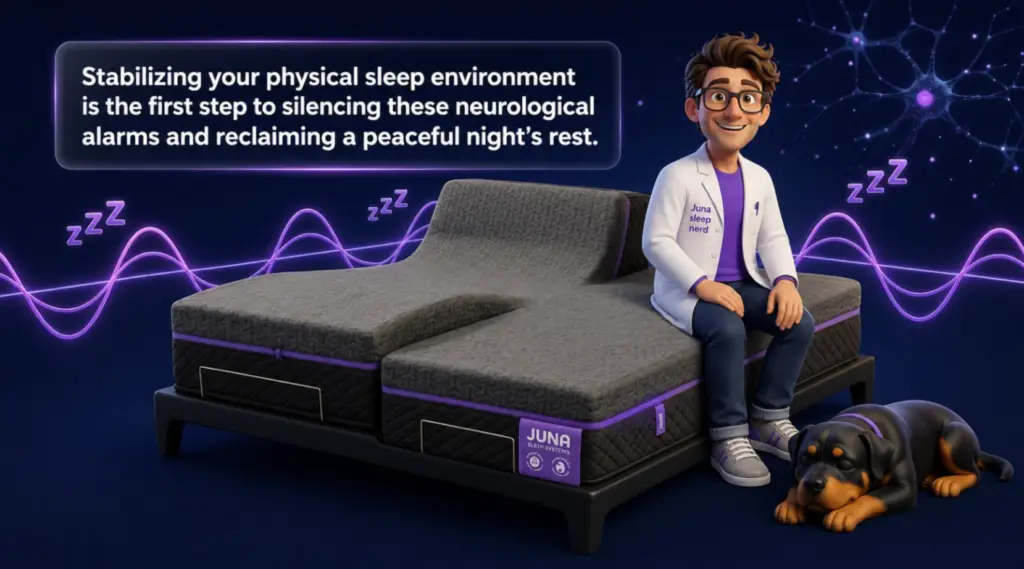
By completely eliminating the physical pressure points that send distress signals to your brainstem, a Juna mattress helps silence the environmental alarms that trigger incomplete arousals during N3 slow-wave sleep. Your body rests in perfect orthotic alignment, allowing your brain to transition smoothly between light sleep, deep slow-wave sleep, and REM states without being jarred by physical discomfort.
True Customization via the Lifetime Comfort Commitment
Navigating atypical parasomnias requires a highly flexible sleep surface that can adapt to your body’s changing needs over time. If a mattress is too rigid, it can create localized joint tension that triggers a fight-or-flight response; if it is too soft, the excessive sinkage can trap heat and restrict natural movement. Standard mattress retailers lock you into a single firmness setting the moment you walk out the door, turning your recovery journey into an expensive gamble.
Juna eliminates this stress entirely through our exclusive Lifetime Comfort Commitment. Your custom mattress can grow and adapt alongside your health data. If your healthcare provider or your own sleep tracking reveals that your body requires a more supportive lumbar zone to prevent micro-arousals during the first half of the night, or a plush, contouring surface to calm a hyper-vigilant nervous system, you simply contact a friendly Juna Mattress Nerd.
We come directly to your home, unzip your luxurious mattress cover, and adjust or replace the internal high-density comfort layers on-site. This personalized adjustment removes the guesswork, ensuring your mattress continues to support your neurological health for decades to come.
Kinetic Boundaries: Eliminating Inter-Partner Disruptions with the H-Bed
For couples dealing with active parasomnias, partner protection is an absolute necessity. If an individual is prone to thrashing during a night terror or startling awake from Exploding Head Syndrome, those violent kinetic movements travel across a conventional mattress, disrupting their partner’s sleep. Conversely, if a partner gets up in the middle of the night, that movement can trigger a partial arousal in the hyper-vigilant sleeper, sparking a brand-new episode.
The Juna H-Bed is engineered specifically to isolate motion transfer while preserving physical closeness for couples. Built as a single, unified King-sized mattress, the H-Bed features a revolutionary “H” geometry: deep vertical cuts at the center-head and center-foot, anchored by a solid, uncut 28-inch foam bridge right in the middle.
This breakthrough design allows for completely independent side-to-side mechanical movement and kinetic isolation. If one partner shifts or thrashes during an episode, the kinetic energy is absorbed and dissipated before it can cross the midline. The seamless center bridge maintains a unified “cuddle zone,” allowing couples to sleep together peacefully while protecting the hyper-sensitive sleeper from unexpected environmental shocks.
NASA-Inspired Posture Engineering for Autonomic Stability
To prevent the hypnagogic misfires of Exploding Head Syndrome and the intense physical stress of night terrors, your nervous system must transition from sympathetic flight-or-flight dominance into a deep parasympathetic calm before you turn off the lights. Pairing your high-density Juna mattress with an Advanced Adjustable Base provides the ultimate tool for physiological down-regulation. By engaging the built-in “Zero Gravity” preset, your body is placed in a weightless, neutral posture originally calculated by NASA researchers to eliminate gravity-induced strain.
- Lowering Sympathetic Tonus: Elevating the torso and thighs unloads compression forces from your lower spine, immediately calming your muscular system and sending safety signals to the brainstem.
- Optimizing Vascular Flow: Elevating your legs above heart level improves venous blood return, helping lower a racing pulse and stabilizing your cardiovascular system.
- Preventing Airway Obstructions: Slight head elevation expands your upper respiratory pathways, preventing snoring and drops in blood oxygen that can trigger stress-induced micro-arousals.
The Factory-Direct Difference: Sourcing Premium Heavy-Duty Foams
How is Juna able to manufacture sleep systems utilizing heavy-duty, commercial-grade materials while keeping our pricing honest and accessible? It all comes down to our factory-direct business model. The traditional mattress industry relies on a complex chain of middlemen, national brokers, and third-party retail storefronts, with each layer adding heavy markups to the final price. To protect their margins, these brands are forced to use cheap interior foam that breaks down and traps heat.
At Juna, we cut out the commercial middlemen completely. We build our mattresses closer to our customers and sell them directly through our own regional showrooms. This direct model allows us to route our investments away from corporate retail markups and straight into high-performance components, including our specialized Infinity Edge support system.
By combining a 6-inch high-resiliency support core with 2-inch ultra-firm perimeter side rails and a 2.5-inch butterfly quad coil unit, we create a stable, usable sleep surface all the way to the very edge. You get consistent, predictable orthotic support and exceptional breathability across every square inch of your mattress, ensuring your sleep architecture is backed by the finest engineering available.
Conclusion: Take the Terror Out of Your Bed
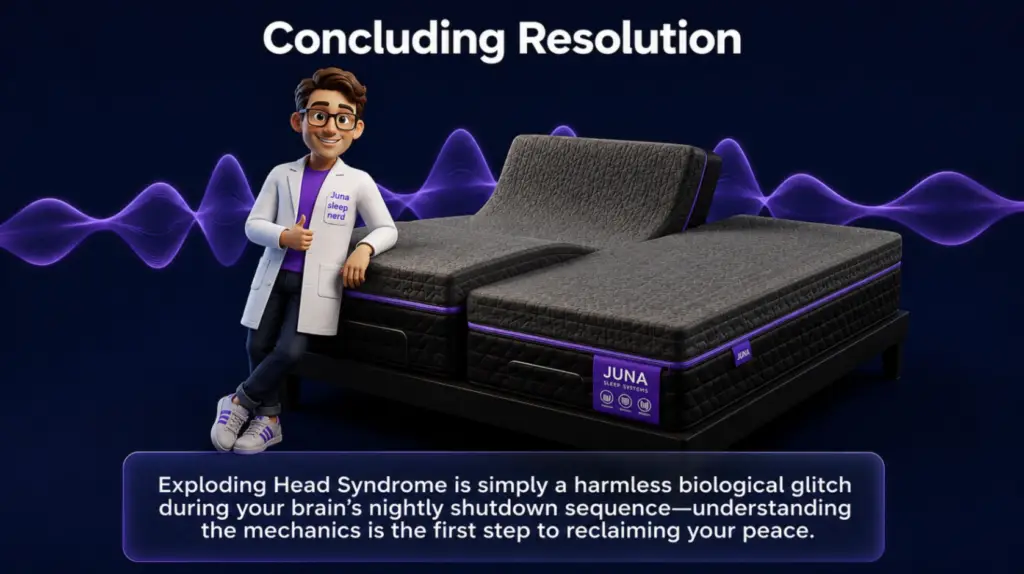
Atypical parasomnias like Exploding Head Syndrome and Night Terrors are challenging, physically exhausting neurological events. They are not a sign of psychological weakness, and your body is not failing on purpose—your brainstem and hypothalamus are simply caught in an unstable sleep-state transition loop.
To break this cycle, you must remove the environmental triggers and physical stressors that your nervous system interprets as threats. By choosing a custom-tailored Juna Sleep System, you provide your body with the ultra-premium materials, adaptive comfort, and perfect motion isolation required to stabilize your sleep architecture. Stop fighting your biology and let a Juna mattress help you transition safely into a natural state of rest.
Frequently Asked Questions (FAQ)
1. What is the clinical connection between Exploding Head Syndrome and Night Terrors?
Both conditions are classified as deep parasomnias driven by state-transition failures within the central nervous system. While Exploding Head Syndrome occurs as an auditory neural misfire at the wake-to-sleep threshold, Night Terrors involve incomplete arousal from deep N3 slow-wave sleep. Both conditions are exacerbated by environmental stressors such as sleep fragmentation and poor mattress support.
2. Is Exploding Head Syndrome dangerous, and does it cause physical pain?
Despite its startling symptoms, Exploding Head Syndrome is an entirely benign condition and does not cause physical pain, tissue damage, or indicate an underlying neurological disease. The perceived explosion or loud noise arises entirely within the brain’s auditory processing centers due to an asynchronous neural shutdown sequence during early sleep transitions.
3. How do sleep terrors in adults differ from regular nightmares?
Unlike standard nightmares—which occur during REM sleep, involve vivid story-driven plots, and allow for immediate cognitive clarity upon waking—sleep terrors in adults originate from NREM N3 deep slow-wave sleep. They involve extreme autonomic panic (screaming, rapid pulse, heavy sweating) and incomplete arousals, leaving the individual unresponsive to comfort and with total amnesia of the event the next morning.
4. How does chronic sleep deprivation trigger a night terror episode?
Chronic sleep deprivation creates a massive sleep debt, which forces the brain into a prolonged “slow-wave rebound” phase during subsequent nights. This heavy deep sleep pressure makes the mechanical transitions out of N3 sleep highly unstable. Any minor physical discomfort or noise can trigger a partial arousal, causing a violent night terror episode.
5. What makes Juna’s 12-year and 18-year warranties non-prorated?
A non-prorated warranty means your protective coverage value never degrades, depreciates, or requires out-of-pocket pro-assembly fees based on how long you’ve owned the mattress. Whether a covered structural defect in materials or workmanship happens in year three or year fifteen, Juna provides the exact same full repair or replacement protection.
6. Can a Juna Mattress Nerd adjust the internal layers of my bed after delivery?
Yes! Through our exclusive Lifetime Comfort Commitment, our dedicated Juna Mattress Nerds can come directly to your home to unzip the mattress cover and adjust the internal foam layers. We can make the mattress firmer or softer, or enhance targeted support zones, to continuously adapt to your body’s unique physiological and neurological needs over time.
7. How does the Juna H-Bed protect partners from parasomnia thrashing?
The Juna H-Bed utilizes a unique “H” geometry featuring independent head and foot articulation separated by a solid, uncut 28-inch central foam bridge. This specialized design provides complete kinetic motion isolation, meaning one partner can shift, startle, or thrash during an episode without transferring movement across to the other side of the bed.
Visit a Juna Showroom Near You
Are you ready to stabilize your sleep architecture and build an environment of absolute physical safety? Visit one of our three regional factory-direct showrooms today to speak face-to-face with an expert Juna Muscle and Sleep Nerd and test a sleep system custom-tailored to your life.
- Juna Sleep Systems – Sioux Falls, SD: Easily accessible for families driving in from Brandon, Harrisburg, or Tea.
Juna Sleep Systems – Rapid City, SD: Conveniently located for West River communities, including Box Elder, Summerset, and Sturgis.
