
The Quick Answer
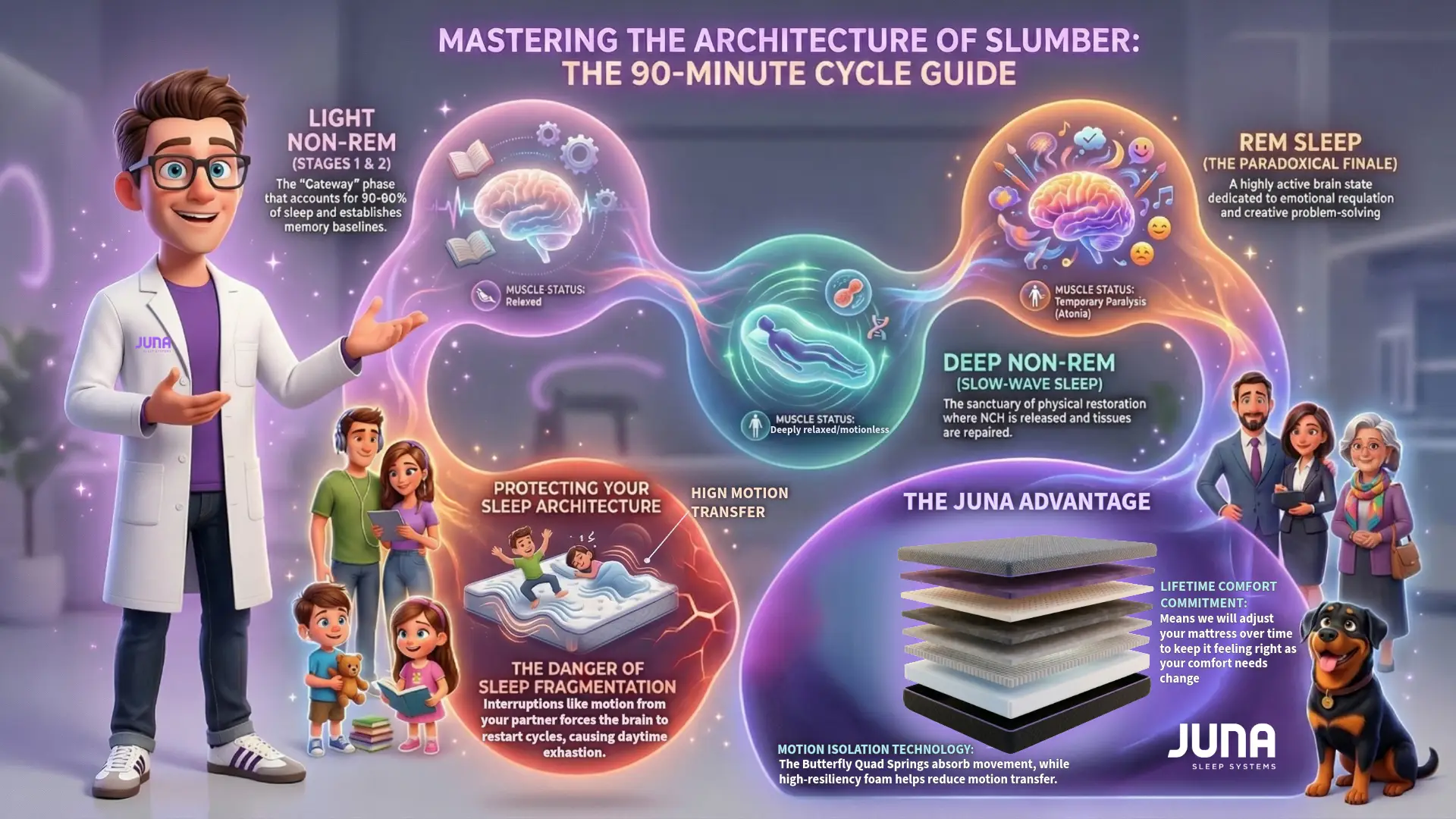
What actually happens when you sleep? Your brain does not simply shut off; it progresses through repeating 90-minute sleep cycles. Each continuous cycle seamlessly shifts between baseline light non-REM sleep, physically restorative deep non-REM sleep, and cognitively vital rapid eye movement (REM) sleep to fully repair your mind and body.
Introduction: Welcome to the Architecture of Slumber
Hello, sleep optimizers! The Juna Sleep Nerd is here to guide you through the hidden world of your nightly rest. Have you ever wondered what exactly happens to your body and brain the moment you close your eyes? The secret to waking up feeling energized lies in understanding your 90-minute sleep cycles.
Far from a passive state of unconsciousness, human rest is an incredibly active, dynamic physiological process. According to the summary of clinical research provided by Juna’s medical advisors, your nightly rest is a highly orchestrated biological event. This precise structural organization is known as the architecture of slumber.
To maximize your health and daytime performance, you must protect this delicate architecture. In this comprehensive guide, we will explore the profound science behind these repeating 90-minute sleep cycles. We will deeply analyze the mechanisms of light non-REM, deep non-REM sleep, and rapid eye movement REM sleep so you can finally master your nights.

Table of Contents
[Rank Math TOC Block Placeholder]
Decoding the Blueprint: What Are 90-Minute Sleep Cycles?
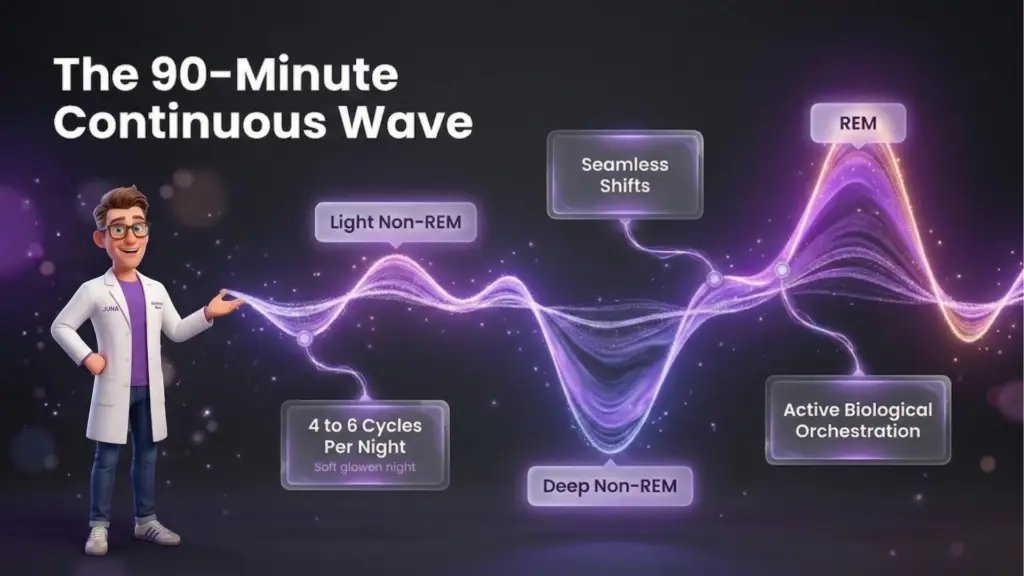
Every single night, a healthy adult experiences a complex biological rhythm. This architecture of slumber is built entirely upon repeating 90-minute sleep cycles. From the moment you drift off until your morning alarm sounds, your brain is riding a continuous electrical wave, dropping into profound depths of unconsciousness and rising back up toward wakefulness.
Typically, you will complete four to six of these 90-minute sleep cycles over a full eight-hour night. However, the exact composition of each cycle changes as the night progresses. The first few 90-minute sleep cycles are dominated by the physical repair processes of deep non-REM sleep.
As morning approaches, your later 90-minute sleep cycles shift to prioritize the emotional and cognitive processing found in rapid eye movement REM sleep. Understanding this shifting biological focus is crucial for optimizing your bedroom environment and your sleep schedule.
The Danger of Sleep Fragmentation
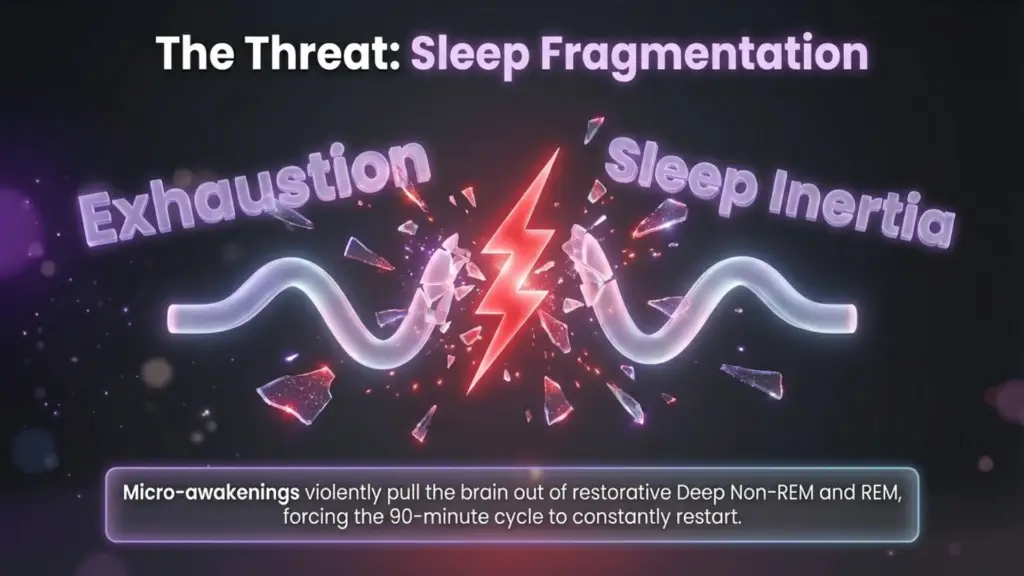
When your 90-minute sleep cycles are interrupted—whether by a snoring partner, a sudden temperature fluctuation, or a sagging, uncomfortable mattress—your brain is often forced to restart the process.
This disruptive phenomenon is clinically known as sleep fragmentation. It actively prevents you from reaching the most critical, restorative stages of sleep, leaving you feeling utterly exhausted the next day, regardless of how long you were in bed. This is exactly why optimizing your mattress and sleep environment is paramount for protecting your 90-minute sleep cycles.
Followed the link to a high-authority NIH or NCBI Sleep Study
Stage 1 and Stage 2: The Gateway of Light Non-REM Sleep
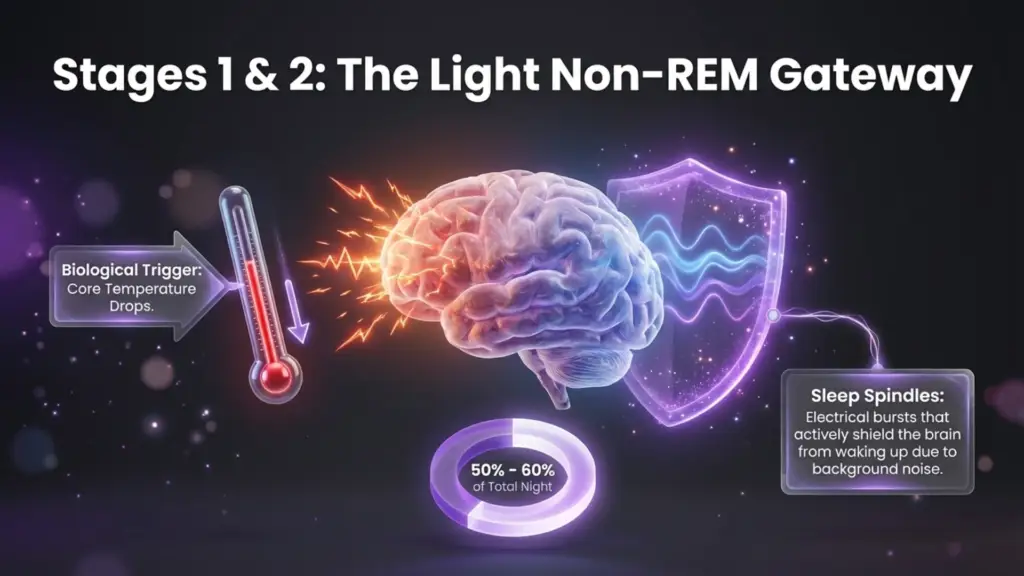
Every journey through your 90-minute sleep cycles begins with light non-REM sleep. “Non-REM” stands for Non-Rapid Eye Movement. While it is sometimes incorrectly dismissed as mere “transition sleep,” this phase accounts for roughly 50% to 60% of your total sleep time and serves vital biological functions.
Stage 1 (N1): The Fragile Descent
Stage 1 is the absolute lightest phase of light non-REM sleep. Typically lasting only one to five minutes, this is the fragile, fleeting bridge between wakefulness and slumber. During the very beginning of your 90-minute sleep cycles, your brain starts shifting from the fast, active beta waves of daytime wakefulness into slower alpha and theta brain waves.
The summary of clinical research indicates that during N1, your heart rate, breathing rate, and eye movements begin to slow significantly. Your muscles begin to deeply relax, though they may occasionally twitch with sudden, involuntary spasms known as hypnic jerks. Because this stage is so light, you can be very easily awakened by minor noises or a partner’s movement.
Stage 2 (N2): Establishing the Biological Baseline
As you successfully progress deeper into your 90-minute sleep cycles, you enter Stage 2. This is the true, structural backbone of the architecture of slumber. During N2, your core body temperature drops—a necessary biological trigger for sustaining deeper rest—and your eye movements stop completely.
In this crucial stage, the brain begins producing sudden, rapid bursts of rhythmic electrical activity known as “sleep spindles,” along with large, slow waves called “K-complexes.” Expert insights from Juna’s medical advisors suggest that these sleep spindles play a critical role in early memory consolidation. They gather the day’s motor skills and factual information. Furthermore, these electrical bursts act as a neurological shield, actively protecting the brain from waking up due to external noises so you can remain safely within your 90-minute sleep cycles.
The Heavy Lifting: Deep Non-REM Sleep (Stages 3 & 4)
After passing through light non-REM sleep, your 90-minute sleep cycles plunge you into the ultimate sanctuary of physical restoration: deep non-REM sleep. Historically divided into Stages 3 and 4, modern sleep medicine often combines these into a single, profound phase known as N3, or slow-wave sleep (SWS).
The Dominance of Delta Waves
Deep non-REM sleep is neurologically characterized by the presence of massive, slow-rolling delta brain waves. During this critical portion of your 90-minute sleep cycles, it is incredibly difficult for external stimuli to wake you up. Your body becomes entirely dead weight.
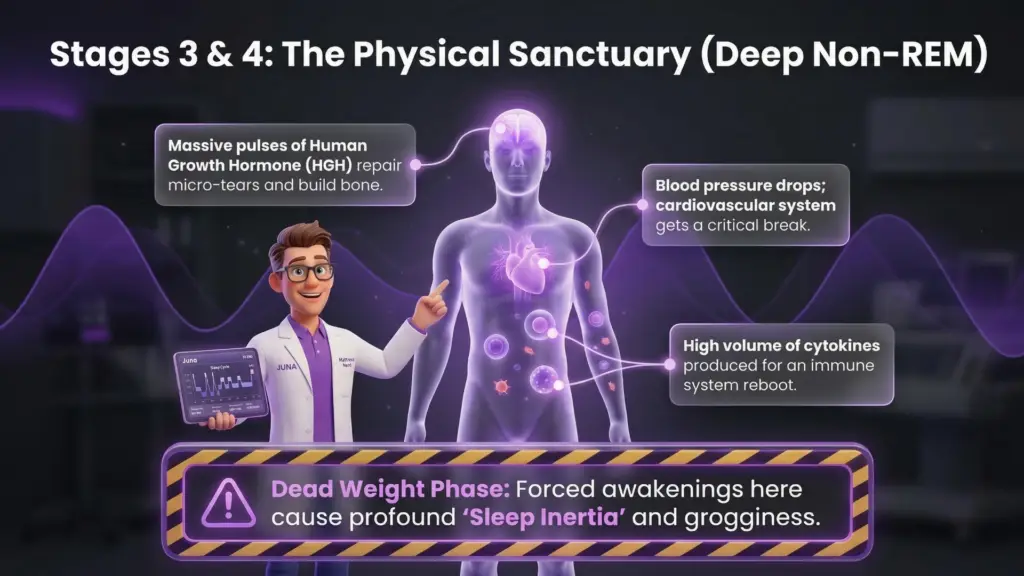
If you are forcibly awakened during deep non-REM sleep—perhaps by a loud alarm or a dog jumping on the bed—you will likely experience “sleep inertia.” This is a profound sense of grogginess, severe confusion, and physical disorientation that can last for an hour or more because your 90-minute sleep cycles were abruptly shattered.
Cellular Repair and Hormonal Rejuvenation
Why is deep non-REM sleep so biologically essential? According to the extensive research compiled in our Sleep Knowledge Base, this specific phase is the body’s primary window for cellular repair, immune fortification, and physical healing.
- Human Growth Hormone (HGH): The pituitary gland secretes massive pulses of HGH. This hormone is absolutely vital for tissue growth, repairing micro-tears in muscles, and building bone density.
- Immune System Reboot: Your body produces high volumes of cytokines, a specialized type of protein that targets systemic inflammation and fights off daily infections.
- Cardiovascular Relief: Blood pressure drops and your heart rate stabilizes at its absolute lowest point, giving your cardiovascular system a much-needed daily break.
- The Glymphatic System: The brain activates its glymphatic system, literally washing cerebrospinal fluid through neural tissue to clear toxic metabolic waste products, such as beta-amyloid, which accumulates during waking hours.
Without sufficient, uninterrupted deep non-REM sleep each night, your body simply cannot heal from the physical stressors of the day. This is why maintaining the integrity of your 90-minute sleep cycles is non-negotiable for athletes and active adults.

The Mind’s Playground: Rapid Eye Movement (REM) Sleep
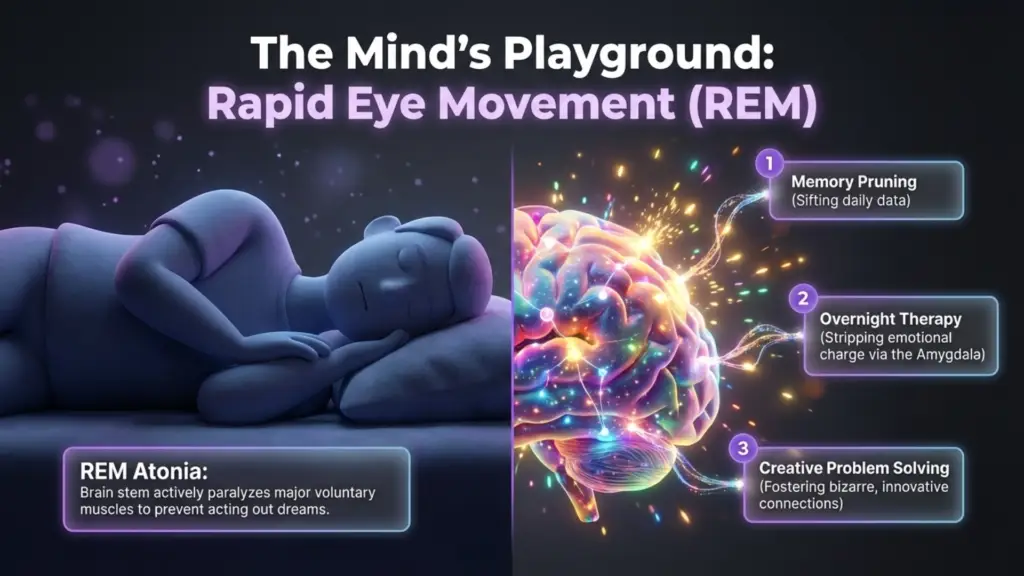
If deep non-REM sleep is dedicated to healing the physical body, rapid eye movement REM sleep is dedicated entirely to healing and upgrading the mind. Usually occurring at the very end of your 90-minute sleep cycles, REM is the grand, complex finale of the architecture of slumber.
The Paradoxical Slumber
In clinical settings, rapid eye movement REM sleep is frequently referred to as “paradoxical sleep.” This is because your brain wave activity during this phase is almost identical to that of a person who is wide awake and alert. Your breathing becomes notably faster and more irregular, your heart rate increases, and your blood pressure rises near normal waking levels.
However, to prevent you from physically acting out your vivid dreams and injuring yourself, your brain stem sends active signals down your spinal cord to temporarily paralyze your major voluntary muscle groups. This fascinating evolutionary safeguard is known as REM atonia, and it is a hallmark of healthy 90-minute sleep cycles.
Cognitive Consolidation and Emotional Regulation
Expert insights from Juna’s medical advisors highlight rapid eye movement REM sleep as the ultimate emotional and cognitive regulator for the human brain. What actually happens during this intense phase of your 90-minute sleep cycles?
- Memory Pruning: The brain meticulously sifts through the massive amount of data collected during the day. It cements vital information and learned skills into long-term storage while discarding irrelevant or useless details.
- Overnight Therapy: The amygdala (the brain’s primary emotional processing center) is highly active. Rapid eye movement REM sleep uniquely strips the visceral, painful emotional “charge” from difficult memories, acting as a natural, neurochemical form of psychological therapy.
- Creative Problem Solving: By forming bizarre, seemingly random connections between unrelated concepts (often experienced by us as vivid dreams), rapid eye movement REM sleep fosters advanced creative problem-solving skills and innovative thinking.
As the night goes on, the total duration of rapid eye movement REM sleep increases with each consecutive rotation. This means your longest, most critical REM periods occur in the final 90-minute sleep cycles right before you naturally wake up. Cutting your sleep short severely deprives you of these cognitive benefits.
Understand and use dreams to learn and forget
The Architecture of Slumber: Comparing Sleep Stages
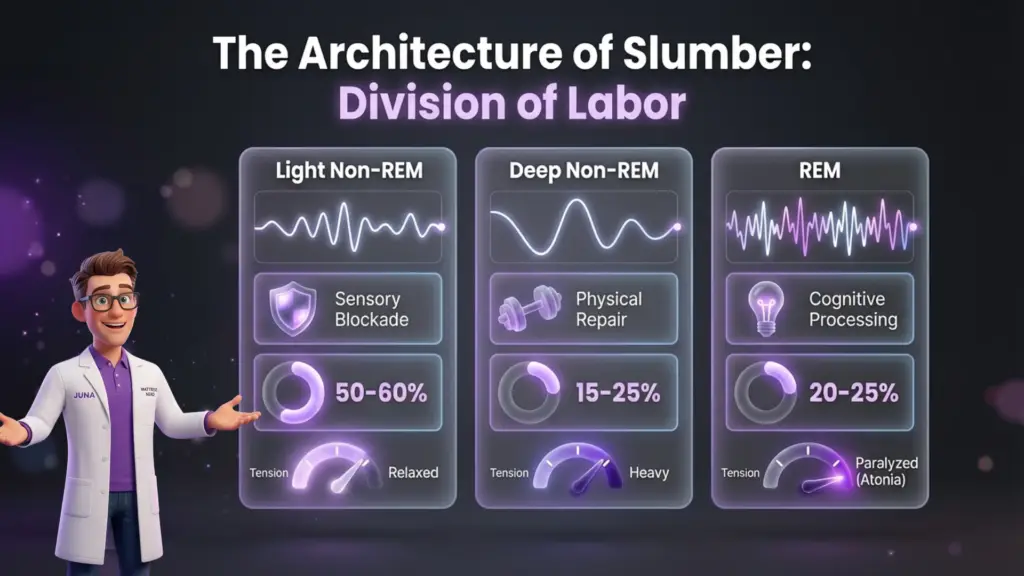
To better understand how these distinct, specialized phases interact within your continuous 90-minute sleep cycles, we have compiled a detailed comparison table below. This illustrates the beautiful division of labor happening inside your body every single night.
| Sleep Stage Phase | Dominant Brain Wave Activity | Primary Biological Function | Percentage of Night | Muscle Tone Status |
| Light Non-REM (Stage 1 & 2) | Alpha, Theta, & Sleep Spindles | Transition, baseline memory storage, and sensory blockade. | ~50% – 60% | Relaxed but capable of movement |
| Deep Non-REM (Stage 3 & 4) | Slow, massive Delta Waves | Physical tissue repair, immune function, and hormone release. | ~15% – 25% | Deeply relaxed and heavy |
| Rapid Eye Movement (REM) | Fast, mixed frequencies (Similar to waking) | Emotional processing, vivid dreaming, and complex memory. | ~20% – 25% | Temporary complete paralysis (Atonia) |
III. The Juna Brand & Service Area Integration
The H-Bed Advantage: Protecting Your 90-Minute Sleep Cycles
When couples attempt to optimize their shared slumber architecture, they often encounter a major roadblock: differing comfort preferences. This leads many to invest in traditional “Split King” mattresses. Unfortunately, these conventional split systems introduce a massive, sleep-destroying flaw right into the middle of your bedroom—the dreaded center gap.
A traditional split bed is simply two entirely separate mattresses pushed together. This creates a harsh physical canyon directly down the middle. If you roll towards the center to cuddle with your partner or simply shift positions naturally during the night, you inevitably fall into this unsupportive void.
This sudden physical discomfort acts as an immediate biological stressor, triggering micro-arousals that violently pull you out of physically restorative deep non-REM sleep and crucial rapid eye movement REM sleep. This chronic sleep fragmentation continually resets your 90-minute sleep cycles, leaving you trapped in light non-REM sleep and waking up exhausted, regardless of how much time you spend in bed.
To solve this massive, industry-wide problem and safeguard your delicate sleep architecture, Juna Sleep Systems engineered a proprietary, revolutionary solution: the Juna H-Bed. The H-Bed is fundamentally superior to traditional “Split” systems because it completely eliminates the center gap while still providing the exact individualized adjustability couples desperately need.
Instead of pushing two distinct beds together, the Juna H-Bed features a unified, perfectly seamless center section. The mattress is exclusively split at the very head and the very foot. This unique design allows each partner to independently operate an adjustable base. This means one person can elevate their head to stop snoring (a major disruptor of 90-minute sleep cycles) while the other sleeps flat.
Because the middle third of the mattress remains solidly connected, you can cuddle, sprawl, and roll smoothly across the entire surface without ever falling into a crevice. By eliminating this physical barrier, the H-Bed actively prevents the nighttime awakenings that completely shatter your continuous 90-minute sleep cycles.
Furthermore, the Juna H-Bed is fortified with our exclusive Infinity Edge technology to maximize the usable sleep surface. In standard memory foam mattresses, the perimeter often lacks structural integrity, compressing unevenly and creating a terrible sensation of “rolling out” of bed.
This subconscious feeling of instability triggers low-level anxiety in your nervous system. This actively prevents the deep muscle relaxation required to successfully transition from light to deep non-REM sleep.
Infinity Edge technology solves this issue by reinforcing the entire perimeter of the H-Bed with high-density, specialized support rails. This maximizes the total usable sleep surface from edge to edge. You can sleep securely right on the perimeter, or right in the seamless center, without any loss of firm, ergonomic support.
When your physical environment is completely secure, your brain confidently initiates the temporary muscle paralysis required during rapid eye movement REM sleep. Investing in the Juna H-Bed with Infinity Edge technology is a strategic biological decision to optimize your 90-minute sleep cycles every single night.
Learn more about the Juna H-Bed
Visit a Juna Sleep Systems Location Near You
Protecting your 90-minute sleep cycles requires finding the perfect mattress fit for your unique biomechanics. We invite you to experience the H-Bed advantage and our transparently built mattresses in person. Upgrading your sleep architecture is just a short drive away at our dedicated showrooms:
Juna Sleep Systems – Sioux Falls, South Dakota
Our flagship location is the premier destination for sleep optimization in the region. Whether you live right in the city or are making the short, easy drive from Brookings, SD, Yankton, SD, or Sioux City, IA, our Sioux Falls showroom team is ready to help you eliminate sleep fragmentation. Visit us to test the Infinity Edge technology and reclaim your deep non-REM sleep.
Juna Sleep Systems – Rapid City, South Dakota
For those in the beautiful Black Hills region, our Rapid City location offers expert guidance on repairing your architecture of slumber. If you reside in the surrounding communities of Deadwood, SD, Hot Springs, SD, or across the border in Gillette, WY, you are just a quick trip away from upgrading your mattress. Come see how the locally crafted Juna H-Bed can protect your 90-minute sleep cycles.

IV. Schema & Closing
Frequently Asked Questions About the Architecture of Slumber
- What exactly are 90-minute sleep cycles?
Your nightly rest is an incredibly active biological rhythm. The brain naturally progresses through repeating 90-minute sleep cycles consisting of light non-REM, deep non-REM sleep, and rapid eye movement REM sleep to fully restore both the body and the mind.
- How many 90-minute sleep cycles do I need each night?
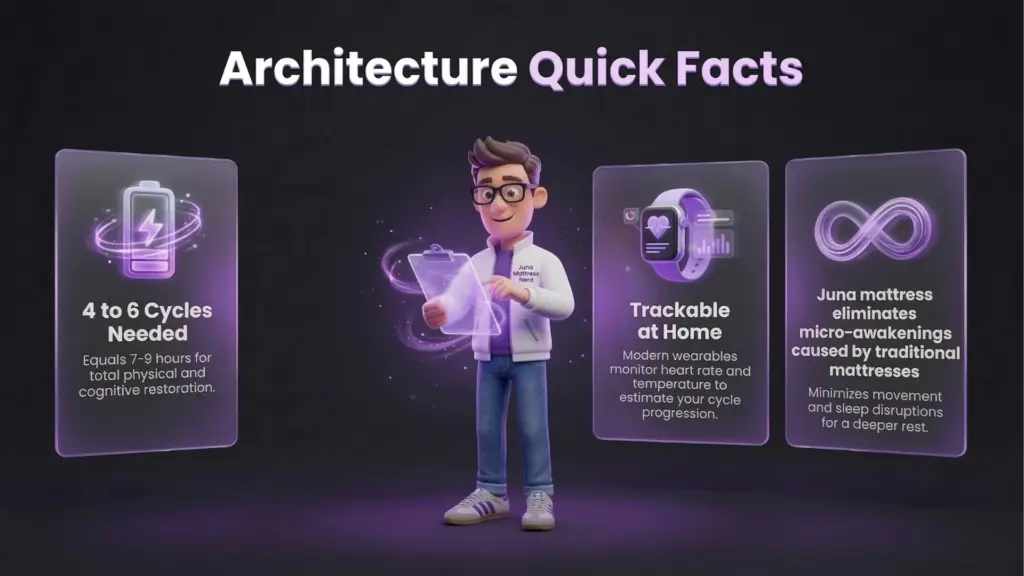
According to the summary of clinical research, most healthy adults require four to six complete 90-minute sleep cycles per night. This equates to roughly seven to nine hours of total sleep, ensuring adequate time for both physical healing and necessary cognitive regulation.
- What is the difference between deep non-REM sleep and rapid eye movement REM sleep?
During your 90-minute sleep cycles, deep non-REM sleep focuses heavily on physical restoration, releasing human growth hormone and repairing tissue. Conversely, rapid eye movement REM sleep is a highly active brain state dedicated entirely to emotional processing, memory consolidation, and vivid dreaming.
- What happens if my 90-minute sleep cycles are interrupted?
When your 90-minute sleep cycles are broken by noise, temperature changes, or a partner’s movement, your brain experiences sleep fragmentation. This actively prevents you from reaching the most restorative stages of sleep, leading to severe daytime exhaustion and impaired cognitive function.
- How does a traditional split king mattress affect my sleep architecture?
Traditional split king mattresses feature a rigid, unsupportive gap right down the center. Rolling into this uncomfortable crack causes physical disruption, which triggers micro-awakenings that constantly reset your 90-minute sleep cycles and trap you in light non-REM sleep.
- How does the Juna H-Bed protect my 90-minute sleep cycles?
The Juna H-Bed protects your 90-minute sleep cycles by completely eliminating the center gap found in traditional split beds. Using Infinity Edge technology and a seamless center, it provides a unified, highly supportive surface that allows couples to sleep deeply without physical disruption.
- Can I track my 90-minute sleep cycles at home?
Yes. While clinical monitoring is always the most accurate, many modern wearable devices (like smartwatches and biometric rings) can track your heart rate, temperature, and movement to accurately estimate your progression through your nightly 90-minute sleep cycles.
Master Your Night, Reclaim Your Day
Understanding the precise architecture of slumber is only the first step. To truly optimize your light non-REM, deep non-REM sleep, and rapid eye movement REM sleep, you need a mattress engineered for absolute biological support.
Don’t let sleep fragmentation from a sagging mattress or a separated split bed ruin another night of critical healing. Head over to the Juna Sleep Systems website to explore our innovative, locally crafted mattresses, or visit one of our Midwest showrooms today to build your perfect sleep sanctuary. Protect your rest, and wake up ready to conquer your world!
