
Juna Classics Mattresses: Premium Comfort from $588
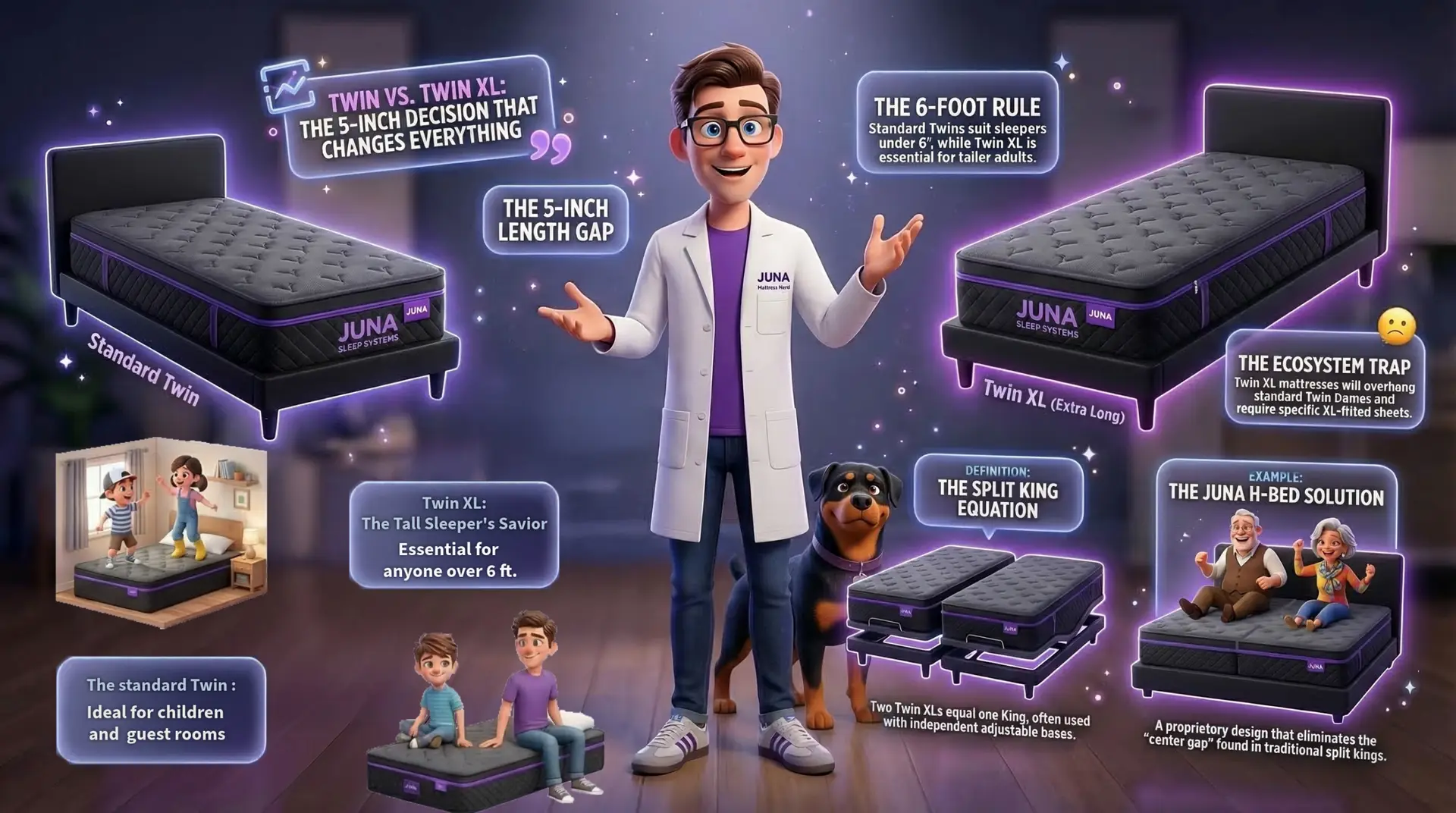
When comparing a Twin vs Twin XL, the primary difference is exactly five inches of length. Both mattresses are conventionally 38 inches wide, but a standard Twin is 75 inches long, while a Twin XL extends to 80 inches long. That extra length makes the Twin XL essential for tall adults and college dorms.
Introduction: The Five-Inch Decision That Changes Your Whole Sleep Setup
Welcome back to the Juna Sleep Systems blog! It is your resident Mattress Nerd here, ready to tackle one of the most common and heavily debated sizing dilemmas we encounter on the showroom floor: the great Twin vs Twin XL mattress debate.
At first glance, when you are standing in a bright, crowded mattress store, these two beds look completely identical. Because they share the exact same 38-inch width, your eyes can easily deceive you into thinking they are the exact same bed. The true difference lies in a mere five inches of length at the foot of the mattress. On paper, five inches sounds utterly trivial, almost negligible.
In your real bedroom, however, that extra length represents the literal difference between a comfortable, restorative night’s rest and a frustrating, sleepless ordeal. It is the difference between saying, “my feet hang off the cold end of the bed,” “my fitted sheet keeps violently popping off the corners,” or “this bed finally fits safely and comfortably.”
This massive, rigorous guide treats the Twin vs Twin XL choice not just as a quick shopping question, but as a crucial engineering and lifestyle problem. We will examine manufacturing standards, dimensional tolerances, strict frame compatibility, precise pricing behavior, and the real-world sleep performance consequences of getting your size wrong.
Table of Contents
Twin vs Twin XL Dimensions
To truly master the Twin vs Twin XL comparison, we must start with the hard numbers and the reality of how beds are physically constructed. Industry education sources and major manufacturers commonly list the “standard” nominal dimensions to help consumers navigate their choices.
Nominal Dimensions and Total Surface Area
The universally accepted nominal measurements for these beds are:
- Standard Twin: ~38″ wide × 75″ long
- Twin XL (Extra Long): ~38″ wide × 80″ long
When you choose the larger side of the Twin vs Twin XL equation, that specific 5-inch length increase also expands the overall sleep surface area by roughly 6 to 7 percent. A standard Twin offers approximately 2,850 square inches (19.8 square feet) of sleep space. The Twin XL pushes that boundary to 3,040 square inches (21.1 square feet). This increase is small in absolute mathematical terms, but it is incredibly meaningful for tall sleepers who need every inch of legroom.

Nominal Dimensions vs Real-World Tolerances
When comparing a Twin vs Twin XL, it is absolutely vital to remember that mattress sizing is not a precision-machined science like cutting aerospace steel. Various mattress brands can differ by an inch or more depending on how the mattress core is designed, how thick the quilted cover is, and how the final dimensions are measured on the factory floor.
For example, some major national manufacturers list a standard Twin at 38″ × 74″ instead of 75″. They explicitly warn in their documentation that mattress dimensions may vary slightly due to the handmade nature of the covers and the expansion of polyurethane foam. Other boutique brands might use 74.5″ or 79.5″ as their baseline, underscoring that “Twin” and “Twin XL” are merely nominal categories, not guaranteed to have exact measurements.
Why does this sizing tolerance matter so deeply? If you are placing a bed into a highly restricted, custom-built architectural alcove, building a DIY wooden platform frame, or shopping for a fitted sheet with unforgiving elastic tolerances, small discrepancies produce highly annoying gaps or bunching that users interpret as a “bad fit.”
Comparison Table: Twin vs Twin XL Key Attributes
Below is a highly detailed, at-a-glance comparison table using widely published nominal dimensions. This table brings instant clarity to the Twin vs Twin XL showdown, flagging exactly where you need to pay attention regarding variability.
| Attribute | Standard Twin Mattress | Twin XL (Extra Long) Mattress |
| Nominal Dimensions (W×L) | 38″ × 75″ | 38″ × 80″ |
| Metric Dimensions (W×L) | 96.5 × 190.5 cm | 96.5 × 203.2 cm |
| Published Surface Area | 2,850 in² (≈ 19.8 ft²) | 3,040 in² (≈ 21.1 ft²) |
| Best For (Height Guidance) | Single sleepers under ~6 ft | Single sleepers over ~6 ft, teens |
| Ideal User Weight | Unspecified (Depends on core) | Unspecified (Same as standard) |
| Bedding Fit Reality | Highly universal availability | Requires specific Twin XL sheets |
| Typical Use Cases | Kids’ rooms, guest beds, bunks | Dorms, tall adults, split kings |
| Price Behavior (Typical) | Lowest baseline cost available | Typically +$50 to +$150 vs Twin |
Compatibility Deep Dive: Frames, Foundations, and Bedding
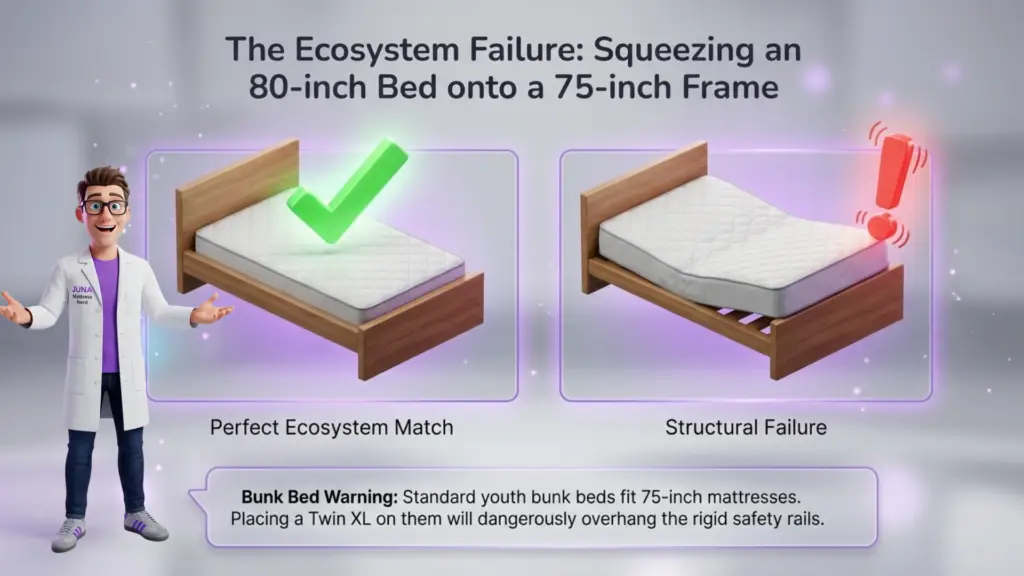
Most consumer frustrations with the Twin vs. Twin XL debate are not actually about the mattress itself. They are entirely about the surrounding bedroom ecosystem. Attempting to squeeze an 80-inch mattress onto a 75-inch foundation system is a guaranteed recipe for failure.
Bed Frames, Platforms, and Foundations
Manufacturer warranty guidelines and comparison guides are incredibly direct on this issue: you absolutely cannot put a Twin XL mattress on a standard Twin platform bed frame or box spring. The Twin XL is five inches longer and will severely overhang the foot of the bed.
While that sounds obvious, it is the most frequent failure mode we see when parents attempt to “upgrade” their rapidly growing teenager from a Twin vs Twin XL without simultaneously buying a new bed frame. They reuse the old wooden headboard and footboard setup, only to realize the new mattress bows awkwardly in the center or simply won’t lie flat.
Bunk Beds and Specialty Youth Frames
If you are buying a mattress for a youth bunk bed, a standard Twin is consistently described as fitting “most bunk beds.” Twin XL beds are significantly less universally supported by standard daybed frames simply because the residential furniture market is overwhelmingly dominated by the 75-inch design standard.
If you specifically track down a bunk bed designed for a Twin XL, you must meticulously verify the maximum supported length. Crucially, you must also check any safety requirements regarding maximum thickness and guardrail height. Thickness constraints are frequently the deciding safety factor for top bunks, ensuring the rails prevent falls. These constraints are often not specified by the mattress brand and must be found in your bunk bed’s specific instruction manual.
Sleep and the health of your child: Learn more.
Bedding: Why “Almost Fits” Always Fails
Because both beds share an exact 38-inch width, many people assume standard sheets will simply stretch to accommodate the extra length. This is a massive, highly frustrating mistake in the Twin vs Twin XL journey.
Using standard Twin-fitted bedding on a Twin XL mattress is strongly discouraged by bedding professionals. The fitted sheet will be roughly five inches too short. It will stretch violently across the sleep surface and will utterly fail to seat securely under the bottom corners. You will wake up every single night with the corners popping off.
As a market pattern, many Twin XL fitted sheets are labeled around 39″ × 80″ (slightly larger than the mattress) specifically to allow that necessary fabric wrap under the mattress.
Depth matters immensely, too! Even if the length and width match perfectly, your fitted sheets must accommodate the unique thickness (pocket depth) of your specific mattress model. There is no universal thickness standard for mattresses of different sizes. A basic 8-inch bed requires different sheets than a luxury 15-inch hybrid model.
The H-Bed Advantage: Rethinking the Split King.
One of the single biggest reasons fully grown adults passionately research the exact Twin vs Twin XL dimensions is to build a master bedroom “Split King.” If you take two Twin XL mattresses and place them perfectly side-by-side, they mathematically equal the exact outer dimensions of a standard Eastern King bed (76″ wide by 80″ long).
Couples routinely choose this traditional split configuration so they can utilize independent, motorized adjustable bases. One partner can sit up to read a book or elevate their legs to relieve pressure, while the other partner sleeps completely flat. It sounds like the perfect compromise. However, standard split king setups have a massive, relationship-straining structural flaw: the dreaded center gap.
The Flaw of Traditional “Split” Systems
When you push two entirely separate Twin vs Twin XL mattresses together, you inherently create a harsh, deep seam straight down the middle of the bed. This center division makes cuddling, intimacy, or simply sleeping in the middle incredibly uncomfortable. It drastically reduces the perceived usable shared surface, even if the tape measure shows the outer dimensions are identical to those of a King.
Furthermore, high-quality standard mattresses feature firm, high-density foam encasements around their perimeters to provide adequate edge support. By pushing two beds together, you place two incredibly hard, rigid edges directly in the middle of your cuddle zone. This creates a highly uncomfortable “speed bump” ridge. Couples naturally avoid this central “no-man’s land,” effectively shrinking the comfortable shared sleeping area to two narrow 38-inch zones and causing them to sleep on the absolute fringes of the bed.
The Juna H-Bed Innovation
At Juna Sleep Systems, we refused to let our customers settle for the miserable, separated middle gap of a standard split king configuration. We completely revolutionized the adjustable sleep system industry by engineering the proprietary Juna H-Bed.
The Juna H-Bed is ingeniously designed from the ground up to completely eliminate the center gap while still allowing for 100% independent movement. Instead of forcing you to sleep on two entirely disconnected rectangles that drift apart during the night, the H-Bed features a unified, absolutely seamless middle section. The mattress is masterfully split at the very head and the very foot (hence the “H” shape), but remains fully connected through the crucial torso and hip region.
This means you can elevate your head to 45 degrees to watch television or alleviate acid reflux, and your partner can keep their side perfectly flat, yet you can both easily roll to the center of the bed and cuddle without ever falling into a cavernous crack. It provides the technological utility of two distinct beds with the uncompromised intimacy of one solid mattress.
Maximizing Surface Area with Infinity Edge Technology
Why is the H-Bed infinitely structurally superior to the traditional Twin vs Twin XL split setup? The secret weapon is our proprietary Infinity Edge technology.
In a traditional dual-bed setup, the center edge support ruins the middle of the bed. By strategically reinforcing the true outer perimeter of the H-Bed with ultra-durable, specialized edge coils—while keeping the central connection zone entirely seamless, plush, and uniform with the rest of the comfort layers—we maximize the 100% usable sleep surface. There is absolutely no hard foam barrier digging into your lumbar spine when you sleep right in the middle.
The Infinity Edge ensures you never feel like you are rolling off the outside edges, making the overall bed feel vastly more spacious and secure. You get true edge-to-edge support exactly where you need it (on the outsides) and zero interference where you don’t (in the middle).
If you are currently fiercely debating the Twin vs Twin XL solely because you want to build a split king for your master bedroom, we beg you to reconsider your strategy. The Juna H-Bed eliminates the gap, removes the firm center ridge, and offers all the independent articulation benefits of a split system, without any of the painful compromises. It is the ultimate investment in your deep sleep and your relationship.
Price Ranges and Total Cost of Ownership
Let’s discuss the financial realities. Mattress pricing is far more sensitive to internal materials, coil construction, foam density, and brand reputation than to the simple choice between Twin and Twin XL sizes.
Typical Market Price Tiers
Rigorous, research-based pricing breakdowns within the mattress industry often show these general tiers:
- Budget Category: $500–$1,500
- Mid-Range Category: $1000–$2,000
- Luxury Category: $2,500–$5,000+
Within any of these specific quality tiers, the Twin XL is typically more expensive. Because it uses slightly more steel coils, higher-density foam, and more fabric, the market frequently cites an incremental premium of $50 to $150 compared to a standard Twin from the same product line.
Ownership Economics Beyond the Sticker Price
Accessory costs are the hidden variable that drastically shifts the Twin vs Twin XL budget. Twin XL accessories (like frames, foundations, and deep-pocket fitted sheets) can be noticeably more expensive or harder to find locally because they are less common in everyday residential homes outside of dorm season and adjustable-bed contexts.
However, you must strategically consider “future-proofing” your value. If the bed is for a young child who is likely to be tall, buying a Twin XL today serves as biological insurance. It avoids a completely new purchase cycle three years down the road (buying a new mattress, a new frame, and new sheets all over again). Getting the Twin vs Twin XL choice right on day one saves hundreds of dollars over a standard 10-year mattress lifespan. You simply cannot stretch a 75-inch bed with a topper.
Space Planning and Room Layouts
A widely cited architectural and building code reference point for habitable residential rooms is a minimum floor area of 70 square feet. This metric implies that a 7′ × 10′ room is often treated as the absolute baseline for a legal, code-compliant small bedroom.
Many major mattress brands and interior design guides recommend this exact 7′ × 10′ size as the absolute minimum room size for either a Twin or Twin XL footprint. Another brand suggests an 8′ × 10′ room for a Twin XL, noting that narrow rooms around 7′ wide can work but might feel tight.
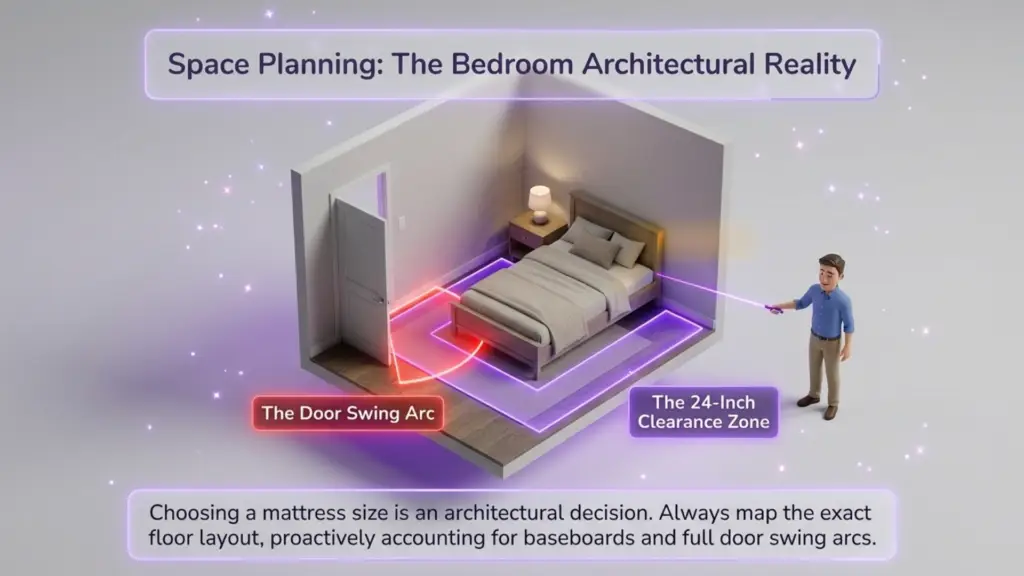
If you want maximum ergonomic comfort, however, premium sleep sizing guides suggest leaving about 24 inches of clear, unobstructed walking space around the bed’s open sides to avoid a claustrophobic, cramped feel.
The Ultimate Space-Planning Checklist
Most sizing surprises and delivery day disasters happen because buyers only measure the empty wall space where the headboard goes, completely forgetting to account for daily living patterns. A rigorous Twin vs Twin XL measurement pass must include:
- Exact interior dimensions: Measure wall-to-wall, deliberately accounting for the thickness of the baseboards if the fit will be incredibly tight in an alcove.
- Clear operational paths: Measure the full swing arc for bedroom doors, closet doors, dresser drawers, and desk chairs. Five inches of extra mattress length can completely block a closet door from opening!
- External frame dimensions: Never just measure the nominal mattress specs. Some bulky upholstered platform bases or sleigh-bed footboards add 6 to 8 inches to the total bed footprint.
Sleep Performance and User Fit
What actually changes in your physical sleep performance when you upgrade from a Twin vs Twin XL? The answer is legroom. This metric is particularly critical for back and stomach sleepers, who tend to stretch out completely straight during the night.
What does not inherently change? Pressure point relief, spinal alignment, motion isolation, and thermal cooling remain direct functions of the internal mattress construction, not the size category. However, component scaling means coil counts can vary slightly by size, affecting feel. Also, on a highly narrow 38-inch bed, you spend significantly more time sleeping near the perimeter edge. If the edge support is weak, the usable sleep surface feels incredibly tiny.
Pros and Cons by Specific User Group
- Children (Elementary Age): The standard Twin is a universally strong, highly recommended choice once kids outgrow their cribs. It maximizes remaining floor space for playing and easily fits novelty youth frames. A Twin XL can be “future growth insurance” if the child is already tall for their age.
- Growing Teens: Teenagers are the classic “oops, they outgrew it” demographic. The Twin XL is the absolute best recommendation for growing teens because it provides the necessary 80-inch length without monopolizing the room’s width as a Full-size would.
- Adults & Tall Sleepers: Single adults under six feet tall fit a standard Twin perfectly fine. However, anyone over six feet is immediately directed to the Twin XL to prevent their ankles from hanging over the edge. The practical rule is: you want length that prevents foot overhang even when using pillows and shifting positions.
- College Dorms: The Twin XL is the undisputed, heavily regulated standard for college dorm beds. Universities utilize this size because it safely accommodates tall student-athletes while conserving premium square footage in shared dormitories. (Note: Specific dorm dimensions can vary by school; always verify your housing spec sheet.)
- Couples: Let’s be explicit: neither a standard Twin nor a Twin XL is recommended for couples, as the width is only ~38 inches. Bed-sharing on a single Twin destroys sleep efficiency and ruins motion isolation.
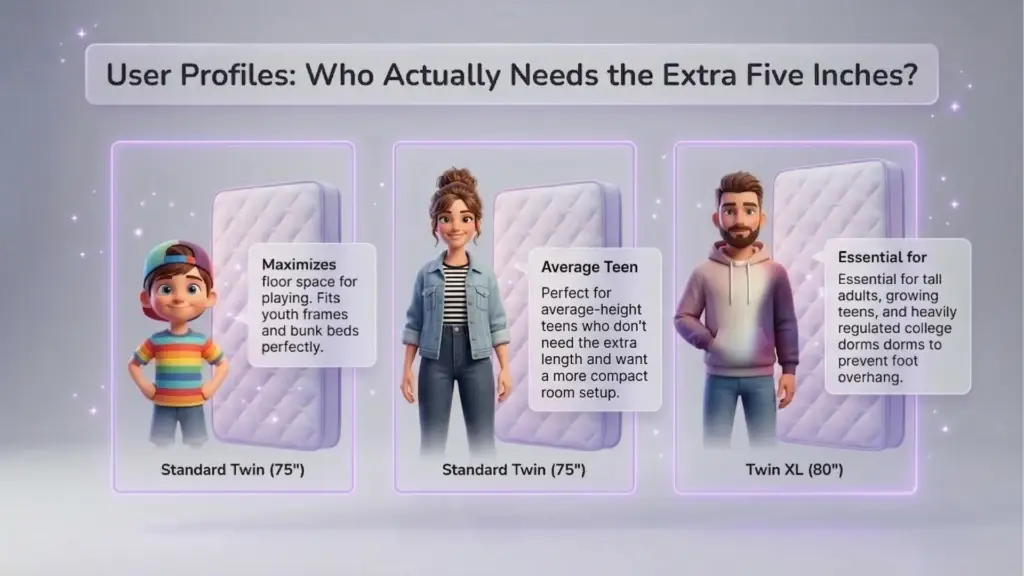
Breaking down the specific user demographics for Standard Twin versus Twin XL mattresses.
Juna Sleep Systems Locations: Serving Your Community
As the dedicated Juna Mattress Nerd, I constantly study the data, but I always recommend feeling the physical quality of our beds in person. Making the high-stakes Twin vs Twin XL choice is infinitely easier when you can stretch out, roll over, and experience the dimensions yourself. We are incredibly proud to serve our hardworking Midwest communities through our locally owned, factory-direct showrooms.
Juna Sleep Systems – Sioux Falls, South Dakota
Our Sioux Falls factory and showroom is the beating epicenter of Juna’s commitment to transparent, honest sleep science. We absolutely love welcoming guests who make the short, easy drive in from Watertown, SD, Worthington, MN, and Sioux City, IA. Instead of guessing your proper size online and dealing with the hassle of shipping returns, let our highly trained local Sioux Falls experts guide you through the intricacies of Twin vs. Twin XL options and let you test the legendary H-Bed in person.
Juna Sleep Systems – Rapid City, South Dakota
Serving the breathtaking, expansive Black Hills region, our Rapid City location delivers the exact same ironclad lifetime comfort guarantees and custom, hand-built quality. We are passionately dedicated to providing perfect nights of sleep for our neighbors, frequently assisting exhausted folks driving in from Spearfish, SD; Sturgis, SD; and Rapid Valley, SD. Come visit our welcoming Rapid City team today and see precisely why a custom-built Juna mattress is guaranteed to outlast anything else on the current market.
[Media Placeholder 4: A welcoming, brightly lit view of a Juna Sleep Systems showroom exterior.]
Alt Text: The welcoming exterior storefront of a Juna Sleep Systems mattress showroom.
Misconceptions, Durability, and Buying Recommendations
Before you finalize your Twin vs Twin XL purchase, let’s clear up some widespread industry myths and discuss long-term durability.
Common Sizing Misconceptions
- Misconception: “Twin and Twin XL use the exact same sheets; you just pull them tighter.”
Reality: They share a width exclusively. The XL is a full five inches longer. Standard sheets will violently pop off the corners when you move. - Misconception: “A Twin XL is just a Full bed in disguise.”
Reality: A Full bed is 54 inches wide. The Twin XL’s main change is length, keeping the narrow 38-inch width. - Misconception: “Two Twin XLs are a King in every way.”
Reality: The outer dimensions match perfectly, but the harsh center gap completely destroys middle comfort unless you specifically purchase a unified system like the Juna H-Bed. - Misconception: “The size of the bed determines how much back support I get.”
Reality: Support and pressure relief are driven purely by the internal mattress coil design and foam layers, not the physical footprint.
Your Actionable Sizing Checklist
If you are strictly choosing between a Twin vs Twin XL, these are the highest-signal decisions:
- Do the primary sleeper’s feet currently hang off a 75-inch surface, or will they predictably do so within the next few years? (If yes, buy the Twin XL unequivocally.)
- Is the bed destined for a regulated college dorm room or an adjustable-base context where Twin XL is common? (If yes, buy the Twin XL).
- Do you already own an expensive, standard Twin frame, daybed, or youth bunk bed that physically cannot accept an 80-inch mattress? (If yes, buy a standard Twin).
- Have you accurately priced the specific accessories (sheets, protectors, frames) required for your definitively chosen size?
- Have you mapped the exact floor layout of the bedroom to proactively ensure realistic clearance for doors and daily movement?
Frequently Asked Questions (FAQ)
- What is the exact size difference between a Twin vs Twin XL mattress?
The exact size difference between a Twin and a Twin XL mattress is 5 inches in length. Both mattresses share a standard 38-inch width, but a traditional Twin is 75 inches long, while a Twin XL is 80 inches long to accommodate taller sleepers.
- Can I safely use my old standard Twin fitted sheets on a new Twin XL bed?
No, using standard Twin sheets on a Twin XL is highly discouraged. Because the Twin XL is five inches longer, standard fitted sheets will be far too tight, fail to seat correctly under the mattress corners, and pop off during the night. You must buy specific Twin XL sheets.
- Is a Twin XL mattress the exact same length as a Queen mattress?
Yes! A Twin XL and a standard Queen mattress are both 80 inches long. This makes the Twin XL the perfect space-saving choice for taller teens and adults who need the legroom of a Queen but lack the width on the bedroom floor.
- Why is the Twin XL the universally mandated standard size for college dorms?
When comparing Twin vs Twin XL, universities overwhelmingly mandate the Twin XL because its 80-inch length comfortably accommodates taller, growing student-athletes, while its narrow 38-inch width allows colleges to efficiently maximize space in tiny, shared dorm rooms.
- How do I fix the highly uncomfortable gap between two split king mattresses?
If you are frustrated by the massive gap between two Twin XL beds, the ultimate solution is to upgrade to the Juna H-Bed. The H-Bed features a seamless middle section that completely eliminates the center trench while still allowing for independent head and foot articulation.
- Will a new Twin XL mattress fit safely onto my child’s standard bunk bed?
Generally, no. Standard youth bunk beds and daybeds are overwhelmingly engineered for 75-inch standard Twin mattresses. A Twin XL is five inches too long and will dangerously overhang the rigid rails of a standard bunk bed frame. Always check your bunk bed’s specific manual.
- Does a Twin XL mattress actually last longer than a standard Twin mattress?
No, the physical footprint of the mattress does not dictate its longevity. The durability of both a Twin vs Twin XL is determined entirely by the quality of the internal materials, the coil construction methods, and the weight of the sleeper. Both sizes typically last 7 to 10 years when built properly.
Conversion-Focused Closing
If you remember absolutely only one crucial thing from this comprehensive, rigorous guide, let it be this: deciding between a Twin vs Twin XL is rarely a choice about subjective comfort; it is entirely a mathematical choice about fit.
The most luxurious, supportive, perfectly engineered mattress in the world instantly becomes a nightly irritation if it is the wrong length for your body. The extra five inches of a Twin XL completely dictate the room’s functional circulation, determine which bed frames you can safely buy, and determine whether a tall sleeper’s feet get cold hanging over the edge at night.
Choose a standard Twin when you want maximum ecosystem compatibility with standard bunk beds and when the sleeper is highly unlikely to exceed the 75-inch height limit. Choose a Twin XL when dorm room norms, adjustable-base compatibility, and future height growth make 80 inches the much safer, smarter long-term investment. And if you are a couple looking at split systems, don’t settle for the gap—upgrade to the uncompromised, seamless comfort of the Juna H-Bed!
Ready to find your perfect fit and completely transform your sleep health? Don’t leave your comfort to chance or guesswork. Visit a Juna Sleep Systems showroom near you today, or deeply browse our advanced sleep systems online to discover exactly what you’ve been missing. Experience the Infinity Edge difference today!
