

Quick Answer: The Overnight Skill-Loading Process
How Sleep Enhances Motor Skills Through Neural Reinforcement. The phrase “practice makes perfect” is one of the most persistent myths in athletic training, music education, and physical rehabilitation. We are conditioned to believe that the key to mastering a physical movement is raw, relentless repetition—grinding until the muscles adapt. However, cutting-edge neurobiology tells a completely different story. Physical repetition during the day does not actually lock in a skill; it merely creates a fragile, temporary blueprint. The true automation of physical movement happens while you are unconscious. Specifically, how sleep enhances motor skills relies on an intricate, overnight editing process driven by Stage 2 non-REM sleep.
- The Limitation of Practice: Waking repetition creates a highly volatile, easily disrupted memory trace in your motor cortex. Practice doesn’t make perfect; practice makes permanent only after it is processed by sleep.
- The Hero of Muscle Memory (Stage 2 Sleep Spindles): During Stage 2 non-REM sleep (which makes up nearly 50% of your night), your thalamus fires rapid, looping bursts of electrical activity called sleep spindles (11−16 Hz).
- The Overnight Performance Boost: These spindles act like a digital soldering iron, mapping the physical movements you practiced from the conscious, high-effort areas of your brain into the automatic, effortless processing centers. This is why you can wake up the next morning and execute a movement you struggled with the day before seamlessly.
Introduction: The Myth of the Daylight Grind
Through Neural Reinforcement We’ve all experienced the frustration of the physical plateau. You spend hours trying to perfect a golf swing, master a complex piano passage, or fine-tune a new lifting technique. By the end of a grueling training session, your movements feel heavy, inconsistent, and mechanical. You leave the gym or the studio feeling as though you’ve made zero progress.
But something extraordinary happens when you wake up the next morning. You step up to the ball, place your fingers on the keys, or unrack the barbell—and the movement suddenly flows with effortless precision. Without taking a single additional physical repetition, you have improved overnight.
At Juna Sleep Systems, we understand that human performance isn’t just manufactured on the training floor or in the studio; it is validated in bed. Just as we meticulously engineer the physical boundaries of our mattresses to support your joints, your brain relies on the uninterrupted architecture of Stage 2 sleep to refine your neuromuscular pathways.
Whether you are looking to shave seconds off your reaction time or visiting one of our local factory showrooms in Sioux Falls, South Dakotaor Rapid City, South Dakota, understanding how sleep automates physical performance is the ultimate key to training smarter.
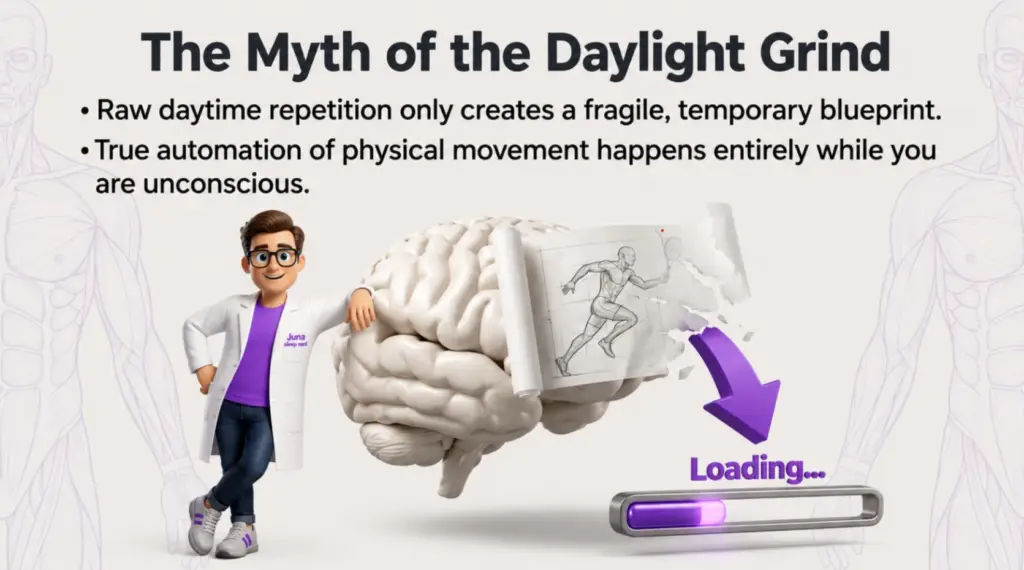
The Limit of Physical Repetition: Why Grinding Hits a Wall
When you practice a physical skill during the day, you are not actually building stronger “muscle memory” in the muscles themselves. Muscles have no cognitive capacity; they are simply execution tools controlled by the brain’s motor cortex. Waking practice is essentially an input phase. You are uploading raw data into a volatile, short-term neurological folder.
The major limitation of waking practice is that this raw memory trace is highly unstable. It is incredibly vulnerable to interference. If you practice a specific movement pattern for an hour, and then immediately pivot to an unrelated physical task or experience high levels of stress, the original memory trace can easily be degraded or entirely overwritten.
Furthermore, your brain eventually hits a point of diminishing returns during waking hours. As neuromuscular fatigue sets in, your physical form breaks down, meaning you begin practicing imperfect movements—essentially programming flaws into your software.
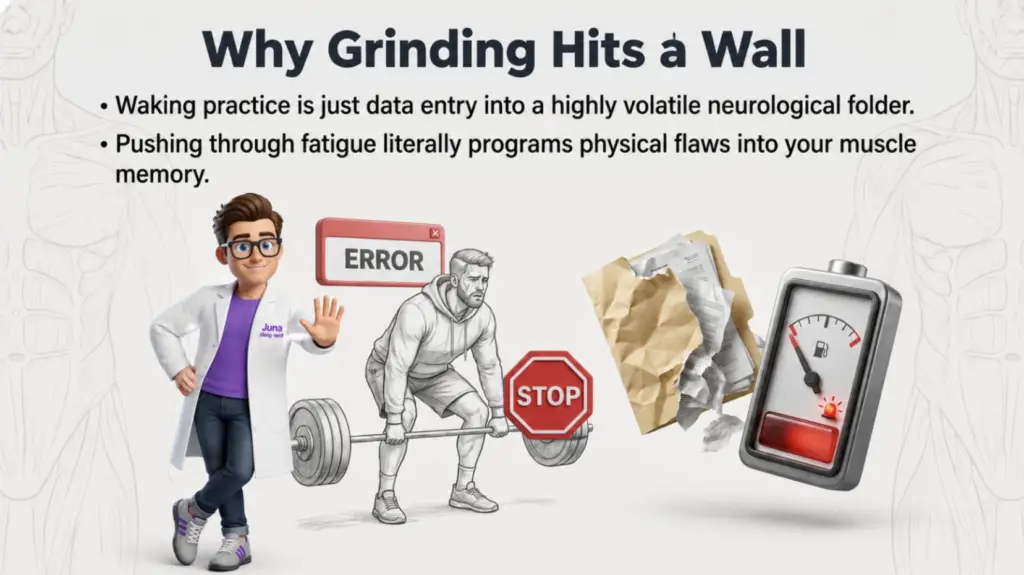
Discover ( the Limit of Physical Repetition: Why Grinding Hits a Wall )
Stage 2 Non-REM: The Engine Room of Muscle Memory
How Sleep Enhances Motor Skills Through Neural Reinforcement To transform a fragile daytime memory trace into a permanent physical skill, the brain must shift from data acquisition to data consolidation. While deep Stage N3 slow-wave sleep is heavily responsible for physical tissue repair and factual memory saving, Stage 2 non-REM (N2) sleep is the absolute engine room for motor skill enhancement.
Stage 2 sleep is often overlooked in popular health discussions because it is viewed as a shallow transitional phase between light and deep sleep. This is a massive scientific misunderstanding.
N2 sleep makes up approximately 50% of your total nightly sleep architecture, occurring in longer, more frequent blocks as the night progresses—particularly during the early morning hours. It is during this specific stage that your brain isolates your neuromuscular system from external distractions and begins its structural programming.
The Solder Iron of the Brain: How Sleep Spindles Automate Skills
The primary tool used during Stage 2 sleep to improve physical performance overnight is an electrical phenomenon known as a sleep spindle. Generated by the thalamus, sleep spindles are brief, intense bursts of rhythmic neural activity that fire at a frequency of 11−16 Hz, lasting anywhere from 0.5 to 3 seconds.
[Thalamus Generates Spindle Burst: 11-16 Hz]
│
▼
[Channels Open in Motor Cortex]
│
▼
[Calcium Influx Drives Synaptic Plasticity]
│
▼
[Motor Skill Automated & Locked In]
These spindles serve as a biological soldering iron. When a sleep spindle fires, it shoots an electrical pulse across the motor cortex, traveling precisely along the neural highways that were activated during your daytime practice.
This localized electrical stimulation triggers an influx of calcium ions into the target neurons, activating specific genes that strengthen the physical connections (synapses) between those cells.
By firing thousands of times per night, sleep spindles systematically loop through your daytime movements, strengthening efficient pathways while pruning the irregular mistakes you made when you were fatigued.
The Neurological Shift: Moving from Conscious Effort to Automatic Execution
The ultimate result of this nightly spindle activity is a profound physical relocation of memory within your brain.
When you are first learning a physical skill during the day, the movement is heavily managed by your prefrontal cortex—the seat of conscious, analytical thought. This is why new movements feel clunky, rigid, and slow; you are literally forced to “think” your way through every single step of the sequence.
During Stage 2 sleep, the continuous firing of spindles shifts the movement pattern away from the high-stress, high-energy prefrontal cortex and transfers it deep into the subcortical regions of the brain: the cerebellum and the basal ganglia.
The cerebellum is the brain’s automatic processing unit. Once a movement pattern is successfully uploaded here, it no longer requires conscious thought. The skill becomes automated, fluid, and lightning-fast. You no longer have to think about how to execute the movement; your body simply triggers the program automatically.
Performance Matrix: Daytime Repetition vs. Overnight N2 Consolidation
The following matrix contrasts the physical and neurological differences between active waking practice and overnight Stage 2 sleep processing.
| Neurological Metric | Daytime Physical Repetition | Overnight Stage 2 Sleep (N2) |
| Primary Brain Region | Prefrontal Cortex (Conscious Control) | Cerebellum & Basal Ganglia (Automation) |
| Electrical Marker | Desynchronized Beta & Gamma Waves | Rhythmic Thalamic Sleep Spindles (11−16 Hz) |
| Memory State | Volatile, unstable, prone to interference | Stabilized, structural, deeply insulated |
| Movement Quality | Rigid, mechanical, high mental energy | Fluid, automatic, low mental energy |
| System Fatigue | High neuromuscular exhaustion | Zero physical strain; cellular recovery |
| Error Processing | Records both proper form and flaws | Prunes away flaws; locks in perfect execution |
The Fragility of Stage 2 Sleep: The Micro-Arousal Threat
Because Stage 2 sleep is lighter than deep slow-wave sleep, it is incredibly fragile. This creates a massive problem for anyone looking to optimize their athletic or physical skills. Because N2 sleep occurs in frequent, prolonged cycles throughout the entire night, it is highly susceptible to sleep architecture disruptions caused by environmental discomfort.
The primary enemy of Stage 2 sleep is the micro-arousal—a fleeting, subconscious shift from sleep to near-wakefulness that lasts only a few seconds. You won’t remember these disruptions in the morning, but they instantly yank your brain out of Stage 2 sleep, resetting your sleep cycle and completely cutting off the sleep spindle sequence.
If your brain is jolted out of N2 sleep mid-cycle, the biological soldering process is broken. The movement patterns you practiced during the day remain trapped in the volatile prefrontal cortex, leaving you with the exact same physical hitches, slow reaction times, and performance plateaus the following day.
Discover ( Why Stage 2 Sleep Is Fragile: The Micro-Arousal Threat)
Ergonomic Sabotage: How Mattress Sag Corrupts Motor Learning
The most common cause of these skill-destroying micro-arousals is a degraded, sagging mattress surface. When you sleep on a mass-market mattress constructed with low-density 1.2 lb to 1.8 lb foams, the structural core of the bed quickly collapses under your body’s heaviest points—specifically your pelvis and lumbar region.
This structural sag forces your spine into a distorted, unnatural posture. To keep your spinal cord safe from hyperextension, your deep core and back muscles are forced to stay contracted, meaning they never get a chance to relax.
As these muscles fatigue, they compress your joints, restrict blood flow, and pinch peripheral nerves, sending a continuous stream of pain and distress signals up to your brainstem.
Your brainstem responds to these physical distress alarms by triggering a micro-arousal, forcing your body to shift positions to escape the mechanical strain. Every time you toss, turn, or adjust your posture on a sagging bed, you tear through your Stage 2 sleep windows, directly sabotaging your brain’s ability to automate muscle memory.
Discover ( How Mattress Sag Sabotages Motor Learning)
The Juna Strategy: Engineering an Uninterrupted Movement Sanctuary
At Juna Sleep Systems, we design our premium mattresses to eliminate the environmental and physical stressors that compromise your sleep architecture. We understand that a mattress should never force your body to work through the night. Our sleep systems are meticulously engineered to provide absolute physical stillness, keeping your central nervous system securely anchored in Stage 2 sleep so your brain can maximize its overnight performance boost.
Erasing Motion Disturbance via Independent Kinetic Isolation
For co-sleepers, a partner’s movement is a major source of Stage 2 sleep fragmentation. Because your body is highly responsive to motion during N2 sleep, a partner rolling over or adjusting on a traditional inner-spring mattress creates a physical shockwave that instantly shatters your sleep cycle.
The Juna H-Bed completely solves this problem through an innovative, proprietary design. Constructed as a single, unified King-sized mattress, the H-Bed features deep vertical cuts at the head and foot, connected by a solid, uncut 28-inch foam bridge in the center.
This creates a flawless kinetic barrier. When your partner shifts or gets out of bed, the motion is entirely absorbed and dissipated on their side of the mattress. Your side remains perfectly still and undisturbed, protecting your fragile Stage 2 sleep cycles from external disruption.
Customized Biomechanical Support via the Lifetime Comfort Commitment
Human bodies are incredibly dynamic, changing over time due to athletic training, weight shifts, injury recovery, or natural aging. A mattress surface that offers ideal orthopedic support today may begin to create localized pressure points a few years down the road. If your mattress cannot adapt to these changes, it will eventually cause the exact muscle strain that triggers sleep-disrupting micro-arousals.
Juna eliminates this risk entirely through our exclusive Lifetime Comfort Commitment. We refuse to lock you into a single firmness setting at the time of purchase.
If your body ever requires a modification in support or pressure relief, you simply call us. Our expert Juna Mattress Nerds will come directly to your home, unzip your mattress cover, and physically swap out or re-arrange the internal high-density comfort layers right in front of you. This perpetual personalization guarantees your body always enjoys perfect alignment, ensuring uninterrupted motor skill learning for decades to come.
Postural Engineering for Neuromuscular Decompression
To set the stage for optimal Stage 2 sleep spindle production, you must thoroughly relax your neuromuscular system before you close your eyes. Pairing a high-density Juna mattress with our Advanced Adjustable Base provides the ultimate tool for systemic decompression. By selecting the scientifically validated “Zero Gravity” position, your body is cradled in a weightless, neutral posture that completely unloads gravitational stress from your frame.
- Decompressing the Spine: Elevating your head and knees slightly removes mechanical tension from your lower back, instantly relaxing your paraspinal muscles and halting pain signals.
- Calming Autonomic Stress: Elevating your legs above heart level enhances venous return, lowering a racing heart rate and shifting your nervous system into a calm state.
- Maximizing Respiratory Volume: A subtle head elevation keeps your airways completely unobstructed, preventing snoring and oxygen drops that break your sleep architecture.
The Factory-Direct Model: Pure Material Value for Peak Performance
How is Juna able to integrate these premium, heavy-duty foams into our sleep systems while keeping our pricing honest and accessible? It all comes down to our factory-direct business model. The traditional mattress industry relies on an incredibly bloated supply chain filled with middlemen, distributors, and national brokers—each layer adding heavy markups to the final price. To maintain their profit margins, mainstream brands are forced to cut corners on the quality of their interior foams.
At Juna, we cut out the middlemen completely. We build our mattresses locally and sell them directly to you through our own regional showrooms. This allows us to route our investments away from corporate retail markups and straight into world-class components, including our specialized Infinity Edge support system.
By surrounding our high-resiliency support core with an ultra-firm perimeter rail and a butterfly quad coil unit, we deliver consistent support all the way to the very edge of the bed. You get a reliable, highly breathable sleep surface that protects your physical alignment and supports deep brain recovery, backed by the absolute best value in the industry.
Conclusion: Let Your Sleep Finish Your Training
Waking repetition is only the first half of the performance equation. If you want to master a physical skill, protect your form from breaking down, and break through stubborn performance plateaus, you must allow your brain to pull off its nightly file-transfer sequence. How sleep enhances motor skills is a powerful reminder that true athletic and physical excellence is directly tied to the quality of your physical recovery environment.
By removing the mattress sag, motion transfer, and pressure points that cause sleep fragmentation, a custom-built Juna Sleep System provides your brain with the unbroken Stage 2 sleep it needs to automate your muscle memory. Stop letting an inferior bed compromise your physical progress—visit a Juna showroom today and give your body the sanctuary it deserves.
Frequently Asked Questions (FAQ)
1. Why isn’t physical repetition alone enough to master a skill?
Waking practice only creates a volatile, temporary memory trace in your brain’s motor cortex. This raw data is highly unstable and easily disrupted by stress, fatigue, or subsequent tasks. True automation occurs only when sleep processes this data, making it permanent.
2. What exactly are sleep spindles, and how do they help my performance?
Sleep spindles are brief, intense bursts of rhythmic electrical activity (11−16 Hz) generated by the thalamic region during Stage 2 sleep. They act like a biological soldering iron, traveling along the specific neural pathways activated during your daytime practice to physically strengthen and secure those connections.
3. How does sleep move muscle memory into automatic execution?
During Stage 2 sleep, the continuous firing of spindles shifts the movement pattern out of the prefrontal cortex—the area responsible for slow, conscious, high-effort thought—and uploads it into the cerebellum and basal ganglia. This subcortical zone manages automatic processing, allowing you to execute the skill smoothly without consciously thinking about it.
4. How does a sagging mattress directly ruin my physical coordination?
A sagging mattress drops your spine out of alignment, forcing your core and back muscles to stay tense all night to protect your body. This physical stress sends constant pain signals to your brainstem, triggering frequent, hidden micro-arousals. These micro-awakenings instantly cut off your Stage 2 sleep cycles, preventing your brain from locking in the benefits of your physical practice.
5. Why is Juna’s non-prorated mattress warranty better than common brands?
Juna provides a complete 12- or 18-year non-prorated warranty, meaning your protective coverage value never degrades based on how long you’ve owned the bed. Traditional brands often use prorated warranties that force you to pay hefty out-of-pocket fees for repairs or replacements as the mattress ages.
6. Can Juna adjust the firmness of my mattress after I buy it?
Yes! Through our exclusive Lifetime Comfort Commitment, our expert Juna Mattress Nerds will come directly to your home to unzip the mattress cover and adjust or swap out the internal high-density foam layers on-site. This ensures your body continues to receive optimal orthotic support as your physical needs evolve.
7. How does the Juna H-Bed stop partner movement from waking me up?
The Juna H-Bed features a unique “H” structural geometry with deep vertical cuts at the head and foot of the mattress, separated by a solid 28-inch central foam bridge. This design provides absolute kinetic isolation, meaning one partner can shift or toss throughout the night without transferring any physical movement across to the other side of the bed.
Visit a Juna Showroom Near You
Are you ready to optimize your physical recovery and build a sleep environment that automates your muscle memory? Visit one of our three regional factory-direct showrooms today to speak face-to-face with a Juna Sleep Nerd and test a mattress built for your life.
- Juna Sleep Systems – Sioux Falls, SD: Conveniently located for families driving in from Brandon, Harrisburg, or Tea.
- Juna Sleep Systems – Rapid City, SD: Easily accessible for West River communities, including Box Elder, Summerset, and Sturgis.
