
Quick Answer:
How Deep Sleep Cements Memories is explained through slow-wave sleep and memory consolidationis one of the most fascinating frontiers in modern cognitive neuroscience and sleep medicine. Far from being a passive state of neural downtime, deep slow-wave sleep acts as an active biological editing suite. During this stage, newly acquired data is structurally stabilized, organized, and uploaded from temporary subcortical holding zones into permanent cortical architecture. Engaging in targeted sleep after learning serves as the brain’s ultimate mechanism to future-proof cognitive assets, optimizing neural networks while aggressively protecting against the phenomenon of catastrophic forgetting.
- The Temporary Buffer (The Hippocampus): When you learn new information during the day, it is stored in the hippocampus—a highly flexible but low-capacity short-term storage drive.
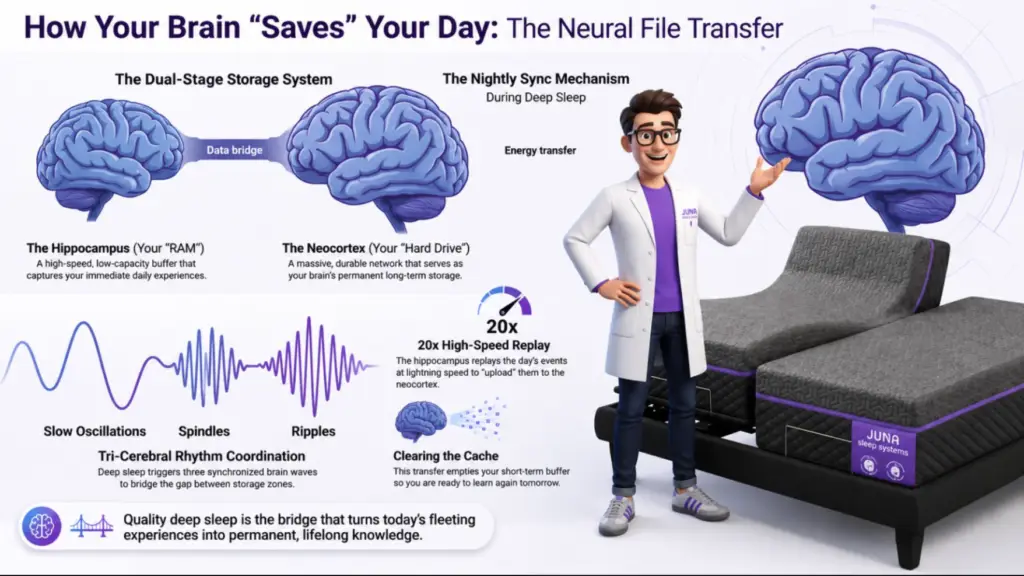
- The Active Save Process (Slow-Wave Sleep): During the deepest stages of non-REM sleep (Stage N3), the brain fires rhythmic electrical waves. These waves trigger a process where memories are replayed at high speeds and transferred to the neocortex—the brain’s permanent, long-term hard drive.
- The Cognitive Benefit: This file-transfer system clears out your short-term memory buffer so you are ready to learn fresh information tomorrow, while permanently stabilizing older memories so they cannot be accidentally overwritten or forgotten.

Discover (How Deep Sleep Cements Memories and support long-term learning through quality sleep)
Introduction: The Nightly Neural Architecture
How Deep Sleep Cements Memories is explained through slow-wave sleep Every single second you are awake, your brain is bombarded by an unrelenting torrent of sensory information. From the complex data sets you analyze at work to the trivial details of a casual conversation, your neural circuits are constantly reshaping themselves to capture the world around you. Yet, if the human brain simply kept accumulating these raw inputs indefinitely without a structured filtration mechanism, our cognitive systems would quickly crash under the weight of severe data corruption.
The true magic of learning does not actually happen while you are staring at a textbook, a computer screen, or practicing a new skill. It happens at night, completely hidden from your conscious awareness.
At Juna Sleep Systems, we recognize that sleep is not merely an escape from the day—it is a highly coordinated, active manufacturing process for the human mind. Just as we precisely engineer high-density foam layers to support your physical skeleton, your brain utilizes the deep, uninterrupted cycles of slow-wave sleep to reconstruct your cognitive architecture.
Whether you are seeking cognitive clarity to enhance your professional performance or visiting one of our regional factory showrooms in Sioux Falls, South Dakotaor Rapid City, South Dakota, understanding how your brain secures its daily intellectual investments is the first step toward optimizing your sleep health.
The Dual-Stage Memory System: Temporary Buffers vs. Permanent Storage
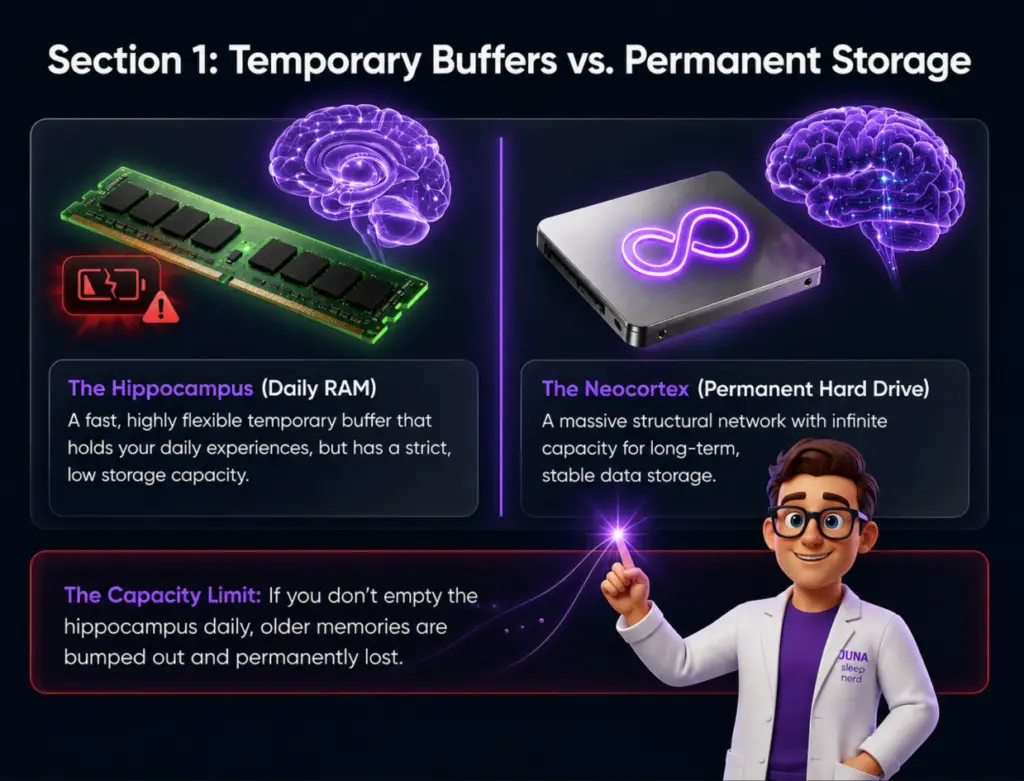
To understand how memory stabilization works, cognitive neuroscientists view the brain through a dual-stage memory transport model. The human brain utilizes two completely distinct structures to manage data: the hippocampus and the neocortex.
The hippocampus is a small, curved structure buried deep within the temporal lobe. Think of the hippocampus as the brain’s temporary RAM buffer. It is highly plastic, incredibly fast at capturing new associations, and responsible for holding all your immediate daily experiences. However, the hippocampus has a strict, highly limited storage capacity. If you try to force too much data into it without emptying the cache, older information gets bumped out and permanently lost.
The neocortex, on the other hand, represents the brain’s long-term solid-state hard drive. It is a massive, highly durable structural network spread across the outer surface of the cerebral hemispheres. The neocortex has an almost infinite storage capacity, but it is incredibly slow to adapt. It requires hours of highly repetitive, specialized electrical stimulation to structurally integrate new data into its existing neural webs without disrupting your pre-existing knowledge base.
The Mechanism of Consolidation: Tri-Cerebral Rhythm Coordination
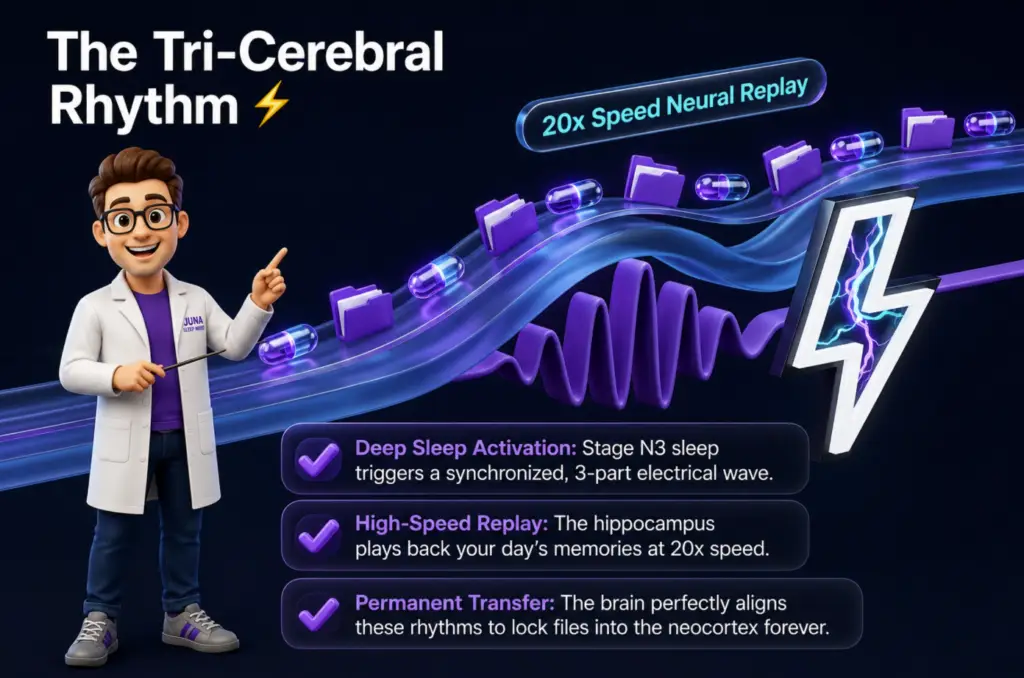
The critical bridge between these two storage zones is activated during Stage N3 non-REM sleep, commonly known as slow-wave sleep (SWS). This is the deep, restorative sleep state that dominates the first half of the night. During SWS, the brain initiates an incredibly synchronized, elegant electrical dialogue known as tri-cerebral rhythm coordination.
This process coordinates three distinct brain rhythms:
- Cortical Slow Oscillations: Massive, slow electrical waves ($<1text{ Hz}$) that sweep across the neocortex, signaling that the long-term hard drive is open for data entry.
- Thalamic Sleep Spindles: Brief, rapid bursts of neural activity ($11-16text{ Hz}$) generated by the thalamus that act as physical time-stamps, opening up localized cellular channels to allow for structural change.
- Hippocampal Sharp-Wave Ripples: High-frequency electrical bursts ($150-250text{ Hz}$) originating in the hippocampus.
During these sharp-wave ripples, the hippocampus plays back the day’s learned experiences at up to twenty times the speed of real life. This high-speed neural replay fires in perfect harmony with the thalamic spindles and cortical slow oscillations.
This coordinated rhythm acts as a molecular bridge, physically driving the memories out of the fragile hippocampus and embedding them into the permanent structural networks of the neocortex.
Discover ( the Mechanism of Memory Consolidation and Tri-Cerebral Rhythm Coordination)
Synaptic Homeostasis: Smart Downscaling to Prevent System Overload
While the brain is busy transferring critical files to permanent storage, it must also address a major structural issue: physical space. This challenge is explained by the Synaptic Homeostasis Hypothesis (SHY), a foundational concept developed by contemporary sleep researchers.
When you are awake and learning throughout the day, trillions of synapses—the connections between your neurons—are constantly being strengthened, growing larger and consuming massive amounts of cellular energy.
If your brain allowed this synaptic growth to continue indefinitely, your neural circuits would quickly max out their physical space and fuel consumption, preventing you from learning anything new the following day.
Deep slow-wave sleep solves this crisis through a process called systemic synaptic downscaling. As slow oscillations wash over the brain, the neural networks undergo a smart, proportional reduction in connection strength.
During this downscaling, the trivial, low-priority inputs you gathered during the day (such as the color of a car you passed on the highway) are systematically weakened and erased.
Simultaneously, memories that were explicitly tagged as valuable via the molecular mechanism of synaptic tag-and-capture are preserved and protected from this downscaling. This selective pruning clears out the cognitive clutter, reduces energy demands, and perfectly prepares your brain to absorb fresh information when you wake up.

Discover ( Synaptic Homeostasis and How Smart Downscaling Prevents Brain System Overload )
Future-Proofing and Preventing Catastrophic Forgetting
The ultimate cognitive benefit of this nightly structural editing is that it future-proofs your memories against a devastating computational glitch known as catastrophic forgetting. In artificial intelligence and neural network modeling, catastrophic forgetting occurs when a system attempts to learn new information, but the new data completely overwrites and erases its previously established knowledge base.
The human brain prevents this disaster through the dual-system file transfer that occurs during deep sleep. By moving memories out of the fragile, volatile hippocampus and gradually weaving them into the deep, distributed networks of the neocortex, sleep structurally insulates your older knowledge.
Once a memory is integrated into the neocortex, it is safely stored within a stable matrix of pre-existing knowledge. This allows you to smoothly stack new skills on top of old ones without degrading your structural foundations, ensuring your mind remains sharp, adaptable, and highly resilient over time.
Complete Memory Consolidation Matrix: Wakefulness vs. Deep Sleep
The following comprehensive matrix illustrates the profound physiological and operational shift the human brain undergoes between active daytime learning and nightly deep slow-wave consolidation.
| Neurological Dimension | Daytime Active Learning | Nighttime Slow-Wave Sleep (N3) |
| Primary Brain Structure | Hippocampus (RAM Buffer) | Neocortex (Solid-State Hard Drive) |
| Dominant Electrical Rhythm | Fast, desynchronized Theta & Gamma waves | Slow, highly synchronized Delta oscillations ($<4text{ Hz}$) |
| Operational Direction | Data Acquisition (Encoding) | File Integration (Consolidation) |
| Synaptic Activity | Widespread strengthening and growth | Selective smart downscaling and pruning |
| Replay Mechanism | Real-time conscious processing | Compressed, high-speed neural playback |
| Energy Consumption | High metabolic demand per synapse | Proportional reduction to baseline efficiency |
| Vulnerability to Loss | High (Susceptible to interference) | Low (Insulated against overwriting) |
Genetic and Environmental Disruptors of Cognitive Stabilization
The delicate process of memory consolidation relies heavily on a perfect balance of genetic traits and environmental conditions. From a genetic standpoint, variations in genes that regulate brain-derived neurotrophic factor (BDNF) and specific neurotransmitter receptors can directly dictate how efficiently your synapses reshape themselves during deep sleep. Individuals with certain genetic profiles may require highly structured, deeper blocks of slow-wave sleep to achieve the same level of memory stabilization as others.
However, environmental disruptions represent the most common threat to this vital cognitive process. Chief among these disruptors is chronic sleep architecture disruptions caused by micro-arousals. A micro-arousal is a fleeting shift from deep sleep to light sleep or brief wakefulness.
These brief awakenings are frequently so short that you won’t even remember them the next morning, but they instantly shatter the synchronized rhythm of your cortical slow oscillations and thalamic sleep spindles.
When these rhythms are broken, the hippocampal file-transfer sequence is abruptly cut off mid-stream. The brain is forced to restart its synchronization process from scratch, drastically reducing the amount of data successfully stored in long-term memory.
This leaves your daily experiences trapped in the hippocampus’s volatile short-term cache, making them highly vulnerable to being overwritten and permanently lost the next day.
The Physical Environment: How Mattress Sag Corrupts Neural Replay
Many individuals fail to realize that their choice of mattress directly influences their cognitive health. When you sleep on an inferior, mass-market mattress built with low-density 1.2 lb to 1.8 lb foams, the bed’s structural core rapidly degrades. Within a few years, the mattress develops a distinct sag zone right beneath your heaviest areas—your pelvis and lower lumbar spine.
This structural collapse causes your skeleton to fall out of orthotic alignment, placing intense mechanical strain on your lower back, hips, and shoulders. As your body attempts to enter deep N3 slow-wave sleep, your muscles are forced to stay tense to protect your misaligned spine, and blood circulation is restricted at key pressure points.
Your peripheral nervous system continuously sends low-level pain and distress signals up your spinal cord and straight into your brainstem.
Your brainstem responds to these comfort alarms by initiating a micro-arousal, forcing your body to toss and turn to escape the physical strain. By repeatedly fragmenting your deep sleep cycles, a sagging mattress acts as a physical disruptor of your cognitive systems, systematically corrupting your brain’s ability to replay and cement your memories.
The Juna Advantage: Engineering an Uninterrupted Cognitive Sanctuary
To maximize the cognitive benefits of sleep, you must provide your brain with an environment of absolute physical comfort and structural peace. At Juna Sleep Systems, we approach mattress manufacturing through the rigorous lens of human biomechanics and sleep science. We refuse to use cheap, commodity foams that flatten under pressure and trap heat. Instead, our premium mattresses are custom-handcrafted using heavy-duty 2.5-5 lb density foam that delivers flawless pressure distribution across every square inch of your body.
By completely eliminating the physical pressure points that trigger nighttime restlessness, a Juna mattress effectively silences the bodily distress alarms that cause cognitive-shattering micro-arousals. Your body stays perfectly balanced and relaxed, allowing your central nervous system to remain securely anchored in deep, uninterrupted slow-wave sleep for maximum memory retention.

Erasing Motion Disruptions via Independent Kinetic Isolation
For co-sleepers, partner movement is an incredibly common cause of sleep fragmentation. Every time a partner shifts, rolls over, or gets up in the night, that kinetic energy surges across a standard mattress, shocking the other sleeper’s nervous system and instantly breaking their slow-wave sleep cycles.
The Juna H-Bed is engineered specifically to eliminate this problem entirely. Designed as a seamless, unified King-sized mattress, the H-Bed features a proprietary “H” structural geometry: deep vertical cuts at the center-head and center-foot, anchored by an uncut 28-inch central foam bridge.
This innovative design provides total side-to-side kinetic isolation. When one partner thrashes or shifts, the physical motion is completely absorbed and dissipated on their side of the bed. The seamless center bridge maintains a cozy, unified “cuddle zone,” protecting both your relationship and the uninterrupted deep sleep required to future-proof your mind.
Custom Orthotic Alignment via the Lifetime Comfort Commitment
Human bodies are incredibly dynamic, changing in shape, weight, and preferred sleeping postures over time. A mattress surface that offers ideal support today might create localized pressure points a few years down the road due to natural physical changes or health developments. If your bed cannot adapt, it will eventually cause the exact structural strain that triggers brain-disrupting micro-arousals.
Juna solves this problem for good with our exclusive Lifetime Comfort Commitment. We don’t believe in locking you into a single firmness setting at the cash register.
If your body ever requires a shift in support to maintain perfect spinal alignment, you simply call us up. Our dedicated Juna Mattress Nerds will come directly to your home, unzip your mattress cover, and physically swap out or re-arrange the internal high-density comfort layers on-site. This long-term customization removes all the risk, ensuring your sleep surface continuously protects your neurological health for decades to come.
Advanced Adjustable Posture for Maximum Cerebral Performance
To set the stage for deep, restorative slow-wave sleep, your body must smoothly shift out of daytime sympathetic stress and transition into a state of deep parasympathetic calm. Pairing a high-density Juna mattress with our Advanced Adjustable Base provides the ultimate tool for this neurological down-regulation. By utilizing the scientifically calculated “Zero Gravity” position, your body is placed in a weightless, neutral posture that completely removes gravitational strain from your skeleton.
- Decompressing the Spine: Elevating your head and knees unloads mechanical compression from your lower back, immediately relaxing your muscles and halting physical distress signals.
- Calming Cardiovascular Strain: Elevating your legs slightly above heart level improves venous blood return, helping slow a racing pulse and promote deep relaxation.
- Optimizing Airway Volume: A slight head elevation keeps your respiratory passages completely open, preventing snoring and oxygen drops that disrupt deep sleep architecture.
The Factory-Direct Paradigm: True Value, Better Brain Recovery
How is Juna able to integrate these premium, heavy-duty foams into our sleep systems while keeping our pricing honest and accessible? It all comes down to our factory-direct business model. The traditional mattress industry relies on an incredibly bloated supply chain filled with middlemen, distributors, and third-party retail storefronts—each layer adding heavy markups to the final price. To maintain their profit margins, mainstream brands are forced to cut corners on the quality of their interior foams.
At Juna, we cut out the middlemen completely. We build our mattresses locally and sell them directly to you through our own regional showrooms. This allows us to route our investments away from corporate retail markups and straight into world-class components, including our specialized Infinity Edge support system.
By surrounding our high-resiliency support core with an ultra-firm perimeter rail and a butterfly quad coil unit, we deliver consistent support all the way to the very edge of the bed. You get a reliable, highly breathable sleep surface that protects your physical alignment and supports deep brain recovery, backed by the absolute best value in the industry.
Conclusion: Save Your Mind While You Sleep
Your memories, skills, and hard-earned daily insights depend entirely on your brain’s ability to execute its nightly file-transfer sequence. How deep sleep cements memories is a beautiful reminder that cognitive success is directly tethered to your physical recovery environment.
By removing the mattress sag, motion transfer, and pressure points that trigger sleep fragmentation, a custom-built Juna Sleep System provides your brain with the uninterrupted slow-wave sleep it needs to future-proof your mind. Stop letting an inferior bed compromise your memory—visit a Juna showroom today and give your brain the sanctuary it deserves.
Frequently Asked Questions (FAQ)
1. How exactly does sleep after learning prevent memory loss?
Engaging in quality sleep after learning activates a deep sleep process in which the brain replays the day’s newly acquired information at high speed. This process permanently transfers memories from the hippocampus’s volatile temporary buffer to the durable, long-term storage of the neocortex, protecting them from loss or overwriting.
2. What is catastrophic forgetting, and how does the human brain avoid it?
Catastrophic forgetting is a major issue in artificial intelligence, in which learning new data completely overwrites old knowledge. The human brain avoids this by using a dual-stage storage system. Deep sleep smoothly integrates new memories into pre-existing long-term cortical networks, allowing you to learn new skills without degrading older ones.
3. How does mattress sag directly harm my memory retention?
When a low-density mattress sags, it throws your spine out of alignment and creates painful pressure points. Your body responds to this physical stress by initiating micro-arousals. These brief, hidden awakenings instantly shatter the synchronized brain waves required for memory consolidation, causing newly learned data to get trapped in short-term storage and erased.
4. What is the Synaptic Homeostasis Hypothesis (SHY)?
The Synaptic Homeostasis Hypothesis states that during wakefulness, our brain connections (synapses) grow larger and consume massive amounts of energy. Deep slow-wave sleep solves this by systematically downscaling these connections, pruning away trivial data while explicitly preserving and protecting important, high-priority memories.
5. Why is Juna’s mattress warranty considered superior to traditional brands?
Juna provides a complete 12- or 18-year non-prorated warranty, meaning your protective coverage value never degrades based on how long you’ve owned the bed. Traditional brands often use prorated warranties that force you to pay hefty out-of-pocket fees for repairs or replacements as the mattress ages.
6. Can Juna adjust my mattress if my support needs change over time?
Yes! Through our exclusive Lifetime Comfort Commitment, our expert Juna Mattress Nerds can come directly to your home to unzip the mattress cover and adjust or swap out the internal high-density foam layers. This ensures your bed continuously delivers perfect orthotic support as your body changes over the years.
7. How does the Juna H-Bed completely eliminate partner motion transfer?
The Juna H-Bed features a unique “H” geometry with deep vertical cuts at the head and foot of the mattress, separated by a solid 28-inch central foam bridge. This design provides absolute kinetic isolation, meaning one partner can shift or toss throughout the night without transferring any physical movement across to the other side of the bed.
Visit a Juna Showroom Near You
Are you ready to optimize your cognitive recovery and build a sleep environment that future-proofs your memory? Visit one of our three regional factory-direct showrooms today to speak face-to-face with a Juna Sleep Nerd and test a mattress built for your life.
- Juna Sleep Systems – Sioux Falls, SD: Conveniently located for families driving in from Brandon, Harrisburg, or Tea.
- Juna Sleep Systems – Rapid City, SD: Easily accessible for West River communities, including Box Elder, Summerset, and Sturgis.
