
The Quick Answer
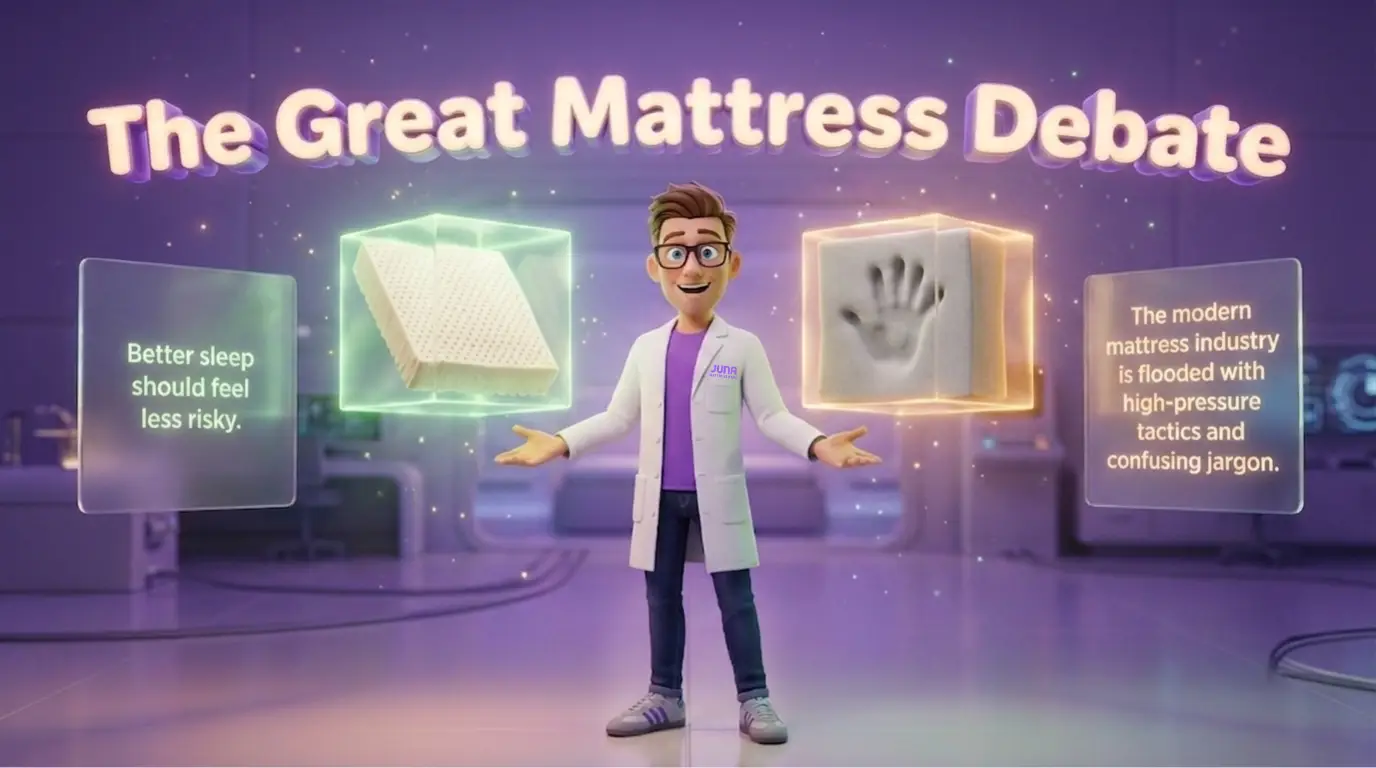
When choosing a latex vs memory foam mattress, the main difference lies in feel and temperature. Memory foam offers a slow-sinking, pressure-relieving “hug” that expertly isolates motion but can sleep warm. Latex provides a naturally cooling, bouncy, and responsive surface. Choose memory foam for contouring, or latex for breathability.
The Great Mattress Debate: An Introduction
Welcome to the ultimate guide from the Juna Mattress Nerd. If you have ever worried about choosing the wrong mattress, you are certainly not alone. The modern mattress industry is flooded with overwhelming choices, confusing technical jargon, and high-pressure sales tactics. For many shoppers, the single most stressful decision is choosing between a latex vs memory foam mattress.
We strongly believe that better sleep should feel less risky. You spend approximately one-third of your entire life in bed. This means your mattress directly affects your spinal health, recovery from joint pain, daily energy levels, and overall wellness. Choosing the wrong material can lead to agonizing tossing and turning, severe night sweats, and waking up with a stiff lower back.
In this deeply comprehensive guide, we are going to break down every granular detail of the latex vs memory foam mattress debate. We will thoroughly explore the sleep science, manufacturing processes, cooling capabilities, and durability of each material. More importantly, we will show you how a mattress should be built for real life, not just a quick showroom test.
1. The Science and History of Memory Foam

Before we can accurately compare a latex vs memory foam mattress, we must thoroughly understand the origins and chemical makeup of memory foam. Understanding how this unique material was designed will immediately explain why it feels the way it does.
The NASA Connection
Memory foam is scientifically known as viscoelastic polyurethane foam. It was originally developed in the 1960s under a highly specialized NASA contract. The primary goal was to create a specific material that could withstand the extreme, crushing G-forces astronauts experience during liftoff and atmospheric reentry, while simultaneously conforming to their individual body shapes to prevent pressure sores.
The material was a massive success in aerospace and medical applications. By the early 1990s, it made its commercial debut in the consumer mattress market. Today, viscoelastic foam is prized worldwide for its unique physical properties and deep pressure relief.
How Memory Foam Actually Works
The secret to memory foam lies directly in its viscoelasticity. “Visco” means it behaves somewhat like a slow-moving liquid under pressure, while “elastic” means it eventually returns to its original flat shape.
When you lie down on a memory foam mattress, the material reacts dynamically to your body heat and physical weight. As the foam warms up, it softens and yields, creating a highly customized, exact mold around your body’s specific curves. When you get out of bed, the foam slowly expands back to its flat state.
Modern Advancements in Foam
Traditional memory foam had one severe flaw: it was incredibly dense and trapped massive amounts of body heat. In recent years, mattress engineers have actively combated this by introducing open-cell foam structures. They also began infusing the foam with cooling gel beads, copper, or graphite. These infusions are explicitly designed to pull heat away from the body. However, memory foam generally still sleeps slightly warmer than most other materials.
2. The Science and Origin of Latex Foam
On the absolute opposite side of the latex vs memory foam mattress debate is a material that relies on nature rather than a chemistry lab. While memory foam is entirely synthetic, true latex foam is a natural product with a fascinating, eco-friendly manufacturing process.
The Source: The Rubber Tree
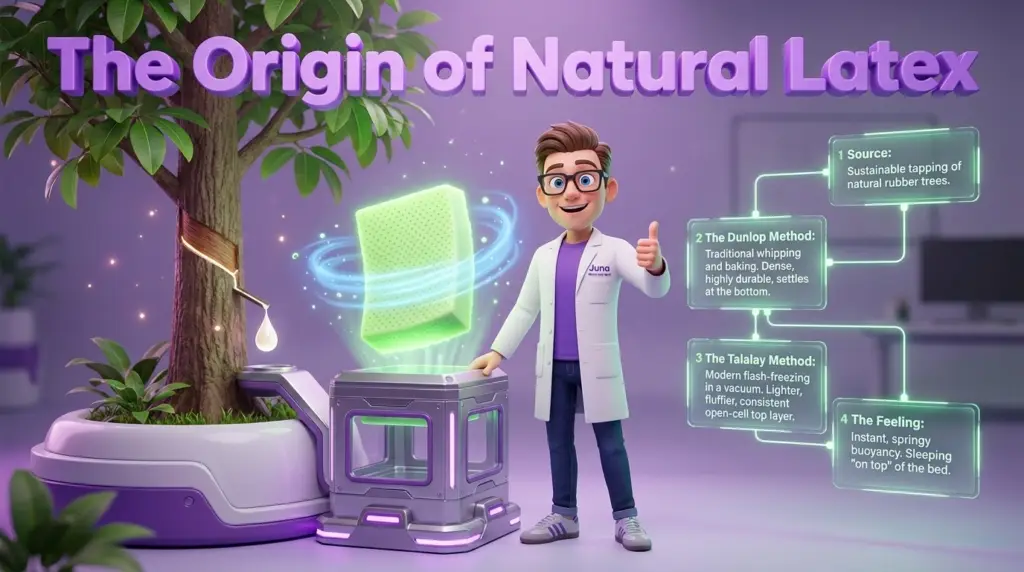
Natural latex is derived from the thick, milky white sap of the rubber tree (Hevea brasiliensis). Harvesters carefully tap the tree’s bark to collect sap without harming the plant. This highly sustainable practice makes a natural latex mattress a highly renewable and eco-friendly resource.
Once the liquid sap is properly collected, it is safely transported to a manufacturing facility. There, it undergoes a specialized, complex baking process to become the solid, supportive foam blocks used in high-end mattresses.
Dunlop vs. Talalay Manufacturing Processes
When researching a latex vs memory foam mattress, you will inevitably see the terms “Dunlop” and “Talalay.” These refer to the two entirely different methods for baking the latex sap.
- The Dunlop Process: the older, more traditional method. The sap is whipped into a thick froth, poured entirely into a mold, and baked. The heavier rubber particles naturally settle at the bottom during baking. This results in a dense, highly durable foam that is slightly firmer at the bottom than the top. Dunlop latex is frequently used as the foundational support core of a premium mattress.
- The Talalay Process: a much more modern, complex method. The mold is only partially filled with whipped sap. The mold is then vacuum-sealed, causing the sap to forcefully expand and fill the space entirely. Finally, it is flash-frozen before being thoroughly baked. This unique flash-freezing creates a lighter, fluffier, and more consistent open-cell structure. Talalay latex is incredibly buoyant and is usually placed in the top comfort layers of the bed.
The Unique Feel of Latex
If memory foam is heavily characterized by a slow, sinking “hug,” latex is defined by its instant, springy buoyancy. Because it is essentially made of rubber, latex has incredibly fast responsiveness. When you lie down on a latex mattress, it cushions your pressure points but forcefully pushes back against your weight. You sleep “on top” of the mattress rather than sinking “into” it.
The harvesting process of natural rubber trees
3. Deep Dive: Head-to-Head Feature Comparison
Now that we understand the core materials deeply, it is time for the ultimate latex vs memory foam mattress showdown. We are going to meticulously analyze how these two distinct foams perform across the most critical sleep metrics.
Pressure Relief and Contouring
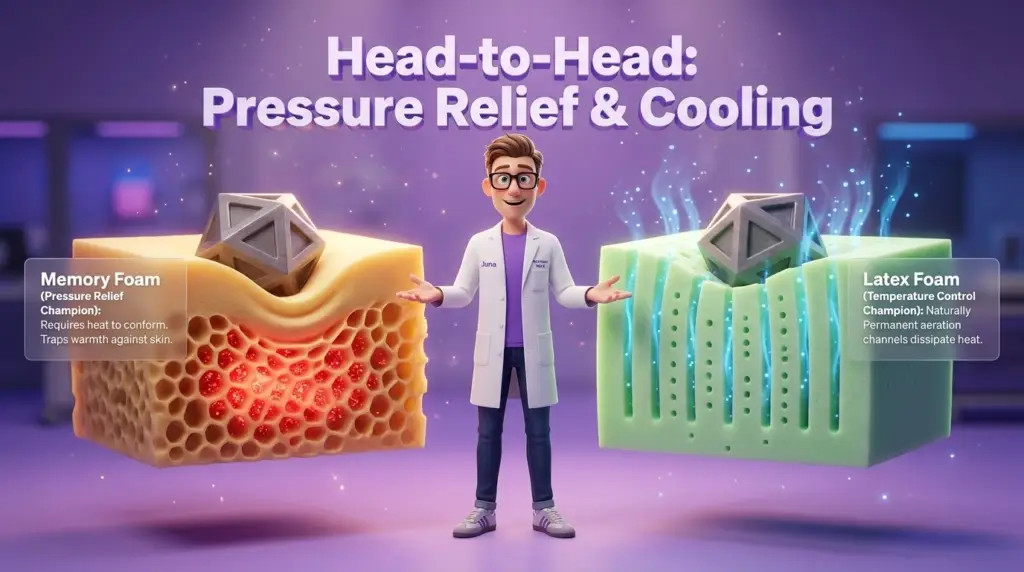
If you suffer from severe joint pain, arthritis, or sharp shoulder pain, pressure relief is likely your absolute top priority. In this specific category, memory foam is generally considered the winner.
Because memory foam reacts directly to your body heat and warps around your specific geometry, it evenly distributes your body weight across the entire surface of the bed. This effectively relieves pressure on the heaviest parts of your body, creating the best mattress for pressure relief.
In a latex vs memory foam mattress comparison, latex still offers excellent pressure relief, but its natural push-back means it won’t provide the same deep, melting contour that viscoelastic foam dynamically delivers.
Temperature Regulation and Cooling
Sleeping hot is one of the most common complaints among adults, leading to severely disrupted REM cycles and intense night sweats. If precise temperature control is vital to you, latex is the undisputed champion of the latex vs memory foam mattress debate.
Natural latex features a naturally open-cell structure. Furthermore, during the complex baking process, metal pins are driven through the latex block, creating hundreds of tiny, permanent aeration channels. This allows body heat to dissipate instantly.
Traditional memory foam, however, requires your body heat to soften and conform, effectively trapping that heat directly against your skin. Even with modern gel infusions, memory foam struggles to match the breathability of a natural latex mattress.
[Placeholder for Internal Link 1: Link to Juna Mattress Size Guide]
Responsiveness and Ease of Movement
Responsiveness refers specifically to how quickly a mattress physically adapts to your changing sleep positions. If you are a combination sleeper who tosses and turns a lot, a slow-responding bed can be physically exhausting.
Memory foam has a notoriously slow response time. When you try to abruptly roll over, you must physically climb out of the deep bodily impression you just made and wait for the dense foam to contour to your new position. Many sleepers describe this as feeling “stuck in the mud.”
Latex, conversely, offers absolute immediate responsiveness. The very second you move, the bouncy rubber snaps back to its original shape, making it effortless to change positions quickly.
[Image Placement 2: Split image graphic showing a bouncing ball on a latex foam layer next to a heavy ball sinking deeply into a memory foam layer.]
Alt Text: Graphic demonstrating the bounce and responsiveness difference in a latex vs memory foam mattress.
Motion Isolation for Couples
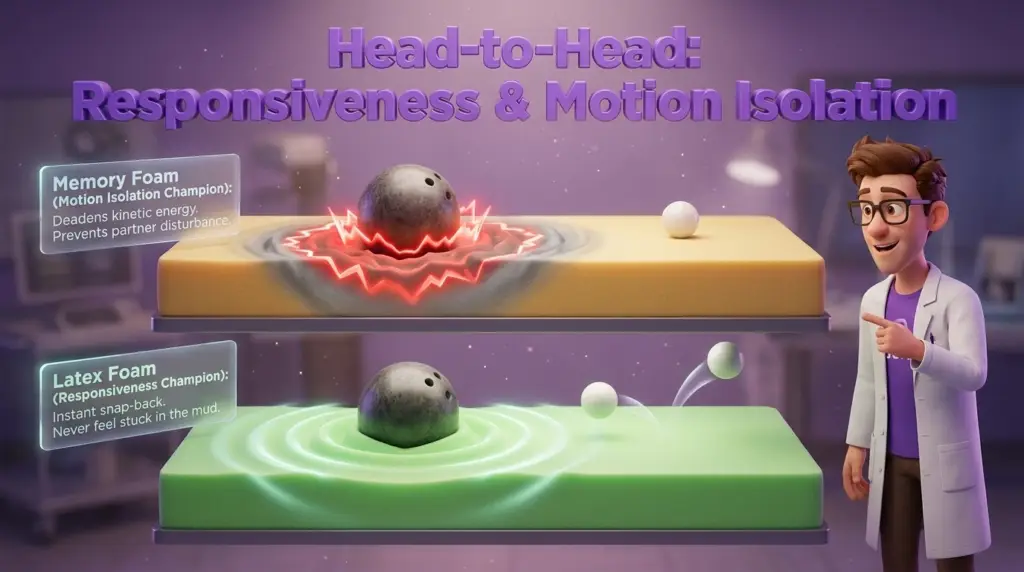
Motion isolation is the distinct ability of a mattress to dynamically absorb movement on one side of the bed so it isn’t physically felt on the other. For couples, especially those with entirely different sleep schedules or highly restless habits, this is a very important metric.
Here, memory foam easily takes the crown. The dense, energy-absorbing nature of memory foam physically traps kinetic energy directly at the source. If your partner gets out of bed for a glass of water, you will likely sleep right through it.
Latex, due to its inherent springiness, naturally allows slightly more vibration to travel across the sleep surface. While it isolates motion much better than a traditional connected-coil innerspring, it cannot compete with the absolute deadening effect of thick memory foam.
Durability and Lifespan
A mattress is a significant financial investment, and it should be built for real life, not just a quick showroom test. When looking at a latex vs memory foam mattress, you must strictly consider the long-term lifespan of the materials. More of the purchase price should go into the materials, not the middlemen.
Natural latex is incredibly resilient. A high-quality latex mattress can easily last 15 to 30 years without suffering from significant sagging or deep body impressions. The rubber simply naturally retains its rebound.
Memory foam, especially lower-density commodity foam found in cheap boxed beds, degrades much faster. The cellular structure rapidly breaks down under constant heat and pressure, usually leading to permanent, painful body impressions within 7 to 10 years. There are some Memory foams that can last longer, but are not seen in many mattresses because of cost
4. Latex vs Memory Foam Mattress Comparison Table
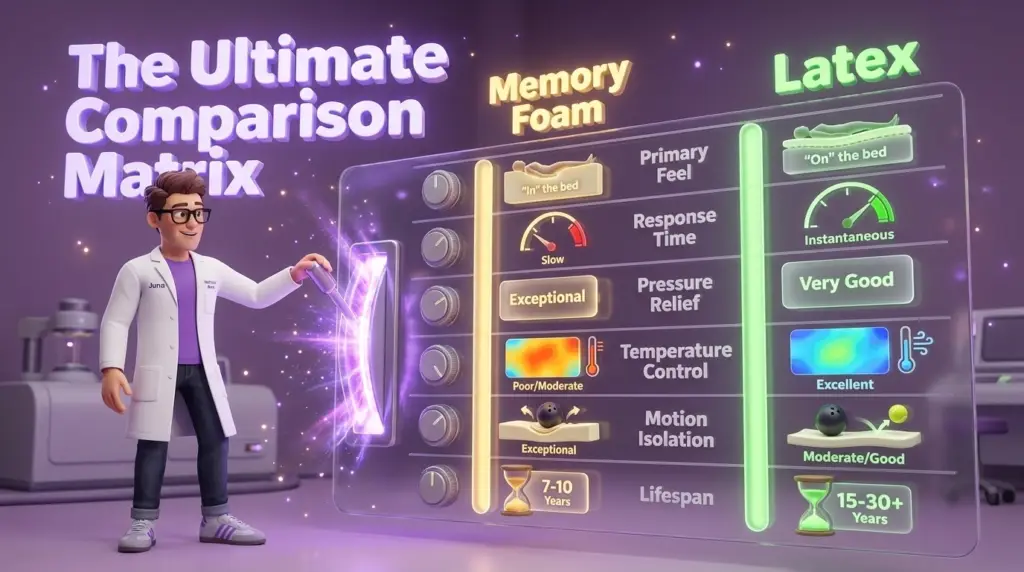
To quickly summarize the significant differences between latex and memory foam, review this detailed comparison chart.
| Feature / Benefit | Memory Foam Mattress | Latex Mattress |
| Primary Feel | Sinking, cradling, “in” the bed | Buoyant, floating, “on” the bed |
| Response Time | Slow (can feel stuck) | Instantaneous (highly bouncy) |
| Pressure Relief | Exceptional (deep contouring) | Very Good (uplifting support) |
| Temperature Control | Poor to Moderate (traps heat) | Excellent (naturally breathable) |
| Motion Isolation | Exceptional (deadens movement) | Moderate to Good (some bounce) |
| Average Lifespan | 7 to 10 years | 15 to 30+ years |
| Material Origin | Synthetic (Polyurethane) | Natural (Rubber Tree Sap) |
[Placeholder for External Link 2: Link to an authoritative medical site discussing how temperature affects deep sleep cycles. (Unfollowed)]
5. Choosing Based on Your Sleep Position
You cannot accurately declare a universal winner in the latex vs memory foam mattress debate without intensely considering your specific sleep style. Here is exactly how your preferred posture highly dictates the best material for you.
The Strict Side Sleeper
Side sleepers aggressively direct their entire body weight onto two very narrow points: the delicate shoulders and the heavy hips. If a mattress is too firm, it can create excessive pressure that leads to numbness, tingling, and morning joint pain.
For side sleepers, the deep, melting contour of memory foam is usually the vastly superior choice. It allows the wide parts of the body to physically sink in deeply, maintaining a perfectly straight, aligned spine.
The Back Sleeper
Back sleepers physically require a highly delicate balance. They need contouring to comfortably fill the empty gap in their lower lumbar spine, but they desperately need enough firmness to completely prevent their hips from sinking too deeply (which causes a painful bowed back).
Both materials work well, but latex often elegantly provides the buoyant pushback needed to keep the delicate spine neutral all night.
The Stomach Sleeper
Stomach sleeping is the absolute most demanding position for spinal alignment. If a stomach sleeper’s hips sink even an inch too far into the bed, the fragile lower back hyper-extends.
In a latex vs memory foam mattress matchup, stomach sleepers should almost exclusively look toward firm latex. The immediate, powerful push-back prevents the heavy hips from sinking, keeping the spine completely level and severely reducing morning backaches.
6. The Juna Hybrid Solution: Why Choose Just One?
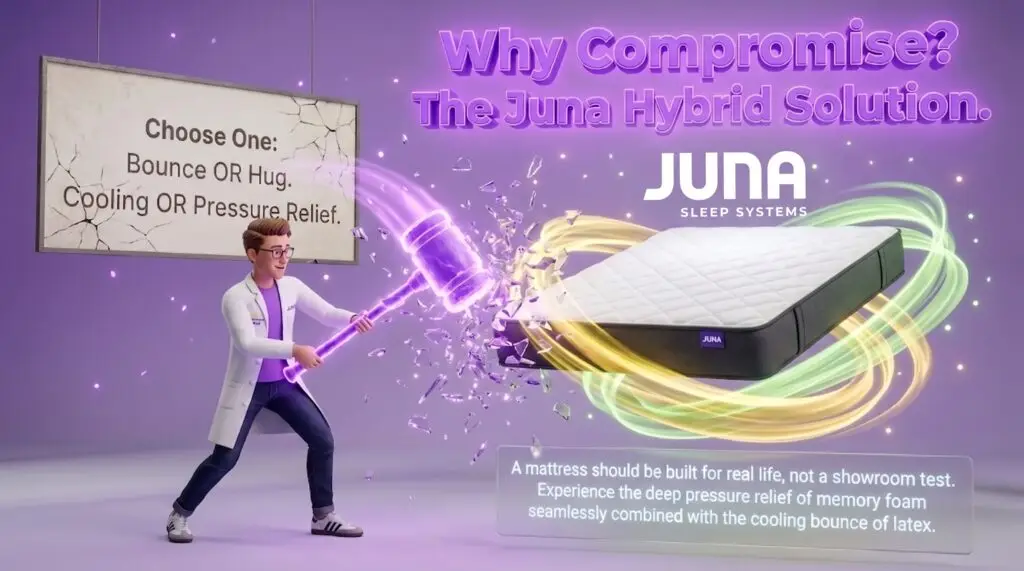
Throughout this guide, we have treated the latex vs memory foam mattress debate as an “either/or” choice. Traditional mattress companies want you to believe you have to pick a side. They tell you that you must choose either the deep-pressure relief of memory foam, which sleeps hot, or the cooling bounce of latex, which loses the contouring “hug.”
At Juna Sleep Systems, we don’t believe you should ever have to compromise on your sleep. A mattress should be built for real life, not just a quick showroom test. Instead of forcing you to choose between two imperfect options, we meticulously engineered our mattresses to bring the absolute best of both materials together in one premium hybrid sleep system.
Here is exactly how we use specific, high-quality components together, why we use them, and what they actually do to make the mattress better for you:
Talalay Latex for Instant Responsiveness and Cooling
We use premium Talalay latex in our comfort layers because it offers unmatched breathability and bounce.
- What it does: The unique manufacturing process of Talalay latex creates a highly buoyant, aerated, open-cell structure that allows air to flow freely. It acts like a network of microscopic springs.
- Why it matters to you: When you roll over in the middle of the night, the bed instantly moves with you. You will never feel “stuck in the mud.” Furthermore, the natural airflow keeps your skin temperature comfortably cool all night long, preventing disruptive night sweats.
Fast-Acting, Open-Cell Memory Foam for Pressure Relief
Traditional memory foam sleeps hot and responds slowly. To fix this, Juna pairs the latex with a highly specialized, fast-acting open-cell memory foam.
- What it does: It provides that signature, melting contour around your heaviest points (your shoulders and hips), but the “open-cell” design allows heat to escape rather than trapping it against your body. The “fast-acting” chemistry means the foam returns to its flat shape within seconds, not minutes.
- Why it matters to you: You get all the joint-soothing pressure relief you need to prevent morning aches and pains, without the agonizing heat retention or the physical struggle of crawling out of a deep body impression when you change sleep positions.
High-Resilience (HR) Foam for Lasting Durability
Beneath the softer comfort layers, a mattress needs a solid transition. We use high-resilience (HR) foam, a heavy-duty, ultra-dense material rarely found in standard retail beds due to its higher manufacturing cost.
- What it does: It acts as a powerful shock absorber between the plush top foam layers and the steel coil system below.
- Why it matters to you: HR foam actively prevents the painful “bottoming out” sensation. It ensures your heavier areas—like your hips and torso—stay perfectly supported and aligned, preventing the dreaded “hammock effect” that causes lower back pain. It is a major reason why Juna mattresses outlast traditional, cheap commodity foam beds.
Pocketed Coils for Targeted Support and Airflow
To support these premium foam layers, Juna uses an advanced pocketed coil system as the mattress’s foundational engine.
- What it does: Each individual steel coil is wrapped in its own fabric pocket, allowing it to compress independently of the coils next to it. Furthermore, the empty space between the coils acts as a massive internal lung, pushing warm air out of the sides of the mattress every time you move.
- Why it matters to you: Because the coils aren’t wired together, they provide phenomenal motion isolation. If your partner gets in and out of bed, the movement is trapped exactly where it happens. Plus, it provides dynamic, targeted support to your spine that flat, solid foam blocks simply cannot match.
The Ultimate Benefit: Modular Perfection
By intelligently stacking Talalay latex, fast-acting memory foam, HR foam, and pocketed coils, a Juna hybrid mattress gives you the deep pressure relief of a memory foam bed seamlessly combined with the cooling bounce of a latex bed.
Best of all, because of our Lifetime Comfort Commitment, these internal layers are never permanently glued shut. If you get the mattress home and realize your body needs the bouncy latex closer to the top, or the contouring memory foam closer to your body, a Juna Mattress Nerd can easily unzip your mattress cover right in your bedroom and adjust or swap the layers to fit your exact evolving preference.
You get more value in the materials, and you are never stuck with a bed that doesn’t fit your needs.
- Elevating Your Sleep: Adjustable Bases and Zero Gravity
Once you have finally settled the debate between a latex vs memory foam mattress, the next critical step is choosing the right foundation. For decades, flat box springs were the standard, but they offer zero flexibility. Today, coupling an all-foam bed with a premium adjustable base is the ultimate upgrade for your overall health, wellness, and sleep cycles.
Because neither latex nor memory foam contains the rigid, heavy border wire found in traditional continuous-coil innerspring mattresses, both materials bend seamlessly. When paired with a Juna adjustable base, these mattresses naturally unlock the incredible Zero Gravity position.
The Science of Zero Gravity
Zero Gravity is not just a marketing buzzword; it is a specific posture originally calculated by aerospace engineers to reduce physical stress on astronauts’ bodies during liftoff. By slightly elevating your head and raising your knees above your heart, you evenly distribute your weight across the mattress.
This posture creates a weightless, floating feel that immediately takes the pressure off your lower lumbar spine. It allows the muscles in your back to fully release and relax, which is crucial for achieving deep, restorative sleep cycles.
Beyond Pressure Relief
Beyond the physical relief on your joints, adjustable bases completely transform how you use your bedroom. They make it easier to read, watch TV, lounge, or recover in bed without awkwardly stacking pillows behind your neck.
Furthermore, specific features like customized lumbar support, soothing massage motors, and dedicated Anti-Snore settings can help some sleepers breathe more comfortably. Elevating the head just a few degrees can open the airways, which may reduce snoring and help you stay in uninterrupted REM sleep longer.
8. The Ultimate Couples Solution: The Juna H-Bed
Couples frequently face a massive dilemma when shopping for a latex vs memory foam mattress. One partner might want to sleep flat on a bouncy latex surface, while the other desperately wants to elevate their head on memory foam to reduce snoring or acid reflux.
In the past, the mattress industry forced couples to buy a “Split King.” If you are unfamiliar, a Split King is literally just two separate Twin XL mattresses pushed together inside a standard King frame.
The Problem with the Split King
The traditional Split King notoriously creates a noticeable, uncomfortable gap right down the middle of the bed. Sheets slide around, the mattresses drift apart on slick flooring, and it completely ruins the cuddle zone. It physically separates you and your partner.
Juna solved this universal problem with one of our most popular innovations: The Juna H-Bed.
The Juna H-Bed is a single, unified King-sized mattress. It features a unique ‘H’ geometry: a deep vertical slit cut at the center-head and a deep vertical slit at the center-foot. Crucially, the middle 28 inches remains a completely uncut, solid-foam bridge.
Independent Adjustability Without the Gap
Because of the H-Bed’s functional design, the left side can articulate upward into a reading position while the right side remains completely flat. The central 28-inch bridge serves as a seamless, taut connection between the two sides, made of fabric and foam.
This visual proof shows there is absolutely no gap or trench in the middle. The Juna H-Bed completely retains the cuddle zone. It provides independent adjustability without the traditional split-king gap, delivering a much more unified sleep surface for couples.
You finally get personalized comfort without sacrificing closeness. When you pair the H-Bed with an adjustable base, both partners get exactly what they need on their own side, eliminating mattress compromise forever.
9. Local Quality, Factory-Direct Value
You shouldn’t have to buy a mattress rolled up in a box from an anonymous corporation across the country. Better sleep should feel less risky, and that starts with knowing exactly who built your bed. Juna Sleep Systems is proud to operate as a local, factory-direct manufacturer right here in the Midwest.
By building our premium beds locally, more of your purchase price goes into the mattress materials themselves rather than into wholesale markups and national advertising budgets. We are deeply connected to the communities we serve, ensuring that factory-direct quality is always just a short drive away.
For our customers located near Juna Sleep Systems – Sioux Falls, South Dakota, we frequently deliver custom sleep solutions to our neighbors, making the quick drive from Brandon, SD, the historic community of Mitchell, SD, and the scenic river town of Yankton, SD.
If you live in Western South Dakota, our Juna Sleep Systems location in Rapid City is ready to serve you. We proudly welcome shoppers making the short trip from Spearfish, SD, legendary Deadwood, SD, and our neighbors down in Chadron, NE.
When you shop local with Juna, you get a closer connection between the builder and the customer, ensuring you are supported long after the sale.
[Placeholder for External Link 3: Link to a reputable, followed by a local directory or specific business chamber website relevant to one of the three Juna locations.]
10. Frequently Asked Questions (FAQ)
To summarize this guide, we have answered the most common questions shoppers ask when evaluating a latex vs memory foam mattress.
1. What is the main difference between latex and memory foam?
The main difference lies in how the material reacts to weight and temperature. Memory foam slowly sinks and molds to your body shape, offering a melting “hug” that expertly isolates motion. Natural latex is bouncy, instantly pushing back against your weight, and features a naturally aerated structure that helps you sleep much cooler.
2. Which is better for back pain: a latex vs memory foam mattress?
Choosing a latex vs memory foam mattress for back pain depends on your sleep position. The deep contour of memory foam is usually the best mattress for pressure relief for strict side sleepers. However, the bouncy pushback of a natural latex mattress vs. memory foam is superior at keeping the spine neutrally aligned for stomach and back sleepers.
3. Does a natural latex mattress sleep noticeably cooler?
Yes. In a latex vs memory foam mattress comparison, natural latex is the undisputed winner for cooling. True latex features a breathable open-cell structure with pinholes that allow body heat to escape. Synthetic memory foam requires body heat to soften, which traps warmth against the sleeper.
4. Does memory foam mattress edge support hold up over time?
Standard memory foam mattress edge support often fails quickly because it relies on weak foam encasements that collapse and separate over time. Juna uses the advanced Infinity Edge system instead. This multi-stage reinforced perimeter provides a highly supportive, usable sleep surface without making the bed edge feel overly hard.
5. How long does a latex vs memory foam mattress generally last?
Because natural rubber is inherently resilient, a natural latex mattress typically lasts longer. High-quality natural latex can maintain its bounce and structure for 12 to 20 years. Standard memory foam usually begins to sag and develop body impressions within 7 to 10 years.
6. Can I use an adjustable base with these mattresses?
Absolutely. Both of these flexible foam materials are perfect for an adjustable base. Elevating your head and legs creates a weightless Zero Gravity feel that relieves lower back pressure. If you sleep with a partner, pairing these bases with the unified Juna H-Bed provides independent adjustability without the split-king gap.
7. What happens if I choose the wrong mattress material?
With most traditional retail companies, you are stuck. With Juna, our Lifetime Comfort Commitment drastically reduces your buying risk. If your brand-new latex vs memory foam mattress isn’t perfectly right, our Mattress Nerds will come to your home, unzip the cover, and adjust the internal layers to refine the comfort over time. You are never stuck.
11. Conclusion: Stop Guessing and Start Sleeping
Navigating the latex vs memory foam mattress debate doesn’t have to be a miserable chore. If you crave a slow-sinking, pressure-relieving hug that deadens partner movement, memory foam is your ideal match. If you require a naturally cooling, bouncy, and eco-friendly surface that instantly responds to your movement, natural latex is what you need.
But most importantly, remember that better sleep should feel less risky. You do not have to get it right on the very first try. With the Juna Lifetime Comfort Commitment, your mattress can and will adapt to your changing life. Your long-term comfort matters just as much as your first impression comfort.
Ready to eliminate the guesswork from your sleep? Visit a pressure-free Juna Sleep Systems showroom today. Talk to a Juna Mattress Nerd, experience the gap-free H-Bed for yourself, and feel the Juna factory-direct difference tonight!
